
Table of Contents
Hyper-Local SEO: Stop Competing on “Near Me” Searches
If you’re running an appliance repair business, you’ve noticed something frustrating. You rank pretty well when someone searches “appliance repair near me” from a few blocks away. But when someone five miles out searches for the exact service you offer, you’re invisible.
Meanwhile, your competitor’s van is parked in the wealthiest neighborhood in town, fixing a $3,000 Sub-Zero refrigerator while you’re getting calls about $150 dryer-belt replacements near your shop.
That’s not bad luck. That’s how local search works when you rely only on proximity and generic keywords.
The good news? You can fix it. And it doesn’t require opening new offices or spending thousands on billboards. It requires a smarter keyword strategy built around hyper-local targeting.
This guide will show you exactly how to stop competing on “near me” and start dominating the high-value service areas you actually want to work in.
Why “Near Me” Keywords Are Costing You Money
When someone searches “appliance repair near me,” Google prioritizes businesses closest to the searcher’s physical location. If your shop is in the city center and the searcher is in an affluent suburb 10 miles away, you’re unlikely to appear, even if you service that area.
This creates two problems for appliance repair owners:
You attract low-value jobs near your physical location. If your shop is in a working-class neighborhood, you’ll get more calls for budget repairs. If you’re located in an industrial area, you may not receive residential calls.
You miss high-ticket opportunities in wealthy areas. The homeowner with a built-in Thermador range or a wine cooler that needs service is searching from their zip code, not yours.
Proximity is one of the three major ranking factors in Google’s local algorithm (the others are relevance and prominence). You can’t change where your shop is located, but you can control how relevant Google deems you to specific neighborhoods and search queries.
That’s where hyper-local keywords come in.
What Hyper-Local SEO Keywords Actually Are
Hyper-local SEO keywords go way beyond city names. They combine three elements:
- Geographic specificity (neighborhood, suburb, or zip code)
- Service type (the actual repair or problem)
- Appliance brand or feature (optional but powerful)
Here’s the difference:
Generic keyword: “Appliance repair Phoenix”
Hyper-local keyword: “Sub-Zero refrigerator repair Scottsdale”
Even better: “Ice maker not working Paradise Valley”
The more specific the keyword, the more qualified the lead. Someone searching “ice maker not working Paradise Valley” is not browsing. They have a problem: they’re in a high-income area and want a technician who specializes in premium appliances.
These are the searches that turn into booked jobs, not tire kickers.
The 4 Types of Hyper-Local Keywords You Should Be Targeting
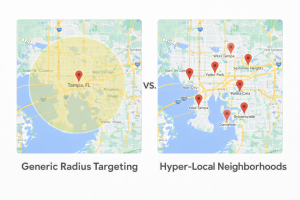
Let’s break down the four keyword categories that actually drive revenue for appliance repair companies.
1. Neighborhood + Service Keywords
These combine your core service with a specific neighborhood or suburb name.
Examples:
- Refrigerator repair Buckhead
- Dishwasher installation Coral Gables
- Washer repair Naperville
Why they work: They capture location-aware, ready-to-hire candidates. These searchers often skip the “near me” phrasing because they already know the area.
Pro tip: Focus on the wealthiest zip codes in your metro area. A service call in a $2 million neighborhood is worth more than three calls in a budget apartment complex.
2. Problem-Specific + Location Keywords
These target the actual issue the homeowner is experiencing, combined with geography.
Examples:
- Oven won’t heat Plano TX
- Dryer not spinning Irvine
- Freezer leaking water Scottsdale
Why they work: These are high-intent, problem-aware searches. The homeowner isn’t researching, they need help today. If your content or Google Business Profile matches this query, you’re getting the call.
3. Brand + Service + Location Keywords
This is where the real money is. Homeowners with high-end appliances are more likely to search by brand because they want a technician who is familiar with their equipment.
Examples:
- Wolf range repair Beverly Hills
- Miele washer technician San Diego
- Bosch dishwasher repair Naperville
Why they work: Premium appliance owners expect premium service. They’re willing to pay diagnostic fees, they’re less price-sensitive, and they often need parts that only specialists carry. If you can rank for brand-specific searches in wealthy areas, you’re printing money.
4. Service Area Page Keywords
These are the backbone of a hyper-local SEO strategy. You create dedicated pages on your website for each city, suburb, or neighborhood you serve.
Examples:
- Appliance repair services in Coral Gables
- Scottsdale appliance repair company
- Same-day refrigerator repair in Buckhead
Why they work: Google wants to see that you’re genuinely relevant to a location. A single homepage that says “serving the greater metro area” won’t cut it. Dedicated service area pages with real content signal to Google that you’re active and trusted in that geography.
What not to do: Don’t copy and paste the same content and just swap city names. Google will ignore those pages or penalize you. Each page needs unique value, real examples, and localized details.
How to Find the Right Hyper-Local Keywords for Your Market
You don’t need expensive tools to do this. You need to think like your customer and use free resources strategically.
Start with Google Autocomplete
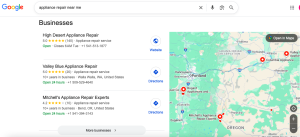
Type your core service into Google and add a space. Google will suggest the most common completions based on real search volume.
Try:
- “Refrigerator repair [your city]”
- “Appliance technician [suburb name]”
- “Ice maker not working [neighborhood]”
Write down every variation that makes sense for your business.
Use Google Business Profile Insights
Log into your Google Business Profile and check the “Search queries” section. This shows you the exact phrases people used to find your profile.
Look for:
- Neighborhood names you didn’t expect
- Specific appliance types or brands
- Problem-based searches
These are real queries from real people in your market. If you’re already getting impressions for a keyword but not ranking well, that’s a green light to create content around it.
Check “People Also Ask” and Related Searches
When you search for a keyword, scroll to the “People Also Ask” section and the related searches at the bottom of the page.
These reveal:
- Questions your audience is asking
- Variations of the keyword
- Adjacent topics Google associates with your service
If you see “How much does it cost to fix a refrigerator in [city]” or “Best appliance repair company in [suburb],” those are content opportunities.
Talk to Your Technicians
Your team knows which neighborhoods they’re driving to, which brands they’re servicing, and which problems are most common.
Ask them:
- Which zip codes have the best customers?
- Which brands are most prevalent in wealthy areas?
- What repairs do people call about most urgently?
This is real-world keyword research. If your techs are constantly fixing Wolf ranges in Paradise Valley, you should be ranking for “Wolf range repair Paradise Valley.”
How to Build Content Around Hyper-Local Keywords
Finding the keywords is step one. Using them effectively is step two.
Here’s how to structure your website and content actually to rank for hyper-local searches.
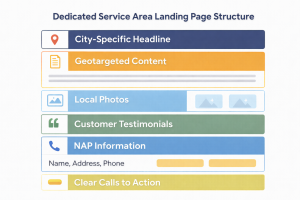
Create Dedicated Service Area Pages
For every major city, suburb, or high-value neighborhood you serve, build a dedicated page.
Each page should include:
- The neighborhood name in the H1 and the title tag
- A brief intro explaining your coverage in that area
- 3-5 paragraphs of unique content (not copied from other pages)
- Specific appliance types or brands are common in that area
- A clear call to action with your phone number
Example structure:
H1: Appliance Repair Services in Coral Gables, FL
Intro: “We’ve been serving homeowners in Coral Gables for over 10 years, providing same-day appliance repair for refrigerators, dishwashers, ovens, and more.”
Body: Talk about the types of homes in the area (older construction, luxury condos, etc.), common appliance issues, and why locals trust you.
CTA: “Call us today for fast, reliable appliance repair in Coral Gables.”
Write Problem-Focused Blog Posts
Blog content is where you can go deep on specific problems and rank for long-tail keywords.
Examples:
- “Why Is My Sub-Zero Refrigerator Not Cooling? (And What to Do)”
- “How to Fix a Leaking Dishwasher in Phoenix’s Hard Water Climate”
- “Oven Won’t Heat? Here’s What Scottsdale Homeowners Should Check First”
These posts should:
- Answer the question in the first 100 words
- Include the city or region naturally in the content
- Provide real troubleshooting steps
- End with a clear offer to help if they need a technician
You’re not trying to rank nationally for “dishwasher repair”. You’re trying to rank for “dishwasher leaking Scottsdale” locally, which is way easier and way more valuable.
Optimize Your Google Business Profile for Service Areas
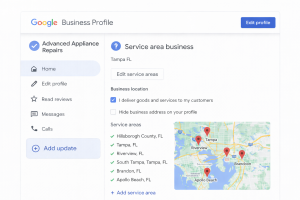
If you’re a service-area business (SAB), you don’t list a street address on your Google Business Profile. But you still need to set your service areas correctly.
Go to your GBP dashboard and:
- Add every city, zip code, or neighborhood you serve
- Remove areas you don’t actually service (this improves relevance)
- Use the business description to mention high-value neighborhoods by name
Example description:
“We provide appliance repair services throughout Scottsdale, Paradise Valley, and North Phoenix. Specializing in high-end brands like Sub-Zero, Wolf, and Thermador.”
This tells Google exactly where you’re relevant.
Use Structured Data (Schema Markup)
Schema markup is code you add to your website that helps Google understand your content.
For appliance repair companies, use:
- LocalBusiness schema (with service area details)
- Service schema (for each type of repair you offer)
- FAQ schema (for blog posts answering common questions)
You don’t need to be a developer to do this. Tools such as Yoast SEO or Rank Math (for WordPress) can automatically generate schema.
Common Mistakes That Kill Hyper-Local SEO
Even if you’re doing everything above, a few mistakes can tank your rankings.
Mistake 1: Keyword Stuffing City Names
Don’t write sentences like: “We serve Phoenix, Scottsdale, Tempe, Mesa, Gilbert, Chandler, and Glendale.”
Google knows that’s spam. Instead, create individual pages or write naturally about the areas you serve.
Mistake 2: Ignoring Your Actual Service Radius
If you say you serve a 50-mile radius, but you’re really only taking calls within 15 miles, you’re wasting effort. Focus your SEO on the areas you actually want to work in, not everywhere theoretically possible.
Mistake 3: Using Generic Content
If your service area pages all say the same thing with different city names, Google will ignore them. Each page needs a unique value. Talk about the neighborhoods, the types of homes, and the common appliance issues in that area.
Mistake 4: Not Tracking What’s Working
You need to know which keywords are driving calls. Use call tracking software or ask every caller, “How did you find us?” If you’re ranking for a keyword but it’s not converting, adjust your content or targeting.
How Hyper-Local Keywords Fit Into a Bigger Strategy
Ranking for hyper-local keywords is powerful, but it’s not the only thing you need.
A complete appliance repair marketing system includes:
- Google Business Profile optimization so you show up in the Map Pack
- Google Ads targeting the same hyper-local keywords for instant visibility
- Call tracking and attribution so you know what’s working
- Reputation management so you have reviews in every area you serve
Our AMPRank system combines organic SEO, Google Ads, and Google Business Profile optimization into one strategy. That way, you’re not just ranking, you’re dominating search results in the exact neighborhoods where your best customers live.
Ready to Stop Competing on “Near Me”?
If you’re tired of getting outbid for low-value jobs near your shop while your competitors work the wealthy suburbs, it’s time to rethink your keyword strategy.
Hyper-local SEO targeting lets you show up exactly where you want to work, for the exact services that make you the most money, in front of homeowners who are ready to hire today.
You don’t need a bigger marketing budget. You need a smarter strategy.
Want help building a hyper-local SEO and Google Ads system that actually drives booked jobs? Book a free strategy call with Appliance Marketing Pros. We’ll show you exactly how to rank in your best service areas and turn search visibility into consistent revenue.
AMP Up Your Growth.
About The Author


