

Table of Contents
The Power of Online Reviews
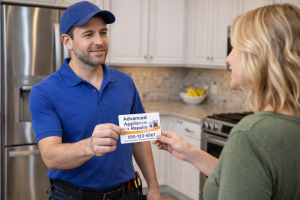
You fixed a refrigerator on a Tuesday afternoon. The customer was thrilled. You left, moved on to the next call, and never heard from them again.
Three months later, you’re wondering why your phone isn’t ringing as often as it used to. Meanwhile, that happy customer you helped? They recommended your competitor to a neighbor because they couldn’t recall your company name.
This happens more often than most appliance repair owners realize. You do great work, but if that work doesn’t turn into visible proof online, it might as well not exist. Google doesn’t care how good your technicians are. It cares about what your customers say about it publicly.
Online reviews are the single most underutilized marketing asset in the appliance repair industry. Most owners treat them like a nice bonus. The reality is that they’re a lead-generation system, a trust signal, and a ranking factor all rolled into one.
If you’re not actively collecting reviews and using them strategically, you’re leaving bookings on the table every single day.
Why Online Reviews Matter More for Appliance Repair Than Other Industries
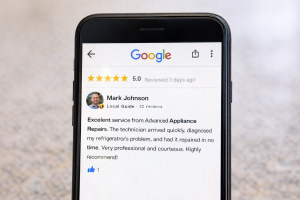
Appliance repair is a high-trust, low-frequency service. Homeowners don’t call you every week. They call you when something breaks, and they’re usually stressed, skeptical, and price-shopping.
That means the decision to book with you is made quickly and is based almost entirely on what they see online in the first 30 seconds.
Here’s what actually influences that decision:
- Google Business Profile star rating and review count. If you have 12 reviews and your competitor has 94, you lose before the phone rings.
- Recency of reviews. A company with 50 reviews from two years ago looks dead. A company with 20 reviews from the last three months looks active and trusted.
- Review content specificity. Generic five-star ratings don’t build trust. Reviews that mention your technician by name, describe the problem, and talk about the experience do.
Homeowners are not comparing your technical skills. They’re comparing your proof. And proof comes from reviews.
What Google Actually Uses Reviews For
Google doesn’t just display your reviews to make you look good. It uses them as ranking signals across multiple systems.
Local Pack Rankings
Your Google Business Profile review count, average rating, review velocity, and review keywords all factor into whether you show up in the local three-pack when someone searches “appliance repair near me.”
We’ve seen appliance repair companies jump from position seven to position two in the local pack after systematically collecting 30 to 40 high-quality reviews over 90 days. Nothing else changed. Same website, same ads, same service area. Just more recent reviews.
Google Ads Quality and Conversion Rate
If you’re running Google Ads and your GBP has weak reviews, your click-through rate drops and your cost per lead goes up. People see your ad, click through, check your reviews, and bounce.
Google notices that behavior. It lowers your Quality Score and increases your cost per click.
The inverse is also true. Strong reviews improve your ad performance even if your landing page stays the same.
Organic SEO and Click Behavior
Reviews show up in search snippets, especially for branded searches. When someone searches for your company name after seeing your truck or receiving a referral, the first thing they see is your star rating.
If it’s strong, they click and call. If it’s weak or missing, they keep scrolling and call someone else.
Reviews also generate fresh, keyword-rich content on your GBP. When customers mention “refrigerator repair,” “same-day service,” or “fair pricing,” Google indexes that language and associates it with your business.
The Four Types of Reviews That Drive Appliance Repair Bookings
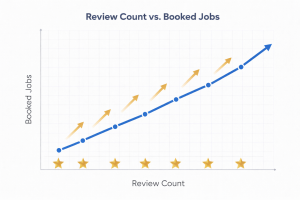
Not all reviews are created equal. Some move the needle. Others just take up space.
1. Recency Reviews
These are your most recent five to ten reviews. They prove you’re still in business and actively serving customers.
If your last review is from six months ago, potential customers assume you’re either struggling or not taking on new work. Recency signals momentum.
2. Volume Reviews
This is your total count. It’s a trust amplifier.
A company with 15 reviews might be new or inconsistent. A company with 150 reviews has been around, served many people, and has a track record.
Volume also insulates you from negative reviews. One bad review out of 100 is a rounding error. One bad review out of five is a red flag.
3. Keyword Reviews
These are reviews that naturally include the services you want to rank for.
When a customer writes, “They fixed my Samsung refrigerator the same day I called,” Google considers that content relevant to searches such as “Samsung refrigerator repair” or “same-day appliance repair.”
You can’t force this, but you can guide it by asking better follow-up questions when you request reviews.
4. Story Reviews
These are the detailed, narrative-style reviews that describe a problem, your response, and the outcome.
Story reviews build emotional trust. They show how you handle stress, communicate with customers, and solve real problems. They also tend to be longer, which gives Google more content to work with.
The Biggest Mistakes Appliance Repair Owners Make With Reviews
Most appliance repair companies know reviews matter. But knowing and executing are two different things.
Here are the patterns we see that kill review generation:
Waiting for Customers to Leave Reviews on Their Own
This rarely happens. Customers are busy. They’re relieved that their appliance is fixed and move on with their day.
If you don’t ask, you don’t get. And if you don’t make it easy, you definitely don’t get.
Asking Once and Giving Up
You send one text after the job with a review link. The customer doesn’t respond. You assume they didn’t want to leave a review.
Reality: they saw the text while driving, forgot about it, and never thought about it again.
Follow-up matters. A second request 48 hours later often doubles your response rate.
Sending Customers to the Wrong Platform
You ask for a review but don’t specify where. The customer leaves a nice review on Yelp or Facebook, which does nothing for your Google rankings.
Every review request should point directly to your Google Business Profile. That’s where search behavior happens.
Ignoring Negative Reviews
Bad reviews happen. Ignoring them makes them worse.
Responding quickly, professionally, and with accountability shows future customers that you care about resolution. It also gives you a chance to explain context or correct misinformation.
We’ve seen negative reviews become trust-builders when the owner responds well.
Not Tracking Review Velocity
Most owners check their reviews once a month and feel good if the number went up.
But if you’re not tracking how many reviews you’re getting per week or per month, you have no idea if your system is working or if you’re falling behind competitors.
How to Build a Review Generation System That Actually Works
If you want consistent reviews, you need a system. Not a reminder. Not good intentions. A repeatable process that runs whether you remember it or not.
Step 1: Identify Your Review Request Trigger
Decide exactly when you’ll request a review.
The best time is right after the job is complete and the customer is happy. That’s when the experience is fresh and the relief is highest.
Some companies ask in person before leaving. Others send an automated text or email within two hours of job completion.
Both work. The key is consistency.
Step 2: Make the Ask Simple and Specific
Don’t say “If you have time, we’d love a review.”
Say: “If we did a good job today, would you mind leaving us a quick review on Google? It takes about 30 seconds and really helps other homeowners find us.”
Then hand them a card with a QR code or send a text with a direct link to your Google Business Profile review page.
The easier you make it, the more reviews you’ll get.
Step 3: Automate the Follow-Up
Use a CRM, scheduling software, or review platform to automatically send a follow-up request 24 to 48 hours after the job.
This captures customers who intended to leave a review but forgot.
You can also send a third touchpoint at the seven-day mark for high-value jobs or repeat customers.
Step 4: Respond to Every Review
Thank customers for positive reviews. Keep it short and genuine.
Address negative reviews with empathy and a path to resolution. Don’t argue. Don’t make excuses. Acknowledge the issue and offer to make it right.
This shows future customers that you’re responsive and accountable.
Step 5: Track and Optimize
Set a goal for the number of reviews you want per month. Track your current rate. Compare it to competitors in your market.
If you’re getting two reviews a month and your competitors are getting ten, you have a problem. And it’s fixable.
What to Do With Reviews Once You Have Them
Collecting reviews is step one. Using them strategically is step two.
Feature Reviews on Your Website

Display your best Google reviews on your homepage, service pages, and contact page.
Use the customer’s first name, the service they received, and a short quote. This builds trust and reinforces your credibility before someone even picks up the phone.
Use Reviews in Google Ads
Google Ads allows you to display review extensions and seller ratings if you meet certain thresholds.
These display your star rating directly in your ad, increasing click-through rate and lowering cost per click.
Leverage Reviews in Follow-Up Sequences
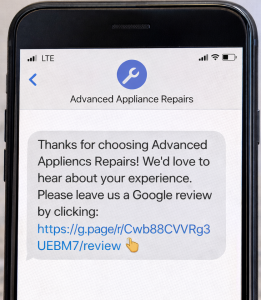
When you send estimate follow-ups or seasonal reminders, include a line like: “See why over 200 homeowners trust us with their appliance repairs.”
Link to your Google Business Profile. Let the reviews do the selling for you.
Share Reviews on Social Media
Post a review once or twice a week on Facebook or Instagram. Tag the service (like refrigerator repair or dryer vent cleaning) and thank the customer.
This keeps your social presence active and reinforces your reputation across platforms.
How Many Reviews Do You Actually Need?
There’s no magic number, but here’s what we see in competitive appliance repair markets:
- Under 20 reviews: You’re invisible in local search and losing to competitors by default.
- 20 to 50 reviews: You’re in the game, but still vulnerable to competitors with more volume.
- 50 to 100 reviews: You’re competitive in most markets and have enough social proof to convert leads consistently.
- 100+ reviews: You’re a market leader. You have insulation against negative reviews and strong ranking signals across Google.
Your goal should be to reach 50 reviews as quickly as possible, then maintain a steady monthly flow of new reviews.
In most markets, that means collecting three to five reviews per week if you’re running a multi-tech operation.
The ROI of a Strong Review Profile
Here’s what actually changes when you go from 15 reviews to 75 reviews over six months:
- Your local pack rankings improve, which means more organic calls from Google Maps.
- Your Google Ads cost per lead drops because your Quality Score and conversion rate improve.
- Your close rate on estimates goes up because customers trust you before they meet you.
- Your technicians receive greater respect during service calls because customers already believe you’re credible.
We’ve tracked this across dozens of appliance repair clients. Companies that prioritize reviews consistently outperform those that don’t, even when they have better websites or larger ad budgets.
Reviews are leverage. They compound over time. And they’re one of the few marketing assets you can build without spending more money on ads.
What Happens If You Ignore Reviews
If you’re not actively managing your online reputation, here’s what’s happening right now:
- Competitors with fewer years in business are outranking you because they have more recent reviews.
- Potential customers are calling someone else because your review count looks stale or your rating is weak.
- You’re paying more per click on Google Ads because your conversion rate is lower.
- Referrals are going to waste because people can’t verify your credibility when they Google your name.
You can’t fix this overnight. But you can start fixing it today.
How Appliance Marketing Pros Helps Appliance Repair Companies Build Review Systems
We work with appliance repair companies across the United States to build predictable, scalable review generation systems that integrate with your existing workflow.
That includes:
- Automated review requests are sent via text or email after every completed job
- Direct links to your Google Business Profile optimized for mobile
- Follow-up sequences that increase response rates without being pushy
- Review monitoring and response management
- Monthly reporting so you know exactly how many reviews you’re generating and how that compares to competitors
We also integrate review data into your broader marketing strategy, including Google Ads, local SEO, and Google Business Profile optimization.
If you’re tired of watching competitors with worse service outranking you because they have better reviews, let’s fix that.
Book a free strategy call with Appliance Marketing Pros. We’ll audit your current review profile, identify where you’re losing ground, and develop a plan to turn customer feedback into consistent bookings.
No pressure. No long contracts. Just a clear plan and the systems to execute it.
Your customers already trust you. Let’s make sure Google and future customers do too.
About The Author


