
Table of Contents
Local Services Ads vs Google Ads: Which is Best for Your Appliance Repair Business?
Local Services Ads vs Google Ads: Best for Appliance Repair?
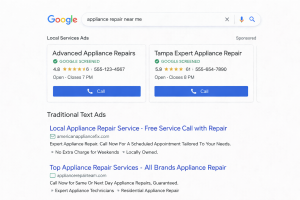
If you run an appliance repair company, you’ve probably noticed Google’s search results look different from how they used to. There are now three distinct sections where your business can appear when someone searches for appliance repair in your area.
At the very top, you see Local Services Ads with the green “Google Guaranteed” checkmark. Below that are traditional Google Ads. And further down is the map pack with organic results.
The question every appliance repair owner asks is simple: where should I spend my money?
The answer isn’t as straightforward as most marketing agencies make it sound. Both platforms can work, but they work differently. If you don’t understand how they’re built, you’ll either waste money on the wrong one or manage them poorly.
This guide explains how Local Services Ads and Google Ads work for appliance repair companies, what each costs, and when to use one, both, or neither.
What Are Local Services Ads?
Local Services Ads, also known as LSAs or Google Guaranteed Ads, appear at the top of Google search results. They appear when someone searches for services such as “appliance repair near me” or “refrigerator repair.”
The biggest difference between LSAs and traditional ads is the payment model. With Local Services Ads, you pay per lead, not per click. That means you only pay when someone calls or messages you directly through the ad.
Google also conducts a background check and verifies your license before approving your business. Once approved, you get the Google Guaranteed badge. This signals to potential customers that Google has vetted your business and will back jobs up to a specified amount if something goes wrong.
Your ad shows your business name, star rating, years in business, and your service area. It also shows how many times you’ve been hired through the platform. When someone clicks your ad, they see your full profile with reviews, services, and contact options.
What Are Google Ads for Appliance Repair?
Google Ads, also called PPC or pay-per-click ads, appear below Local Services Ads but above the map pack. These are the traditional text ads you’ve seen for years.
With Google Ads, you bid on specific keywords like “Sub-Zero repair” or “emergency dishwasher service.” You write ad copy, choose a landing page, and set a daily budget. Every time someone clicks your ad, you pay.
The cost per click varies based on competition, your quality score, and how you structure your campaigns. In most appliance repair markets, clicks range from $8 to $35, depending on the keyword and time of day.
Google Ads gives you full control over targeting. You can show ads only during business hours, exclude certain zip codes, target people searching for specific appliance brands, or build remarketing campaigns that follow website visitors.
You also control the message. Your ad copy, headlines, and landing pages are entirely up to you. That means you can speak directly to the type of customer you want and filter out the ones you don’t.
The Real Difference: Pay-Per-Lead vs. Pay-Per-Click
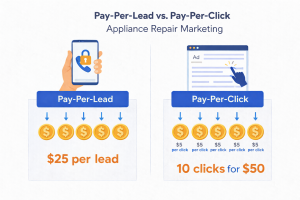
The payment model is the most important difference between these platforms.
Local Services Ads charge you per lead. If someone calls or messages you through the ad, you pay. If they just view your profile and leave, you don’t. Google sets the price per lead based on your market and service type. For appliance repair, expect to pay $25 to $70 per lead, depending on your location.
Google Ads charges you per click. Someone clicks your ad, you pay. Whether they call, fill out a form, or immediately hit the back button doesn’t matter. You’re charged either way.
This creates a different risk profile. With LSAs, you’re guaranteed contact, but you have no control over lead quality until after you’ve paid. With Google Ads, you control who sees your ad and where they land, but you pay for traffic that might not convert.
Here’s what that looks like in practice. Let’s say you get 100 people to see your ad on both platforms.
With Local Services Ads, you might get 8 calls directly. You pay for those 8 leads. If your cost per lead is $50, you spent $400. If 4 of those leads convert into jobs at an average ticket of $300, you generated $1,200 in revenue.
With Google Ads, maybe 12 people click your ad at $20 per click. You spent $240. If your website converts 50% of visitors into calls, that’s 6 calls. If 4 of those turn into jobs at a $300 average ticket, you made $1,200 in revenue but spent less to get there.
The problem is most appliance repair websites don’t convert at 50%. They convert at approximately 10%-20%. That changes the math fast.
Where Each Platform Shows Up on Google
Local Services Ads appear at the top of search results, above all other listings. This is prime real estate. When someone searches for “dishwasher repair near me,” your LSA profile may be the first result they see.
Google Ads appear directly below Local Services Ads, above the map pack. They’re still near the top but less prominent.
The map pack and organic results show up below both paid placements.
This positioning matters because most people click on the first option. If you’re not in the LSA section, you’re already losing visibility to competitors who are. If you’re not running Google Ads either, you’re relying entirely on map pack rankings, which can be inconsistent.
Lead Quality: What You Actually Get
This is where theory and reality split.
Local Services Ads are designed to deliver high-intent leads because the person must take action to contact you. They either call or message directly. There’s no “browsing.”
In practice, LSA lead quality varies. You’ll get legitimate emergency calls from homeowners who need help now. You’ll also get price shoppers across five companies, landlords looking for the cheapest option, and occasional spam.
Google allows you to dispute leads if they’re clearly invalid, like a wrong number or someone asking about a service you don’t offer. But the dispute process takes time, and approval isn’t guaranteed.
Google Ads lead quality depends entirely on how you set up your campaigns. If you target broad keywords like “appliance repair” with no filters, you’ll get a mix of homeowners, DIYers looking for advice, people in the wrong service area, and competitors checking your ads.
If you target specific branded keywords like “Bosch dishwasher repair” and send people to a landing page that clearly explains your service, pricing expectations, and response time, your lead quality improves dramatically.
The difference is control. With LSAs, Google decides who sees your ad and when. With Google Ads, you decide.
Cost Comparison: What You’ll Actually Spend
Let’s break down real numbers.
Local Services Ads charge per lead. In most mid-sized markets, appliance repair leads cost between $30 and $60. In competitive metros such as Los Angeles and New York, expect $60 to $90 per lead.
Google sets your weekly budget cap. You tell Google how much you’re willing to spend per week, and they’ll send you leads until you hit that limit. Once you hit your budget, your ad stops showing until the next week.
If you set a $500 weekly budget and your cost per lead is $50, you’ll get 10 leads per week. Whether those leads turn into jobs depends on your response time, pricing, and how you handle the call.
Google Ads charges per click. Cost per click in appliance repair typically ranges from $10 to $30, depending on the keyword. Generic terms like “appliance repair” cost more. Specific terms like “Whirlpool washer repair” cost less.
Your total spend depends on your daily budget and the competitiveness of your market. If you set a $50 daily budget and your average cost per click is $15, you’ll get about 3 clicks per day, or 90 clicks per month.
If your website converts 20% of clicks into calls, that’s 18 calls. If 50% of calls turn into booked jobs, that’s 9 jobs. At a $300 average ticket, that’s $2,700 in revenue from $1,500 in ad spend.
The key difference is predictability. LSAs provide a fixed cost per lead with variable lead volume. Google Ads offers variable cost per click and greater control over targeting and volume.
Setup and Eligibility: What It Takes to Get Started

Local Services Ads have strict eligibility requirements. You need to operate in an eligible service category, which includes appliance repair in most states. You also need a valid business license, insurance, and to pass a background check for anyone who will be in customers’ homes.
The approval process takes 2 to 4 weeks. You submit documentation, Google reviews it, and if everything checks out, you’re approved. If you’re missing anything or your paperwork doesn’t match, you’ll need to resubmit.
Once approved, you build out your profile. You add your service areas, hours, services offered, and photos. You also need reviews. LSA profiles with more reviews and higher ratings get more visibility.
Google Ads have no eligibility requirements beyond a Google account and a valid payment method. You can set up a campaign in under an hour if you know what you’re doing.
The challenge with Google Ads isn’t approval. It’s setup. Most appliance repair owners who try to run their own Google Ads make the same mistakes. They target too many keywords, write generic ad copy, send traffic to their homepage instead of a dedicated landing page, and don’t track which calls came from which keywords.
This leads to wasted spend and frustration. Then they blame Google Ads for not working when the real issue was setup.
When to Use Local Services Ads
Local Services Ads work best if you want simple, fast setup and you’re willing to trade control for convenience.
Use LSAs if:
- You’re eligible and can pass the background check and licensing requirements.
- You want to leverage the Google Guaranteed badge to build trust.
- You need leads now and don’t have time to build out a full Google Ads campaign.
- You don’t have a strong website or landing page yet.
- You’re comfortable with a fixed-cost-per-lead model.
- You can respond to leads within minutes. LSAs reward fast response times with better placement.
LSAs are also a good fit if you’re a smaller operation that just needs a steady stream of calls without managing complex campaigns.
When to Use Google Ads
Google Ads works best if you want control, scalability, and the ability to target specific customer segments.
Use Google Ads if:
- You want to target specific appliance brands, models, or service types.
- You have a website or landing page that’s built to convert visitors into calls.
- You’re willing to invest time in campaign setup and ongoing optimization.
- You want to track exactly which keywords and ads drive revenue.
- You need more volume than LSAs can provide.
- You want to run remarketing campaigns to bring back past website visitors.
Google Ads are also better if you’re trying to build brand awareness or if you offer premium services that require more explanation before someone calls.
The Hybrid Strategy: Why Most Successful Shops Run Both
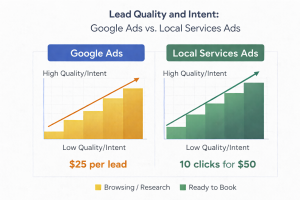
Here’s what most marketing agencies won’t tell you. The best appliance repair companies don’t choose between Local Services Ads and Google Ads. They run both.
LSAs capture high-intent leads at the top of the search results. Google Ads capture everyone else, including people searching for specific services, branded terms, or longer-tail keywords that LSAs don’t cover.
Running both also protects you from platform risk. If Google changes LSA eligibility requirements or your profile is paused for review, your Google Ads campaigns will continue to run. If your Google Ads account is experiencing issues, LSAs are still driving calls.
The key is budget allocation. You don’t need to spend the same amount on both. Start with whichever platform best fits your business, then layer in the other once you have a baseline.
For most appliance repair companies, that means starting with LSAs for simplicity, then adding Google Ads once you have a process for handling leads and a landing page that converts.
Common Mistakes That Waste Money on Both Platforms
Most appliance repair owners make the same mistakes when they try to run these platforms themselves.
With Local Services Ads, the biggest mistake is not responding fast enough. Google tracks your response time and uses it to determine placement. If you’re slow to respond, your ad gets pushed down. If competitors respond faster, they get the lead.
The second mistake is failing to dispute bad leads. If you get a spam call or someone asking about a service you don’t offer, dispute it immediately. Don’t just accept the charge and move on.
With Google Ads, the biggest mistake is targeting too broadly. If you’re bidding on “appliance repair” with no geographic filters or negative keywords, you’re paying for clicks from people who will never hire you.
The second mistake is sending traffic to your homepage. Homepages are built for navigation, not conversion. If someone clicks your ad and lands on a page with 10 different links and no clear call to action, they leave. You paid for that click and got nothing.
The third mistake is failing to track calls. If you don’t know which keywords or ads drove which calls, you can’t optimize. You’re flying blind.
What Good Management Actually Looks Like
Whether you run these platforms yourself or hire someone to do so, good management looks the same.
For Local Services Ads, effective management means responding to every lead within 5 minutes, disputing invalid leads the same day, requesting a review for every completed job, and adjusting your weekly budget based on job volume and capacity.
For Google Ads, good management means running separate campaigns for different service types, writing ad copy that speaks to specific customer problems, sending traffic to dedicated landing pages, tracking every call back to the keyword that drove it, and adjusting bids based on what’s actually converting into revenue.
Both platforms also require regular review. What worked last month might not work this month. Seasonality, competition, and Google’s algorithm all shift constantly.
How to Decide What’s Right for Your Business
If you’re just starting with paid advertising, start with Local Services Ads. The setup is simpler, the cost is predictable, and the Google Guaranteed badge helps with trust.
If you’re already running LSAs and you’re hitting your weekly budget cap, add Google Ads to capture additional volume.
If you’re a growth-stage shop with 5 or more technicians and you need predictable lead flow, run both platforms and track everything.
If you’ve tried Google Ads before and it didn’t work, the issue was likely with your setup, not the platform. Most appliance repair owners who “tried Google Ads” ran campaigns with no strategy, no tracking, and no optimization. That’s not a fair test.
The Real Question: Who’s Managing It?
The platform matters less than the execution. A well-run Google Ads campaign will outperform a poorly managed LSA profile every time. And vice versa.
Most appliance repair owners don’t have time to learn Google Ads or manage LSA disputes while also running service calls and managing technicians. That’s not a criticism. It’s reality.
If you plan to run these platforms yourself, commit to learning them thoroughly. Take the time to understand how they work, track your results, and adjust based on data.
If you don’t have that time, hire someone who specializes in appliance repair marketing. Not a general marketing agency. Not someone who runs ads for dentists and lawyers and has one appliance repair client.
You need someone who understands the service business model, knows what appliance repair customers actually search for, and can build campaigns that drive booked jobs, not just clicks.
What Appliance Marketing Pros Does Differently
We don’t treat Local Services Ads and Google Ads as separate projects. We treat them as two parts of the same system, which we call AMPRank.
AMPRank combines LSA management, Google Ads, Google Business Profile optimization, and call tracking into one integrated approach. The goal is to achieve total visibility across all parts of Google search results.
When we manage LSAs, we respond to leads on your behalf if needed, dispute bad leads immediately, and optimize your profile for placement. When we manage Google Ads, we build campaigns around the specific services and brands your technicians are best at, track every call back to the keyword, and adjust bids based on actual job revenue.
We also connect everything to your CRM or booking system so you can see exactly which platform and which keyword drove which job and how much revenue it generated.
That’s the difference between running ads and running a system. Most agencies run ads. We build systems that deliver predictable call volume and clear ROI.
If you’re tired of inconsistent lead flow, unclear ROI, or working with agencies that don’t understand appliance repair, let’s talk. We’ll walk through your current marketing, show you exactly where the gaps are, and build a plan that actually fits your business.
Book a free strategy call with Appliance Marketing Pros and let’s AMP up your growth.
About The Author


