

Table of Contents
Building Trust in a Market Full of Scams: How Appliance Repair Companies Win Customers in 2026

You know the problem. A homeowner’s fridge dies on a Tuesday afternoon. They panic. They Google “appliance repair near me.” And within 30 seconds, they’re staring at a screen full of companies they’ve never heard of, half of which look sketchy.
Some have fake reviews. Others have websites that scream 1998. A few are lead sellers posing as local repair shops. And buried somewhere in that mess is your business, trying to look legitimate while everyone else is gaming the system.
This is the reality of appliance repair marketing in 2026. The scammers haven’t gone anywhere. If anything, they’ve gotten better at faking credibility. And that makes your job harder, because even when you’re the real deal, you have to work twice as hard to prove it.
Here’s the truth: trust is the only competitive advantage that actually matters anymore. Price doesn’t win. Speed doesn’t win. The company that looks most trustworthy wins the call. And if you don’t control how trust shows up online, someone else will.
This guide breaks down exactly how appliance repair companies build unshakeable trust in a market designed to confuse customers. No theory. No fluff. Just the systems that separate legitimate businesses from the noise.
Trust in a Scam-Ridden Market: Why Credibility Matters More Than Ever
Appliance repair sits in a uniquely vulnerable position. Customers are inviting a stranger into their home to fix something they don’t understand, and they’re doing it under pressure.
The fridge is leaking. The washer won’t spin. The oven died right before Thanksgiving dinner. They need help now, and they have no idea who to trust.
That anxiety creates a massive trust gap. And in that gap, scammers thrive.
Here’s what makes appliance repair especially hard:
The service is invisible. Most customers can’t tell if you actually fixed the problem or just unplugged something and plugged it back in. They have to trust that the work was real and the price was fair.
The urgency is real. When someone’s fridge is broken, they’re not comparison shopping for three days. They’re calling the first company that looks legitimate. If your trust signals are weak, you lose that call in seconds.
The scam reputation is widespread. Appliance repair has a long history of bait-and-switch pricing, fake part replacements, and high-pressure upsells. Even if you’ve never done any of that, customers assume you might.
There’s no relationship yet. Unlike a regular plumber or HVAC company that might service a home annually, most appliance repair is one-and-done. You’re starting from zero trust every single time.
All of this means that the company with the strongest trust signals wins, even if they’re not the cheapest or the fastest. And those trust signals live almost entirely online now.
The Trust Stack: What Actually Builds Credibility for Appliance Repair Companies
Trust isn’t one thing. It’s a stack of signals that either reinforce each other or contradict each other. When they align, you look legitimate. When they don’t, you look like every other scammer.
Here’s the stack, in order of impact:
1. Google Business Profile Completeness and Consistency
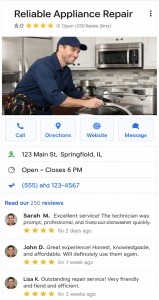
Your Google Business Profile is the first thing most customers see. If it’s incomplete, inconsistent, or outdated, you’ve already lost.
What customers check immediately:
- Your rating and review count. Anything below 4.0 stars is a red flag. Anything under 10 reviews looks new or inactive.
- Your response rate. If you’re not responding to reviews, especially negative ones, it signals you don’t care.
- Your photos. Stock images or no images at all make you look fake. Real photos of your team, your trucks, and your work make you look real.
- Your hours and contact info. If your phone number is wrong or your hours are outdated, customers assume you’re not a real business.
Most appliance repair companies treat their Google Business Profile like a set-it-and-forget-it listing. That’s a mistake. It’s a living asset that needs constant attention.
2. Review Volume, Recency, and Response Quality
Reviews are the single most powerful trust signal in appliance repair. But it’s not just about having a high rating. It’s about how many reviews you have, how recent they are, and how you respond to them.
Here’s what separates legitimate companies from the rest:
Volume matters more than rating. A 5.0-star rating with 8 reviews looks suspicious. A 4.7-star rating with 200 reviews looks established.
Recency signals activity. If your last review is from six months ago, customers assume you’re not busy. Active businesses get reviews every week.
Response quality shows you care. Responding to every review, positive or negative, with a real human reply (not a template) proves you’re paying attention.
The biggest mistake appliance repair owners make with reviews is being passive. They assume happy customers will leave reviews on their own. They don’t. You have to ask, and you have to make it easy.
3. Website Design and Messaging Clarity
Your website is where customers go to confirm what they learned from your Google Business Profile. If your site contradicts the trust you built on Google, you lose the call.
Here’s what a trust-building appliance repair website includes:
Clear service area and service list. Customers need to know immediately if you cover their area and if you fix their appliance. Vague language kills trust.

Real photos of your team and trucks. Stock photos scream “lead seller.” Real photos prove you’re local.
Transparent pricing structure. You don’t have to list exact prices, but explaining how you charge (flat rate vs. hourly, service call fees, etc.) removes the fear of surprise costs.
Certifications and manufacturer training. If you’re certified by GE, Whirlpool, or Samsung, say so. It proves you’re not just some guy with a toolbox.
A clear phone number and contact form. If customers have to hunt for your phone number, they’ll call someone else.
Most appliance repair websites fail because they try to be clever instead of clear. Customers don’t want clever. They want to know you’re real, you’re local, and you can fix their appliance today.
4. Consistent NAP (Name, Address, Phone) Across the Web
This one sounds boring, but it’s critical. If your business name is “ABC Appliance Repair” on Google but “ABC Appliance Services” on Yelp, and your phone number is different on your website than it is on Facebook, Google doesn’t know which version is correct.
That inconsistency doesn’t just hurt your SEO. It makes you look disorganized or fake.
Run a quick audit. Search for your business name and check:
- Google Business Profile
- Yelp
- Better Business Bureau
- Angi (formerly Angie’s List)
- HomeAdvisor
- Your website footer
If the name, address, or phone number is different anywhere, fix it. This is basic hygiene, but most appliance repair companies get it wrong.
5. Active Social Proof Beyond Reviews
Reviews are the foundation, but they’re not the only form of social proof. Customers also look for:
Before-and-after photos. Show the broken appliance and the fixed appliance. It proves you do real work.
Customer testimonials with names and locations. Generic testimonials don’t work. “John in Denver” is more believable than “a satisfied customer.”
Video testimonials. Even a 15-second iPhone video of a happy customer carries more weight than 10 written reviews.
Case studies or common repair stories. A blog post titled “How We Fixed a GE Refrigerator That Wouldn’t Cool in Aurora, CO” is both helpful and trust-building.
The goal is to show that real people in real locations trust you with real appliances. The more specific, the better.
How Scammers Fake Trust (and How to Spot Them)
Understanding how scammers build fake credibility helps you build real credibility. Here’s what they do:
Fake reviews. They buy Google reviews from overseas click farms. The reviews are generic, posted in clusters, and often from accounts with no other activity.
Stock photos and stolen identities. They use stock images of technicians or steal photos from real companies. Reverse image search reveals this instantly.
Vague service areas. They claim to serve “Denver and surrounding areas” without specifying where. Real companies list specific cities and zip codes.
No physical address. They use a P.O. box or hide their address entirely. Real companies list a real location.
Template responses to reviews. Every response is identical. Real companies write unique replies.
Lead seller tactics. They rank for appliance repair keywords, collect the call, and sell it to multiple companies. The customer gets spammed by five different businesses.
If you’re competing against these tactics, your job is to be as specific, transparent, and verifiable as possible. Scammers rely on vagueness. You win by being the opposite.
The Google Business Profile Strategy That Actually Works
Your Google Business Profile is the single highest-leverage trust asset you control. Most appliance repair companies treat it like a static listing. The ones who win treat it like a living marketing channel.
Here’s the system:
Step 1: Complete Every Section
Google rewards complete profiles. Fill out:
- Business name (exactly as it appears everywhere else)
- Address (real address, not a P.O. box)
- Phone number (local number, not a call tracking number)
- Website URL
- Business hours (accurate and updated for holidays)
- Service area (specific cities and zip codes, not just “Denver metro”)
- Business categories (primary: Appliance Repair Service; secondary: Refrigerator Repair, Washer Repair, etc.)
- Business description (clear, keyword-rich, no fluff)
Step 2: Upload Real Photos Every Week
Google prioritizes profiles with fresh content. Upload photos of:
- Your team (real faces, not stock photos)
- Your trucks (branded vehicles prove you’re local)
- Completed jobs (before-and-after shots)
- Your shop or office (if you have one)
Aim for 3-5 new photos per week. It signals activity and keeps your profile fresh in Google’s algorithm.
Step 3: Post Weekly Updates
Google Posts are underused by appliance repair companies. They’re free, they show up in your profile, and they signal that you’re active.
Post about:
- Common repair tips (e.g., “Why Your Dryer Isn’t Heating: 3 Common Causes”)
- Seasonal reminders (e.g., “Get Your Fridge Ready for Summer”)
- Service area updates (e.g., “Now Serving Aurora and Centennial”)
- Customer success stories (e.g., “We Fixed This GE Washer in 30 Minutes”)
Posts expire after 7 days, so consistency matters more than perfection.
Step 4: Respond to Every Review Within 48 Hours
This is non-negotiable. Every review, positive or negative, gets a response.
For positive reviews, say thank you and mention something specific from their review. For negative reviews, acknowledge the issue, apologize if appropriate, and offer to make it right. Never argue. Never get defensive.
Google tracks response rate and response time. The faster and more consistently you respond, the better your profile performs.
Step 5: Use the Q&A Section Proactively
Most customers don’t know the Q&A section exists, but Google indexes it. Use it to answer common questions before customers ask:
- “Do you offer same-day service?” (Yes, in most cases. Call us at [number].)
- “What brands do you repair?” (We repair all major brands, including GE, Whirlpool, Samsung, LG, and more.)
- “Do you charge a service call fee?” (Yes, we charge a $X service call fee that goes toward the repair if you choose to proceed.)
This preemptively builds trust and helps with local SEO.
The Review Generation System That Doesn’t Feel Pushy
Most appliance repair companies don’t ask for reviews because they don’t want to seem pushy. That’s a mistake. Customers are happy to leave reviews if you make it easy and ask at the right time.
Here’s the system:
Step 1: Ask Immediately After the Job
The best time to ask for a review is right after you finish the repair, while the customer is still happy. Don’t wait until later. Don’t send an email three days later. Ask in person.
Script: “I’m glad we got that fixed for you. If you’re happy with the service, would you mind leaving us a quick review on Google? It really helps us out.”
Most customers will say yes. Hand them a card with a QR code that links directly to your Google review page. Make it one tap.
Step 2: Send a Follow-Up Text (Optional)
If they don’t leave a review on the spot, send a text an hour later:
“Hi [Name], this is [Your Name] from [Company]. Thanks again for choosing us today. If you have a minute, we’d really appreciate a review: [link]. Have a great day!”
Keep it short. One reminder is enough.
Step 3: Make It Easy
The easier it is to leave a review, the more reviews you’ll get. Use a short link (bit.ly or a custom domain) that goes directly to your Google review page. No extra clicks. No login required.
Step 4: Don’t Incentivize
Google’s terms of service prohibit offering discounts, gift cards, or anything of value in exchange for reviews. Don’t do it. It’s not worth the risk of getting your profile suspended.
How to Handle Negative Reviews Without Losing Trust
Negative reviews happen. Even the best appliance repair companies get them. The difference is how you respond.
Here’s the framework:
Step 1: Respond Quickly
Respond within 24-48 hours. A fast response shows you’re paying attention and you care.
Step 2: Acknowledge the Issue
Start by acknowledging their experience, even if you disagree with their version of events.
“Thank you for sharing your feedback. I’m sorry to hear your experience didn’t meet your expectations.”
Step 3: Offer to Make It Right
Invite them to contact you directly to resolve the issue.
“We’d like to make this right. Please give us a call at [number] so we can discuss this further.”
Step 4: Keep It Short and Professional
Don’t write a novel. Don’t argue. Don’t make excuses. Keep it under 3-4 sentences.
Step 5: Take It Offline
If the customer responds, move the conversation off the public review. Resolve it privately, then ask if they’d consider updating their review.
The goal isn’t to delete the negative review. The goal is to show future customers that you handle problems professionally.
The Website Trust Signals Customers Actually Check
Your website has one job: confirm that you’re legitimate. Here’s what customers look for in the first 10 seconds:
1. A Real Phone Number (Above the Fold)
If customers have to scroll to find your phone number, you’ve already lost. Put it in the header, in large text, with a click-to-call link for mobile.
2. Your Service Area (Clearly Stated)
Don’t say “serving the Denver area.” Say “serving Aurora, Centennial, Littleton, Englewood, and surrounding areas.” Specificity builds trust.
3. Real Photos of Your Team
Show faces. Show names. Show your trucks. Prove you’re a real local business.
4. Certifications and Manufacturer Training
If you’re certified, say so. Put logos on your homepage. Link to verification if possible.
5. A Clear Explanation of How You Charge
Customers hate surprise fees. Explain your pricing structure upfront. You don’t have to list exact prices, but explain the process.
Example: “We charge a $79 service call fee to diagnose the issue. If you choose to proceed with the repair, that fee goes toward the total cost.”
6. Customer Reviews (Embedded)
Embed your Google reviews directly on your homepage using a widget. It reinforces the trust you built on Google.
7. A Simple Contact Form
Some customers prefer forms over phone calls. Make it easy. Name, phone, email, and a brief description of the problem. That’s it.
The NAP Consistency Audit Every Appliance Repair Company Should Run
NAP stands for Name, Address, Phone. If these three things aren’t identical across every platform, Google doesn’t trust your business information. And if Google doesn’t trust it, customers won’t either.
Here’s how to audit:
Step 1: List Every Platform Where Your Business Appears
- Google Business Profile
- Yelp
- Better Business Bureau
- Angi
- HomeAdvisor
- Thumbtack
- Your website
- Any local directories
Step 2: Check for Inconsistencies
Look for:
- Different business names (e.g., “ABC Appliance Repair” vs. “ABC Appliance Services”)
- Different addresses (e.g., Suite 100 vs. no suite number)
- Different phone numbers (e.g., main line vs. direct line)
Step 3: Standardize Everything
Pick one version of your business name, address, and phone number. Update every platform to match exactly. Yes, it’s tedious. Yes, it matters.
Step 4: Monitor Ongoing
Set a calendar reminder to check NAP consistency every quarter. Platforms change. Information drifts. Stay on top of it.
The Social Proof Strategy Beyond Reviews
Reviews are the foundation, but they’re not the only way to build trust. Here are three underused tactics:
1. Before-and-After Photos
Show the broken appliance. Show the fixed appliance. Post them on your website, your Google Business Profile, and your Facebook page.
Customers want proof that you do real work. Photos are proof.
2. Video Testimonials
Even a 15-second iPhone video of a customer saying “these guys were great” carries more weight than 10 written reviews.
Ask happy customers if they’d be willing to record a quick video. Most will say yes. Post it everywhere.
3. Case Studies and Repair Stories
Write blog posts about common repairs. Example: “How We Fixed a Samsung Refrigerator That Wouldn’t Cool in 30 Minutes.”
These posts serve two purposes: they help with SEO, and they prove you know what you’re doing.
How to Position Against Lead Sellers and Scammers
Lead sellers are the biggest threat to legitimate appliance repair companies. They rank for your keywords, collect the call, and sell it to multiple companies. The customer gets spammed, and you paid for a lead that’s already been sold to three other businesses.
Here’s how to position against them:
1. Be Specific About Your Service Area
Lead sellers are vague. You’re specific. List every city and zip code you serve. Prove you’re local.
2. Show Your Face
Lead sellers use stock photos. You use real photos of your team. Prove you’re a real business.
3. List a Real Address
Lead sellers hide their address. You list yours. Prove you have a physical location.
4. Respond to Reviews
Lead sellers don’t respond to reviews because they’re not real businesses. You respond to every review. Prove you care.
5. Educate Customers
Write blog posts and social media content about how to spot lead sellers. Educate your market. Position yourself as the alternative.
The Trust Metrics You Should Actually Track
Trust isn’t just a feeling. It’s measurable. Here are the metrics that matter:
1. Google Business Profile Views
Track how many people view your profile each month. If views are increasing, your trust signals are working.
2. Call Volume from Google
Track how many calls come directly from your Google Business Profile. This is the clearest signal that your profile is converting.
3. Review Volume and Recency
Track how many reviews you get per month. Aim for at least 4-8 new reviews per month for a small operation, more for larger teams.
4. Review Response Rate
Track what percentage of reviews you respond to. Aim for 100%.
5. Website Traffic from Organic Search
Track how many people find your website through Google search. If traffic is increasing, your SEO and trust signals are working together.
6. Conversion Rate (Calls or Form Fills)
Track what percentage of website visitors call or fill out your contact form. If your trust signals are strong, this number should be 3-5% or higher.
Why Trust Is the Only Moat That Matters
Price can be undercut. Speed can be matched. Service quality is hard to prove before the job is done.
But trust? Trust is the only thing that’s actually defensible. Once you’ve built it, scammers can’t replicate it. Lead sellers can’t fake it. And competitors can’t buy it.
The appliance repair companies that win in 2026 are the ones that treat trust like a system, not a nice-to-have. They optimize every touchpoint. They respond to every review. They prove they’re real, they’re local, and they’re not going anywhere.
If you’re tired of competing on price, tired of losing calls to lead sellers, and tired of being lumped in with scammers, this is the path forward. Build trust systematically. Control the signals. Own the narrative.
That’s how you win.
Ready to build a trust system that actually drives calls? Appliance Marketing Pros specializes in helping appliance repair companies dominate their local markets through Google Ads, local SEO, and reputation management. We’ve spent years working exclusively with appliance repair businesses, and we know what works. If you’re ready to stop competing with scammers and start owning your market, schedule a strategy call and let’s talk about what’s possible for your business.
About The Author


