

Table of Contents
The Anti-Lead Gen System: Why Appliance Repair Companies Are Ditching Shared Leads for Owned Assets
You’ve probably heard the pitch a hundred times.
“We’ll send you qualified appliance repair leads for just $50 each.”
Sounds great until you realize you’re splitting those leads with three other companies. Or the homeowner already called someone else. Or it’s spam. Or the job’s outside your service area.
You’re not alone. Appliance repair owners across the country are waking up to the same problem: rented leads are expensive, unpredictable, and impossible to scale without bleeding money.
That’s why more businesses are switching to what we call the Anti-Lead Gen system. Instead of renting access to leads from third-party platforms, you build and own the assets that generate calls directly to your business.
No middleman. No shared contacts. No bidding wars.
Let’s break down why this shift is happening and how it works for appliance repair companies specifically.
What Is Anti-Lead Gen?
Anti-Lead Gen isn’t about avoiding lead generation. It’s about rejecting the model where you pay someone else to control your customer pipeline.
In the traditional lead gen model, you rent access to homeowners through platforms like Angi, Thumbtack, HomeAdvisor, or similar services. You pay per lead, but you don’t own the relationship. The platform does.
In the Anti-Lead Gen model, you invest in owned digital assets that bring customers directly to you:
- Your website optimized for appliance repair searches
- Your Google Business Profile ranking in local search
- Service pages targeting specific problems homeowners search for
- Content that answers real questions people ask before they call
You still generate leads. You just own the system that produces them.
Why Shared Lead Platforms Are Failing Appliance Repair Companies
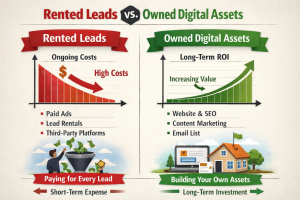
The economics of rented leads have shifted dramatically over the past few years. What used to be a decent supplement to word-of-mouth has become a money pit for most businesses.
Here’s what we see when appliance repair owners come to us frustrated with lead platforms:
Lead costs keep climbing. What started at $20 per lead is now $50, $75, or more. Platforms raise prices because they can. You either pay or lose access.
Lead quality keeps dropping. Homeowners submit the same request to multiple platforms. By the time you call, they’ve already booked someone else or they’re just price shopping with no intent to hire.
You’re competing on price alone. When three companies call the same homeowner within five minutes, the conversation becomes about who’s cheapest. That’s not a business model. That’s a race to the bottom.
You have no control. The platform decides when you get leads, what you pay, and who else gets the same contact. If they change their algorithm or pricing, your phone stops ringing and there’s nothing you can do about it.
Tracking is a nightmare. Most platforms don’t integrate cleanly with your scheduling software or CRM. You can’t measure true ROI because you don’t know which leads actually turned into revenue.
One owner we work with was spending $4,000 a month on a lead platform and converting maybe 15% of what came through. When we calculated his actual cost per booked job, it was over $250. He was profitable on the work itself, but barely, and he had no idea, month to month, how many calls he’d get.
That’s not a marketing strategy. That’s a dependency.
The Real Cost of Rented Leads
Let’s run the numbers on what rented leads actually cost an appliance repair business.
Say you’re paying $60 per lead from a shared platform. Industry averages show you’ll close somewhere between 10% and 20% of those leads if you’re good at follow-up.
At a 15% close rate, you need to buy roughly 7 leads to book one job.
That’s $420 in lead costs per booked appointment.
If your average appliance repair ticket is $250 to $400, you’re either losing money or making almost nothing after you factor in labor, parts, and overhead.
Now add in the time your team spends chasing bad leads, calling back homeowners who already hired someone, and dealing with price shoppers who were never going to book.
The math doesn’t work unless you’re charging premium rates and closing at a much higher percentage than most companies manage with shared leads.
Compare that to owned assets.
A homeowner searches “refrigerator not cooling” and finds your website. They read your service page. They see your Google reviews. They call you directly.
No competition. No shared contact. No bidding war.
That’s the lead cost of your monthly SEO and website investment, spread across however many calls you get. As your rankings improve, your cost per lead drops. And you own the asset that’s generating the traffic.
What Owned Assets Actually Look Like for Appliance Repair
When we talk about owned assets, we’re talking about the digital properties you control that bring customers to you.
Here’s what that system includes:
Your website with service page clusters. This means dedicated pages for each major appliance type and common repair problems. Not one generic “appliance repair” page. Individual pages for refrigerator repair, dishwasher repair, washer and dryer repair, oven repair, and ideally pages targeting specific issues like “refrigerator not cooling” or “dishwasher not draining.”
Each page should explain the problem, what causes it, and how you fix it. This builds trust and ranks for the exact searches homeowners use when they need help.
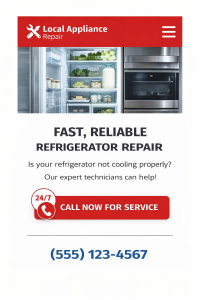
Google Business Profile optimized for local search. Your GBP is the most valuable piece of real estate you have for local visibility. When someone searches “appliance repair near me” or “refrigerator repair in [city],” Google shows a map pack with three businesses.
If your profile is optimized with the right categories, complete information, regular posts, and a steady flow of reviews, you show up. If it’s not, you’re invisible.
High-intent content that answers real questions. Blog posts and guides that target the questions homeowners ask before they call. Things like “How much does it cost to fix a refrigerator?” or “Is it worth repairing a 10-year-old dishwasher?”
This content builds trust, demonstrates expertise, and captures search traffic from people actively looking for help.
A system for collecting and responding to reviews. Reviews are the number one trust signal for local service businesses. A steady flow of recent, positive reviews on your Google Business Profile makes you the obvious choice when homeowners compare options.
Tracking and attribution that shows what’s working. You need to know which calls came from organic search, which came from Google Ads, and which came from direct traffic or referrals. Without that data, you’re flying blind.
These assets work together to create a system that brings in calls consistently without paying per lead.
How the Anti-Lead Gen System Works in Practice
Let’s walk through what this looks like for a typical appliance repair company.
A homeowner’s dishwasher stops draining. They pull out their phone and search “dishwasher not draining.”
Your service page for dishwasher repair ranks on page one because you’ve optimized it for that exact problem. The page explains common causes, what to check, and when to call a professional.
The homeowner reads it, sees that you know what you’re talking about, and clicks over to your Google Business Profile. You have 50+ five-star reviews, recent photos of your team and your work, and a clear service area map.
They call the number on your profile. Your team answers, books the appointment, and the job is done the next day.
Total lead cost: your monthly SEO investment divided by the number of calls you got that month. If you’re getting 40 calls and you’re spending $2,000 on SEO, that’s $50 per lead. But unlike a rented lead, this one wasn’t shared with anyone. The homeowner called you because they found you, trusted you, and wanted to work with you.
As your rankings improve and your review count grows, you get more calls from the same investment. Your cost per lead drops. Your close rate goes up because the leads are higher quality.
That’s the system.
Why This Works Better for Appliance Repair Specifically
Appliance repair has a few characteristics that make owned assets especially effective.
High search volume for specific problems. Homeowners don’t search “appliance repair.” They search “refrigerator leaking water” or “oven won’t heat” or “washer making loud noise.” Those are high-intent searches with clear commercial value. If you rank for them, you get calls.
Local service area. You’re competing locally, not nationally. That means you don’t need to outrank giant corporate sites. You need to outrank the other appliance repair companies in your city. That’s doable with focused local SEO and a well-optimized Google Business Profile.
Trust matters more than price. Homeowners want someone reliable who can fix the problem quickly. Yes, price matters, but if your website and reviews make you look like the expert, you’ll win the call even if you’re not the cheapest.
Repeat business and referrals. When you own the customer relationship from the start, you can build loyalty. That homeowner who called you for a dishwasher repair will call you again when their refrigerator breaks. And they’ll refer you to neighbors. Rented leads don’t provide long-term value.
The Transition: Moving from Rented to Owned
You don’t have to flip a switch and go all-in on owned assets overnight. Most appliance repair companies we work with transition gradually.
Here’s the typical path:
Month 1-2: Audit and foundation. Figure out where you’re actually getting calls from today. Clean up your Google Business Profile. Make sure your website has basic service pages for each appliance type.
Month 3-4: Content and optimization. Start building out service page clusters. Add content targeting high-intent searches. Set up a review generation system.
Month 5-6: Reduce reliance on rented leads. As organic traffic grows, scale back spending on lead platforms. Redirect that budget into SEO, content, and Google Ads that drive traffic to your owned pages.
Month 7+: Owned assets become your primary source. You’re getting consistent calls from search, your cost per lead is lower, and your close rate is higher because the leads aren’t shared.
The goal isn’t to eliminate all paid advertising. It’s to stop renting access to leads you don’t control and start investing in assets that build long-term value for your business.
What About Google Ads?
Google Ads absolutely has a place in the Anti-Lead Gen system. The difference is how you use it.
Instead of paying a platform to send you shared leads, you run search ads that drive traffic to your owned landing pages. You control the message, the experience, and the data.
When done right, Google Ads for appliance repair can be extremely effective. You’re targeting high-intent searches like “emergency refrigerator repair” or “same day dishwasher repair.” The homeowner clicks your ad, lands on your service page, and calls you directly.
You’re still paying for traffic, but you own the relationship. You can track exactly what you spent and what you made. And you can optimize over time to improve ROI.
The key is to run search-only campaigns focused on the exact services you offer in the exact cities you serve. No display. No broad match. No wasted spend.
Common Objections We Hear
“SEO takes too long. I need calls now.”
Fair. If you’re starting from zero, it can take a few months to see meaningful traffic from organic search. That’s why most businesses run a hybrid approach. Use Google Ads or even some rented leads to keep the phone ringing while you build out your owned assets. But start building now, because six months from now you’ll wish you had.
“I don’t have time to create content or manage a website.”
You don’t have to do it yourself. That’s what agencies like ours exist for. The point is to invest in assets you own, not to add another full-time job to your plate.
“Rented leads are easy. I just pay and the phone rings.”
Until they stop ringing. Or the price doubles. Or the quality tanks. Rented leads feel easy because someone else is doing the work, but you’re also giving up all control. The Anti-Lead Gen system requires more upfront effort, but it pays off in predictability and profitability.
What You Need to Make This Work
You don’t need a huge budget or a massive team. You need focus and consistency.
Here’s what it takes:
A functional website. It doesn’t have to be fancy, but it needs to load fast, work on mobile, and have clear service pages for each appliance type.
An optimized Google Business Profile. Complete information, accurate categories, regular posts, and a system for getting reviews.
A process for tracking calls. Call tracking software that shows you which calls came from which source. Without this, you can’t measure ROI or make smart decisions.
Consistency. SEO and content marketing aren’t one-time projects. You need to keep adding content, building links, and collecting reviews over time.
Patience. Owned assets build value over time. You won’t see results overnight, but the results compound. Six months in, you’ll have more traffic than you did at three months. A year in, you’ll have more than you did at six months.
Why Appliance Repair Owners Are Making the Switch
The appliance repair owners who come to us frustrated with rented leads all say some version of the same thing:
“I’m tired of paying more and more for worse and worse leads. I want to control my own pipeline.”
They’re not wrong. The lead gen platforms optimized for their own profit, not yours. They’ll keep raising prices and degrading quality as long as businesses keep paying.
The Anti-Lead Gen system flips that model. You invest in assets you own. You control the message. You own the customer relationship from the first search to the booked job to the follow-up.
It’s not easier on day one. But it’s more profitable, more predictable, and more sustainable over the long run.
Ready to Build Your Own Lead Generation System?
If you’re tired of renting leads and ready to own your marketing, we can help.
At Appliance Marketing Pros, we specialize in building lead generation systems for appliance repair companies. We handle the SEO, the content, the Google Business Profile optimization, and the tracking so you can focus on running jobs and growing your business.
We’ve been doing this for over 20 years, and we only work with appliance repair, HVAC, and home service companies. We know what works because we’ve done it hundreds of times.
If you want to see what a custom plan would look like for your business, book a free strategy call. We’ll review your current marketing, show you where the opportunities are, and map out a clear path to predictable call volume without renting leads.
No pressure. No generic advice. Just a real conversation about what’s working in appliance repair marketing right now and how to apply it to your business.
Let’s AMP up your growth.
About The Author


