

Table of Contents
Why Your Google Ads CPL Is Too High (And What Appliance Repair Owners Should Actually Pay in 2026)
You’re paying $80, $100, maybe even $150 per lead from Google Ads, and you’re starting to wonder if something’s broken.
It is.
But not in the way most marketing agencies will tell you. They’ll blame your budget, your service area, or tell you “that’s just what it costs.” That’s lazy thinking, and it’s costing you money every single day.
The truth is that most appliance repair businesses are overpaying for leads because their campaigns are set up wrong from the start. Not slightly wrong. Fundamentally wrong. And because no one’s showing them what normal actually looks like, they keep writing checks and hoping things improve.
This guide breaks down what you should actually be paying per lead in 2026, why your costs are probably inflated, and the exact fixes that bring CPL back to earth for appliance repair companies we work with every week.
What Is Google Ads CPL, and Why Does It Matter More Than Clicks?
Cost per lead (CPL) is the amount you pay for each person who contacts your business. That could be a phone call, a form submission, or a chat message.
It’s calculated by dividing your total ad spend by the number of leads you received.
If you spent $1,500 on Google Ads last month and got 30 leads, your CPL is $50.
CPL matters more than cost per click (CPC) because clicks don’t pay your bills. Leads do. You can have a $3 CPC and still lose money if those clicks never turn into calls. You can have a $12 CPC and print money if every third click becomes a booked job.
Most appliance repair owners get stuck obsessing over how much they’re paying per click, when the real problem is how many of those clicks actually turn into opportunities.
What Appliance Repair Businesses Should Pay Per Lead in 2026
Here’s what we see across appliance repair campaigns we manage in competitive and mid-tier markets:
General appliance repair (mixed services): $25 to $55 per lead
Refrigerator repair: $20 to $45 per lead
Washer and dryer repair: $18 to $40 per lead
Dishwasher repair: $20 to $45 per lead
Oven and range repair: $22 to $48 per lead
Emergency or same-day service: $30 to $65 per lead
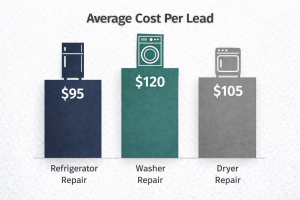
These ranges assume you’re running search-only Google Ads campaigns with proper tracking, a mobile-optimized landing page, and a phone number that actually rings.
If you’re consistently paying more than $70 per lead, something is wrong. If you’re over $100, you’re either in an insanely competitive metro or your campaign has structural problems that need immediate attention.
Why Your CPL Is Probably Higher Than It Should Be
Most appliance repair Google Ads accounts we audit have the same handful of problems. These aren’t small tweaks. They’re the difference between $35 per lead and $90 per lead.
You’re Running Display or Search Partners
Google Ads defaults to showing your ads on partner sites and random display placements unless you turn them off. These placements generate clicks that appear to be traffic but almost never convert into real leads.
We’ve seen accounts where 40% of the budget went to search partners, with zero phone calls to show for it.
Turn off search partners. Turn off the display network. Search-only. Always.
Your Keywords Are Too Broad
If you’re bidding on “appliance repair” as a broad match keyword, you’re paying for clicks from people searching for appliance repair jobs, appliance parts, DIY tutorials, and commercial equipment service.
None of those people is calling you.
Tighten your keywords to exact match and phrase match only. Focus on high-intent terms like “refrigerator repair near me” or “fix broken dishwasher.” Add negative keywords for “jobs,” “parts,” “DIY,” “salary,” “commercial,” and anything else that doesn’t signal someone ready to hire a technician.
Your Landing Page Isn’t Built for Conversions
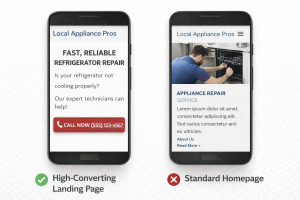
If your Google Ads are sending people to your homepage, you’re bleeding leads.
Homepages are designed to do everything. Landing pages are designed to do one thing: get the phone to ring.
A proper appliance repair landing page has:
A headline that matches the ad (if the ad says “refrigerator repair,” the page should say “refrigerator repair”)
Your phone number at the top, in large text, is clickable on mobile
A short explanation of what you do and why you’re trustworthy
Customer reviews or testimonials
A clear service area
One call to action repeated multiple times: call now
No distractions, no blog links, no “about us” rabbit holes
When someone clicks your ad, they should land on a page that makes calling you the easiest and most obvious next step.
You’re Not Tracking Phone Calls

This is the biggest one.
If you’re not using call tracking, you have no idea how many leads you’re actually getting. You’re guessing. And Google’s conversion tracking doesn’t count phone calls unless you set it up correctly.
Most appliance repair leads come from phone calls, not forms. If Google thinks your campaign isn’t generating conversions, it can’t optimize for the actions that matter. Your CPL stays high because the algorithm doesn’t know what’s working.
Set up call tracking with a service like CallRail or CallTrackingMetrics. Forward a unique tracking number to your business line. Connect it to Google Ads so the platform can see which keywords and ads are driving calls.
Once Google knows what’s working, it will send you more of it. Your CPL drops.
Your Ad Copy Doesn’t Match Search Intent
If someone searches “emergency refrigerator repair,” they want fast service. If your ad talks about “trusted appliance solutions” and “family-owned since 1987,” you’ve lost them.
Your ad should immediately confirm that you do what they need, that you’re available, and that calling you is the right move.
Good ad copy for appliance repair is specific, urgent, and action-oriented:
“Same-Day Refrigerator Repair. Licensed Techs. Call Now.”
“Dishwasher Not Draining? We Fix It Today. Call for Fast Service.”
“Washer Repair Near You. Honest Pricing. Book Your Appointment.”
Match the urgency and specificity of the search. Don’t waste characters on vague branding.
Your Geographic Targeting Is Too Wide
If you’re targeting a 30-mile radius and you only service a 15-mile area, you’re paying for leads you can’t even take.
Or worse, you’re targeting the whole metro area when you really only want the suburbs. Urban clicks cost more and convert worse if your business is built for residential service in quieter neighborhoods.
Tighten your radius. Exclude zip codes where you don’t want to work. Be ruthless about this. Every wasted click costs you money and inflates your CPL.
You’re Bidding on the Wrong Times
Are you running ads at 2 a.m. when no one’s answering your phone? Are you showing ads on Sundays when you’re closed?
If your ads are live but your business isn’t available, you’re paying for clicks that can’t convert.
Set up ad scheduling to match your actual availability. If you offer emergency service 24/7, that’s different. But if you’re a standard Monday-through-Friday operation, turn off nights and weekends.
You’ll cut wasted spend and lower your CPL immediately.
What Actually Lowers CPL for Appliance Repair Companies
Fixing the problems above will drop your cost per lead. But if you want to push it even lower, here’s what moves the needle.
Improve Your Google Business Profile
Your Google Business Profile (the listing that appears in Maps and local search) directly affects your ad performance.
If your profile has 50+ reviews with a 4.8-star average, people are more likely to click your ad and call. If you have 6 reviews and a 3.9 average, they’ll skip you.
Google also uses your profile quality as a signal in its ad auction. Better profiles can mean lower CPCs and better ad positions.
Keep your profile updated. Respond to reviews. Add photos. Post updates. Treat it like the storefront it is.
Raise Your Prices (Seriously)
If your average repair job is $150 and your CPL is $60, you’re spending 40% of revenue on advertising. That’s not sustainable.
If your average job is $350 and your CPL is $60, you’re spending 17% of your budget on CPL. That’s manageable.
The fix isn’t always cheaper leads. Sometimes it’s charging what you’re worth so you can afford to compete for the leads that matter.
Appliance repair is skilled work. Price accordingly.
Use Negative Keywords Aggressively
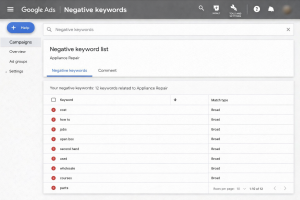
Every appliance repair campaign should have at least 50 negative keywords. Probably more.
Start with the obvious ones:
Jobs
Careers
Hiring
Parts
Manual
DIY
YouTube
How to
Wholesale
Commercial
Then add negatives based on your search term reports. If you’re seeing clicks for “Maytag parts near me” or “appliance repair training,” add those as negatives immediately.
The cleaner your traffic, the lower your CPL.
Optimize for Mobile
Over 70% of appliance repair searches happen on mobile. If your landing page takes 6 seconds to load or your phone number isn’t clickable, you’re losing leads.
Test your page on your phone. Better yet, have someone else test it. If anything feels slow or confusing, fix it.
Speed matters. Clarity matters. Make calling you brain-dead simple.
Stop Running Campaigns You Can’t Measure
If you don’t have conversion tracking set up, pause your campaigns until you do.
Running ads without tracking is like driving blindfolded. You might get somewhere, but you’ll crash a lot along the way.
Set up call tracking. Set up form tracking. Make sure Google Ads knows when someone converts. Then let the algorithm do its job.
When a High CPL Might Actually Be Fine
Not every high CPL is a problem.
If you’re paying $75 per lead but your average job value is $450 and you close 60% of your leads, you’re making $270 per job after ad costs. That’s solid.
If you’re paying $35 per lead but your average job is $180 and you close 30%, you’re barely breaking even.
CPL matters, but it’s not the only number.
What really matters is cost per acquisition (CPA), which is how much you pay to get a customer who actually books and pays for a job.
To calculate CPA, divide your total ad spend by the number of jobs you booked.
If you spent $2,000 and booked 15 jobs, your CPA is $133.
If your average job value is $350 and your profit margin is 50%, you’re making $175 per job. Subtract the $133 ad cost and you’re netting $42 per job from ads.
That’s not amazing, but it’s profitable. And if those customers call you again or refer others, the lifetime value goes way up.
So yes, push your CPL down. But don’t obsess over it if your overall economics are working.
How to Know If Your Google Ads Are Actually Broken
Here’s the checklist:
Your CPL is over $70 and not dropping
You’re spending $1,000+ per month but getting fewer than 15 leads
Your phone isn’t ringing even though Google says you’re getting clicks
You can’t tell which keywords are driving calls
Your landing page is your homepage
You’re running display or search partner ads
You have fewer than 20 negative keywords
You don’t have call tracking set up
If more than three of those are true, your campaign has structural problems. It’s not a budget issue. It’s not a market issue. It’s a setup issue.
And the longer you let it run like that, the more money you’re lighting on fire.
What Appliance Repair Owners Should Do Next
If your CPL is too high, here’s the order of operations:
Turn off Search Partners and the Display Network. This takes 30 seconds and can cut wasted spend by 20% to 40%.
Set up call tracking. If you’re not tracking phone calls, you’re flying blind.
Tighten your keyword targeting. Move to exact and phrase match. Add negatives.
Build or fix your landing page. One page, one goal: get the phone to ring.
Check your ad scheduling. Turn off hours when you’re not available.
Review your service area targeting. Stop paying for clicks outside your zone.
If you don’t have time to do this yourself or you’ve tried and it’s still not working, that’s what we do. Appliance Marketing Pros builds and manages Google Ads campaigns specifically for appliance repair companies. We’ve run enough of these to know what works, what doesn’t, and how to get your CPL where it should be without guessing.
We don’t do display ads. We don’t run campaigns for every industry under the sun. We do search-only Google Ads for appliance repair businesses, and we do it better than generalist agencies because we’ve seen the same problems and fixes a hundred times.
If you’re tired of overpaying for leads or wondering why your ads aren’t working, book a strategy call. We’ll look at your account, tell you what’s broken, and show you exactly what it would take to fix it.
No fluff. No long contracts. Just honest feedback and a clear plan to get your cost per lead back to normal.
About The Author


