

Table of Contents
The Hidden Cost of Missing Call Answering Service for Appliance Repair Businesses
Why Your Missed Calls Are Costing You More Than You Think
You just missed another call.
It’s 7:30 PM on a Tuesday. Someone’s fridge is leaking all over their kitchen floor. They need help now, and they found your business on Google. They called once. You didn’t answer because you were wrapping up a job across town.
They called someone else. That business got the $380 repair. You got nothing.
This happens more than you think. And it’s bleeding your business dry.
Most appliance repair business owners don’t realize how much revenue walks out the door when phones go unanswered. The problem isn’t just one missed call. It’s the pattern. The volume. The cumulative loss of opportunities that could have turned into paying customers.
In this guide, you’ll learn exactly what call answering services do, how much money you’re losing without one, what to look for when evaluating options, and how to decide if it makes sense for your business. We’ll break down real numbers, common mistakes, and the specific ways appliance repair companies use answering services to capture more calls and grow faster.
If you’re tired of wondering how many jobs you missed today, keep reading.
What Is a Call Answering Service?
A call answering service is a team of trained professionals who answer your business phone when you can’t. They pick up calls on your behalf, gather customer information, and either schedule appointments, take messages, or route urgent calls directly to you or your technicians.
Think of it like having a receptionist who works 24/7, but you don’t pay for health insurance, vacation time, or office space.
For appliance repair businesses, this typically means someone answers when you’re:
- On a job and can’t pick up
- Driving between appointments
- Finishing paperwork at the end of the day
- Closed for the evening or weekend
- On vacation or out sick
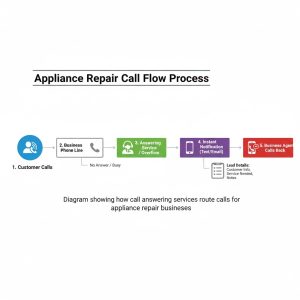
The service integrates with your phone system. When a customer calls your main business number, the call either goes to you first (if you’re available) or automatically routes to the answering service if you don’t pick up within a set number of rings.
Good answering services don’t just take a name and number. They ask the right questions. What appliance is broken? What’s the problem? Is it urgent? What’s your address and availability? They capture the details you need to decide whether to dispatch a tech immediately or schedule for later.
Some services specialize in home services, such as appliance repair and HVAC. They understand the difference between a broken ice maker and a refrigerator that stopped cooling. That context matters when you’re deciding which calls need same-day service and which can wait until tomorrow.
How Much Revenue Are You Losing Right Now?
Let’s do the math.
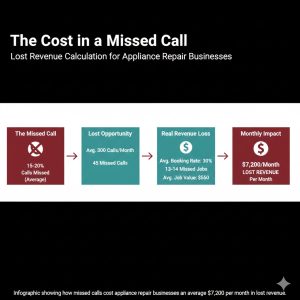
The average appliance repair business misses about 30% of inbound calls. Some miss more. If your phone rings 40 times a week and you’re personally answering or returning calls, you’re probably missing 12 of them.
Here’s what that looks like over a month:
- 12 missed calls per week = 48 missed calls per month
- Average close rate for appliance repair = 50% to 60%
- Average job value = $250 to $400
Let’s be conservative. Say you convert half of those missed calls. That’s 24 jobs per month. At $300 per job, you just lost $7,200 in revenue. Over a year, that’s $86,400.
If you’re a solo operator doing about $200,000 a year, you could be leaving $86,000 on the table. If you’re running a multi-truck operation, the loss is even bigger.
And that’s just from missed calls. It doesn’t include:
- Customers who called once, got voicemail, and moved on
- Calls that came in after hours, when people are most stressed about a broken appliance
- Emergency situations where homeowners called three competitors at the same time and hired whoever answered first
Appliance problems are urgent. Refrigerators spoil food. Washers flood basements. Dryers are fire hazards when they don’t work right. Homeowners don’t wait around. They call the next company on the list.
Most business owners don’t realize the scale of this problem until they start tracking it. When you review the actual call logs and count how many times your phone rang while you were unreachable, the number is usually higher than you expected.
When Missing Calls Costs You the Most
Not all missed calls are equal. Some cost you more than others.
After-Hours Calls
The highest-value calls often come between 5 PM and 9 PM, and on weekends. This is when appliances break down and people realize they have a problem. A fridge that’s been slowly warming all day becomes obvious when someone opens it after dinner. A washer that won’t drain becomes urgent when someone needs clean clothes for work tomorrow.
After-hours calls convert at a higher rate because the urgency is real. These customers are ready to pay. They’re not shopping around. They need help now.
If you’re not answering after hours, you’re losing the most profitable segment of your call volume.
Emergency Calls
Emergency service commands premium pricing. A same-day or next-morning dispatch for a critical appliance issue can bring in $400 to $800 depending on your market and the job.
When a potential customer calls with an emergency and you don’t answer, they don’t leave a voicemail and wait. They call the next company. Whoever picks up first wins the job.
Emergency calls also build long-term customer relationships. When you solve a stressful problem quickly, people remember you. They call you again. They leave good reviews. They refer you to neighbors.
First-Time Callers
Repeat customers are valuable, but first-time callers are how you grow. These are people who found you on Google, saw your truck in the neighborhood, or got a referral from a friend.
If their first interaction with your business is a voicemail, you’ve already lost credibility. They’re comparing you to other companies. If someone else answers live and sounds professional, that’s who they’ll book with.
First impressions matter. Missing the first call from a new customer often means you never get a second chance.
Calls During Peak Seasons
If you’re in appliance repair, you know call volume spikes during certain times of the year. Summer means more AC service calls if you also do HVAC. Holiday seasons mean more ovens and dishwashers breaking before big family dinners.
During peak seasons, you’re already stretched thin. You’re running from job to job. You don’t have time to answer the phone. But that’s also when the most money is flowing into your market. If you’re not capturing those calls, someone else is.
What Appliance Repair Owners Get Wrong About Answering Services
Most business owners who haven’t used an answering service have the wrong mental model. They think it’s just a message-taking service, like a fancy voicemail. That’s not what modern answering services do, especially the ones built for home service companies.
Myth 1: “I can just call people back.”
You can. But most won’t wait. According to industry data tracked by home service software companies, callbacks have a dramatically lower conversion rate than live answers. People move on fast.
When someone calls an appliance repair company, they’re usually calling three or four businesses at once. Whoever picks up first and sounds competent gets the job. If you call back 20 minutes later, they’ve already booked someone else.
Myth 2: “It’s too expensive.”
Answering services typically cost between $150 and $600 per month depending on call volume and features. Let’s say you pay $400 per month. If that service captures even two extra jobs per month at $300 each, you’re already profitable. Most services capture far more than two jobs.
Compare that to the $7,200+ per month you’re losing from missed calls. The ROI is obvious.
Myth 3: “They won’t understand my business.”
Generic answering services won’t. But home service and appliance repair specialists already know your world. They understand the difference between a service call and an emergency. They know how to ask the right questions to triage the situation. They can tell the difference between a DIY question and a paying customer.
The best services train their agents on your specific business. They learn your pricing, service area, hours, and dispatch preferences. After a week or two, they sound like they work for you.
Myth 4: “I’ll lose control of my customer experience.”
This is a valid concern, but it’s manageable. You control the script. You decide which questions the service asks, what information it collects, and how it represents your business. You review call recordings. You adjust as you go.
Good answering services improve your customer experience. They answer fast. They’re polite. They don’t sound rushed or distracted. Compare that to a business owner trying to answer the phone while kneeling behind a washer with a wrench in one hand. The answering service usually sounds more professional.
Myth 5: “I can just use voicemail.”
Voicemail is where calls go to die. Most people don’t leave detailed messages. They say, “Call me back,” and hang up. You call back and play phone tag. By the time you connect, they’ve moved on.
Voicemail also signals that you’re too small, too disorganized, or too busy to handle their problem. It’s a trust issue. Customers want to talk to a human. If your competitor offers that and you don’t, you lose.
What to Look for in a Call Answering Service
Not all answering services are the same. Some are built for law firms and medical offices. Some are offshore call centers with agents reading generic scripts. Some specialize in home services and appliance repair.
Here’s what actually matters when you’re evaluating services.
Live Human Agents, Not Bots
AI chatbots and automated systems have a place, but not for answering your main business line. Appliance emergencies are stressful. Homeowners want to talk to a real person who understands the problem and can help immediately.
Look for services that use trained human agents who answer every call live.
24/7 Availability
If you’re only covering business hours, you’re not solving the problem. The most valuable calls come after hours. Make sure the service operates around the clock, including weekends and holidays.
Home Services Experience
A service that understands appliance repair, HVAC, and plumbing will outperform a generic service. They know the terminology. They ask better questions. They sound credible to your customers.
Ask how many home service companies they work with. If they can’t give you a clear answer, keep looking.
Bilingual Agents
Depending on your market, having Spanish-speaking agents can open up a significant portion of your local customer base. Even if you don’t speak Spanish yourself, the answering service can take the call, gather information, and pass it to you with translation notes.
Customizable Scripts and Intake Forms
The service should let you define exactly what questions they ask and how they qualify leads. You need to know:
- What appliance is broken
- What symptoms is the customer experiencing
- When it stopped working
- Customer’s address and contact info
- Urgency level (same-day emergency vs next available appointment)
- Whether they own or rent (sometimes relevant for who pays)
A good service will work with you to build a script that matches your business.
CRM and Dispatch Integration
If you use field service software like Housecall Pro, ServiceTitan, or Jobber, the answering service should integrate directly with it. When they take a call, it should automatically create a lead or appointment in your system.
This eliminates double entry and ensures nothing falls through the cracks.
Call Recording and Quality Monitoring
You should be able to listen to any call. This lets you quality-check the service, train your own team based on what customers are asking, and resolve any disputes about what was said.
Transparent Pricing
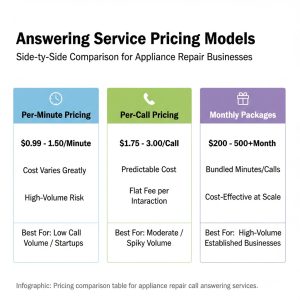
Pricing models vary. Some charge per minute. Some charge per call. Some offer flat monthly rates with included call volume.
Make sure you understand:
- What’s included in the base price
- What triggers overage charges
- Whether there are setup fees or cancellation penalties
- How billing works if call volume fluctuates
Avoid services with hidden fees or contracts that lock you in for a year.
Fast Answer Times
Customers expect the phone to be answered within 3 to 4 rings. Ask the service what their average answer time is. If they can’t give you a number, that’s a red flag.
Message Delivery Options
When the service takes a call, how do they get the information to you? Options usually include:
- Text message with lead details
- Direct dispatch into your field service software
- App notification
- Phone call to you or your on-call tech
Pick the method that fits your workflow. Many businesses use a combination (text for urgent calls, email for routine inquiries).
How Call Answering Services Work with Appliance Repair Businesses
Let’s walk through what this looks like in practice.
Setup and Onboarding
You sign up with the service and go through onboarding. This typically includes:
- Configuring your phone system to forward calls to the service (either all the time or when you don’t answer)
- Building your custom script and intake form
- Training the service on your business (service area, pricing, common jobs, technician availability)
- Integrating with your CRM or dispatch software if applicable
- Testing a few calls to make sure everything works
Most services can get you up and running within a few days.
Daily Operations
Once live, here’s how it works:
Scenario 1: You’re on a job and can’t answer.
A customer calls your main business line. The call rings your phone first. You’re under a counter replacing a dishwasher pump and can’t pick up. After 3 rings, the call automatically forwards to the answering service.
An agent answers: “Thank you for calling [Your Business Name], this is Sarah. How can I help you today?”
The customer explains their washing machine stopped mid-cycle and won’t drain. The agent asks a few questions (front-load or top-load, how old, any error codes, address, availability). The agent tells the customer that a technician will call them back within 30 minutes to schedule a visit.
You get a text message with all the details. You finish your current job, call the customer, confirm the appointment, and add it to your schedule. You just captured a $300 repair that would have gone to a competitor.
Scenario 2: After-hours emergency call.
It’s 8 PM on a Saturday. A customer’s refrigerator is warm and making a loud noise. They call your number. The answering service picks up.
The agent gathers the details and determines it’s urgent. Based on your instructions, they either:
- Send you an immediate text or call your emergency line, or
- Schedule a first-thing-tomorrow appointment and notify you by email
You decide how to handle after-hours emergencies. The service follows your rules.
Scenario 3: Routine inquiry.
Someone calls to ask whether you service a specific appliance brand or whether you’re available next Tuesday. The agent has your FAQ information and can answer basic questions without bothering you. They book the appointment directly into your calendar and send you a confirmation.
Ongoing Management
Most services provide a dashboard where you can:
- See all calls taken
- Listen to recordings
- Review lead details
- Track conversion rates (how many calls turned into booked jobs)
- Adjust your script or instructions
You typically check in weekly to review performance and make small tweaks as needed.
Pricing Models and What You’ll Actually Pay
Call answering services use a few common pricing structures.
Per-Minute Pricing
You pay for every minute the agent spends on the phone. Rates typically range from $1.00 to $1.75 per minute.
Average call length for appliance repair intake is 3 to 5 minutes. So each call costs $3 to $8.
This model works well if your call volume is low or unpredictable. You only pay for what you use. But it can get expensive if you’re getting 50+ calls a week.
Per-Call Pricing
You pay a flat rate per call answered, regardless of length. Rates range from $3 to $6 per call.
This is easier to budget and makes sense for businesses with consistent call volume.
Monthly Packages
Many services offer packages with a set number of included calls per month, plus overage rates if you exceed the limit.
Common packages:
- Small business: $200/month for up to 50 calls
- Growing business: $400/month for up to 150 calls
- High volume: $700/month for up to 350 calls
These packages usually include CRM integration, bilingual agents, and 24/7 coverage.
What You’ll Actually Spend
For a typical appliance repair business with 2 to 4 technicians:
- Call volume: 80 to 120 calls per month
- Expected cost: $350 to $500 per month
- Captured revenue from previously missed calls: $4,000 to $8,000 per month
- Net gain: $3,500 to $7,500 per month
Even if you’re conservative with your estimates, the ROI is usually 5x to 10x the cost of the service.
Hidden Costs to Watch For
Some services charge extra for:
- Setup or onboarding fees ($100 to $300 one-time)
- CRM integrations ($20 to $50/month)
- Call recording storage
- After-hours or holiday coverage
- Bilingual support
Read the pricing details carefully. The best services are transparent and include everything in the base price.
Alternatives to Full-Service Call Answering
Call answering services aren’t the only option. Depending on your business size and budget, you might consider:
Hiring a Part-Time or Full-Time Receptionist
This gives you complete control. The person works directly for you, learns your business deeply, and handles other admin tasks when the phone isn’t ringing.
Pros:
- Total control over training and quality
- Can handle other tasks (invoicing, scheduling, follow-ups)
- Becomes part of your team culture
Cons:
- Expensive ($15 to $25/hour, plus benefits, taxes, and overhead)
- You need enough call volume and admin work to justify full-time
- They can’t work 24/7 unless you hire multiple people
- If they’re sick or on vacation, you’re back to square one
For most small to mid-size appliance repair businesses, this option costs $30,000 to $50,000 per year or more. It makes sense once you’re doing $750,000+ in revenue and need dedicated admin support beyond just answering phones.
Virtual Receptionist Services
Similar to answering services but often more sophisticated. These services act like an extension of your team. They answer as if they work in your office, handle scheduling, manage your calendar, and sometimes even do follow-up calls.
Pricing is higher, typically $800 to $1,500 per month, but the service level is more hands-on.
This works well for larger operations with complex scheduling needs.
Voicemail with Fast Response Time
If the budget is extremely tight, you can optimize your voicemail system and commit to returning every call within 15 minutes during business hours.
Pros:
- Costs almost nothing
- You still have control
Cons:
- You’ll lose most after-hours calls
- Conversion rates are much lower than live answer
- Doesn’t solve the problem when you’re on a job
This is better than nothing, but it’s not a growth strategy.
AI Phone Assistants
A new category of AI-powered phone systems can answer calls, understand natural language, and book appointments. These are improving fast.
As of 2026, the technology is good but not great. It works for simple scheduling but struggles with complex questions or emotional customers who need reassurance.
Watch this space. In two to three years, AI phone assistants might be a legitimate alternative to human answering services.
How to Calculate Your ROI Before You Buy
Before signing up with an answering service, run the numbers for your specific business.
Step 1: Estimate Your Current Missed Calls
Look at your phone system logs or Google Business Profile insights. How many calls are you receiving per week? If you don’t know, estimate based on your lead volume.
Then estimate how many you’re missing. If you’re a solo operator or a small team, assume 20% to 35% of your requests go unanswered.
Step 2: Calculate Potential Revenue from Captured Calls
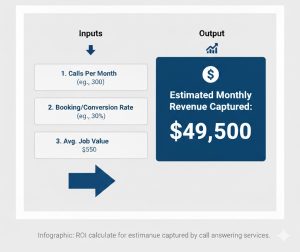
Multiply missed calls by your close rate (usually 50% to 60% for appliance repair) and your average job value.
Example:
- 100 calls per month
- 30 missed (30%)
- 15 would convert (50% close rate)
- $300 average job
- Potential monthly revenue: $4,500
Step 3: Subtract the Cost of the Service
If the answering service costs $400/month, your net gain is $4,100/month, or $49,200/year.
Step 4: Factor in Time Savings
You’ll also save time. No more stopping mid-job to answer the phone. No more playing phone tag with customers. No more checking voicemail constantly.
If this saves you even 5 hours a week, that’s 20 hours a month. What’s your time worth? If you value it at $75/hour (a conservative estimate for a business owner), that’s another $1,500/month in recovered productivity.
Step 5: Decide
If the ROI is 3x or better, it’s a no-brainer. If it’s close, test it for 90 days and track actual results.
Most appliance repair businesses see 5x to 10x ROI within the first three months.
Red Flags: When an Answering Service Isn’t the Right Move Yet
Answering services solve a specific problem: too many inbound calls and not enough capacity to answer them all. But they’re not the right solution for every business at every stage.
You’re Not Getting Enough Calls Yet
If your phone rings fewer than 20 times per month, you don’t need an answering service. You need better marketing. Spend that $400/month on Google Ads or local SEO instead.
Fix the demand problem first. Then, when calls start coming in consistently, add the answering service.
Your Conversion Rate Is Terrible
If you’re already answering most of your calls but only converting 20% to 30% of them into jobs, you have a sales problem, not a missed call problem.
Work on your phone skills. Train your team. Improve your pricing and availability. Get your conversion rate to 50% or higher. Then layer in an answering service to capture the calls you’re missing.
You Don’t Have Operations Dialed In
If you’re constantly running late, double-booking jobs, or struggling to deliver good service, adding more calls will make things worse, not better.
An answering service will send you more leads. If you can’t handle the ones you already have, you’ll damage your reputation and waste money.
Get your scheduling, dispatch, and service quality tight first. Then scale up call volume.
You’re Not Ready to Respond Quickly
Answering services work best when you can respond to leads within 30 minutes to an hour. If you’re going to take six hours to call someone back, the answering service isn’t adding much value.
Before you sign up, commit to fast response times. Set up alerts on your phone. Block time in your schedule for callbacks. Make lead follow-up a priority.
Tracking and Measuring Success
Once you start using an answering service, you need to track whether it’s working.
Key Metrics to Monitor
Total calls handled
How many calls does the service answer per week and per month? This tells you the call volume trends.
Conversion rate
What percentage of calls answered by the service turn into booked jobs? Track this separately from calls you answer yourself to see if there’s a quality difference.
Revenue captured
How much revenue came from jobs booked through the answering service? Multiply booked jobs by the average job value.
Cost per acquisition
Divide the monthly service cost by the number of jobs booked. If you’re paying $400/month and booking 10 jobs through the service, your cost per acquisition is $40. Compare that to your average job profit to see if the math works.
Response time
How fast are you calling back customers after the service takes a message? If this number creeps above 60 minutes, you’re losing conversions.
Customer satisfaction
Are customers happy with the experience? Check reviews and feedback. If people are complaining that the service was rude or unhelpful, you need to address it immediately.
Tools for Tracking
Most answering services provide basic reporting in their dashboard. You’ll see call volume, call duration, and lead details.
For deeper tracking, integrate the service with your CRM. This lets you see the full customer journey from the initial call to the booked job to the completed service.
Set up a simple spreadsheet if your CRM doesn’t have good reporting. Track:
- Date of call
- Lead source (answering service vs you answered directly)
- Job booked (yes/no)
- Job value
- Notes
Review this monthly. If ROI is strong, keep going. If it’s weak, troubleshoot. Maybe the script needs adjustment. Maybe your response time is too slow. Maybe the service isn’t a good fit and you need to switch providers.
Common Mistakes Appliance Repair Companies Make with Answering Services
Even when businesses use answering services, they sometimes undermine their own success. Here’s what to avoid.
Not Training the Service Properly
You can’t just hand over your phone line and hope for the best. Spend time during onboarding to explain your business, your service area, your common jobs, and how you want leads to be qualified.
Provide the service with examples of good and bad calls. Tell them what questions to ask. Clarify what counts as an emergency.
The better you train them upfront, the better results you’ll get.
Using a Generic Script
If your intake script sounds like every other home service company, you’re not differentiating yourself. Customize the script to reflect your brand, your values, and your service approach.
For example, if you specialize in high-end appliance brands, make sure the service mentions that. If you offer same-day service, emphasize it. If you have a satisfaction guarantee, say so.
Ignoring Call Recordings
Most business owners never listen to the calls. That’s a mistake. Call recordings are a goldmine of information. You’ll hear:
- What customers are really asking for
- How well the service represents your business
- Common objections or concerns
- Opportunities to improve your script
Listen to 5 to 10 calls per month. Make adjustments based on what you hear.
Slow Follow-Up
If the answering service takes a call at 6 PM and you don’t call the customer back until 10 AM the next day, you’ve lost the advantage. Speed matters.
Set up alerts so you see new leads immediately. Commit to calling back within 30 to 60 minutes whenever possible.
Not Measuring Results
If you’re not tracking ROI, you don’t know if the service is working. Run the numbers monthly. If the math stops making sense, either fix the problem or cancel the service.
Choosing the Cheapest Option
Price matters, but quality matters more. A cheap service with poorly trained agents who sound robotic or unprofessional will hurt your brand.
Pay for a service that specializes in home services and properly trains its agents. The difference in conversion rate will more than cover the higher cost.
How Call Answering Services Fit into Your Overall Growth Strategy
Call answering services are a lead capture tool. They make sure the demand you’re generating doesn’t leak out before you can convert it.
But they’re not a substitute for good marketing. If your phone isn’t ringing, an answering service won’t help.
Here’s how it fits into a complete growth strategy for appliance repair businesses:
Step 1: Generate Demand
Use Google Ads, local SEO, and Google Business Profile optimization to make sure people find you when they search for appliance repair in your area.
This is where most of your marketing budget should go. You need consistent call volume.
Step 2: Capture Leads
Once people call, you need to answer. That’s where the answering service comes in. It ensures you don’t miss opportunities because you’re busy.
Step 3: Convert and Close
Answer quickly. Quote fairly. Schedule fast. Show up on time. Do great work.
The answering service gets the lead into your system. You still have to close it and deliver.
Step 4: Retain and Repeat
Great service leads to repeat customers and referrals. Build systems to stay in touch with past customers. Send reminders for maintenance. Follow up after big jobs.
Step 5: Scale
As call volume grows, add capacity. Hire more technicians. Improve your scheduling. Invest in better tools. And make sure your answering service can handle the growth.
Done right, the answering service becomes a competitive advantage. While your competitors are missing calls, you’re capturing every opportunity. Over time, that compounds. You grow faster. You build a stronger reputation. You win.
What to Do Next
If you’re losing revenue from missed calls, here’s the action plan:
Week 1: Assess the Problem
Check your call volume and missed call rate. Look at your phone logs, Google Business Profile insights, or call tracking software. Get a baseline number.
Calculate how much revenue you’re leaving on the table using the formula we covered earlier.
Week 2: Research Services
Make a shortlist of 3 to 5 answering services that specialize in home services or appliance repair. Look for:
- 24/7 live agents
- Home services experience
- Transparent pricing
- CRM integration
- Good reviews from other service businesses
Request demos and pricing quotes from each.
Week 3: Test and Onboard
Pick the service that feels like the best fit. Sign up for a trial period if available (many offer 30-day trials).
Set up your phone forwarding, build your script, and train the service on your business.
Week 4: Monitor and Adjust
Track every call for the first few weeks. Listen to recordings. Check conversion rates. Adjust your script and processes as needed.
If it’s working, keep going. If it’s not, troubleshoot or switch providers.
Ongoing: Measure ROI Monthly
At the end of each month, calculate revenue captured, cost per acquisition, and overall ROI. As long as the numbers are strong, keep the service active.
If your business grows and call volume increases significantly, revisit your plan. You might need to upgrade to a higher-tier package or eventually hire an in-house receptionist.
Final Thoughts
Missed calls are an invisible revenue loss. You don’t see it. You don’t feel it. But it adds up fast.
For most appliance repair businesses, 20% to 35% of inbound calls go unanswered. Each one represents a potential job worth $250 to $400. Over the course of a year, that’s tens of thousands of dollars walking out the door.
A call answering service solves this problem. It captures the calls you can’t answer, qualifies leads, schedules appointments, and routes emergencies. It works 24/7. It costs a fraction of what a full-time employee costs. And the ROI is usually 5x to 10x.
It’s not magic. It’s a system. And when you pair it with strong marketing and solid operations, it becomes a serious competitive advantage.
The appliance repair companies that grow consistently don’t just generate demand; they also create it. They capture it, convert it, and deliver great service. If you’re doing the first part but missing the second, you’re leaving money on the table.
Fix that. Answer every call. Turn more leads into jobs. Grow faster than your competition.
If you want help reviewing your call tracking and lead-capture systems, we offer a free Strategy Call to analyze your current setup, identify gaps, and show you exactly where revenue is leaking. No fluff. No sales pitch. Just a clear breakdown of what’s working, what’s not, and what to do next.
We work exclusively with appliance repair, HVAC, and vent cleaning companies across the U.S. Our specialty is building predictable lead flow systems using Google Ads, local SEO, and Google Business Profile optimization. We help businesses capture more calls, book more jobs, and grow with clarity.
Schedule your free Strategy Call here and let’s figure out how much revenue you’re missing right now.
About The Author


