
Table of Contents
LSA Cost Per Lead for Appliance Repair: 2026 Pricing Guide
You’ve probably heard about Google Local Services Ads. Maybe you’re already running them. Maybe you’re thinking about it. Either way, you’re trying to determine whether the cost makes sense for your appliance repair business.
The question isn’t just “how much does a lead cost?” The real question is “what am I actually getting for that money, and does it pay for itself?”
Most marketing agencies will throw numbers at you without context. They’ll say LSA leads cost $20 to $40 and leave it at that. But that doesn’t tell you anything about your business. It doesn’t tell you if you can afford those leads. It doesn’t indicate whether they’ll convert. It doesn’t tell you how to make the system work in your favor.
Let’s fix that.
What LSA Actually Costs for Appliance Repair Companies
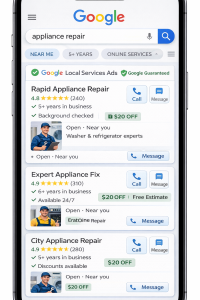
Google Local Services Ads work on a pay-per-lead model. You don’t pay for clicks. You pay when someone contacts you directly through the ad.
For appliance repair businesses, the typical cost per lead ranges from $20 to $45. That’s the national average. But averages hide the details that matter.
Your actual cost depends on where you operate and how competitive your market is. In cities like Los Angeles, New York, or Chicago, you’ll pay closer to $40 or more per lead. In smaller markets with less competition, you pay $20 to $30.
The type of repair also matters. Google doesn’t break out pricing by appliance type, but the value of the job influences the level of competition you face. A refrigerator compressor replacement lead is worth more than a dryer vent cleaning lead. More competition for high-value jobs means higher costs in those categories.
Here’s what most people miss: the cost per lead is only half the equation. What matters is the cost per booked job. If you’re paying $30 per lead but only converting 1 in 5 into actual appointments, your real cost is $150 per job. That’s a very different calculation.
How LSA Pricing Compares to Other Lead Sources
You have options for generating leads. LSA is one channel. Google Ads is another. SEO is another. Paid lead services like HomeAdvisor or Thumbtack are another.
Each has a different cost structure and a different quality profile.
Google Ads search campaigns for appliance repair typically cost $8 to $20 per click. If your landing page converts at 10%, you’re paying $80 to $200 per lead. That’s higher than LSA in most cases. But you control the targeting, the messaging, and the experience. You own the data.
SEO costs nothing per lead once you’re ranking. But it takes months to build. It requires ongoing content creation, optimization, and technical maintenance. The cost is in setup and time, not in individual leads.
Paid lead marketplaces charge $15 to $50 per lead, but those leads are often shared with 3 to 5 other companies. You’re competing on price and speed. The conversion rate is lower. The customer experience is worse. You don’t control how the lead was generated.
LSA sits in the middle. It’s more expensive than a click, but cheaper than most pay-per-lead services. The leads are exclusive to you. Google vets the customer before charging you. And the ads appear at the top of search results, with a green checkmark that signals trust.
The trade-off is that you have less control than Google Ads. You can’t write your own ad copy. You can’t choose exact keywords. And Google decides when to show your ad based on factors you can’t fully control.
What Makes an LSA Cost Per Lead Worth It?
Not all leads are created equal. A $30 lead that turns into a $400 repair is a great deal. A $30 lead that turns into a no-show or a price shopper is a waste.
The value of an LSA lead depends on three things: lead quality, your response time, and your ability to convert.
Lead Quality
LSA leads tend to be higher quality than most other sources because of how the system works. The customer must use Google’s interface to contact you. They see your reviews, service area, and business profile before reaching out. That filters out some of the tire kickers.
But not all of them.
You’ll still get leads from people who aren’t ready to book. You’ll get leads from people outside your service area. You’ll get leads from people who just want a quote over the phone and have no intention of scheduling.
Google allows you to dispute leads that don’t meet its quality standards. If someone contacts you by accident, or if the lead is clearly spam, you can request a refund. But the process takes time, and not every dispute gets approved.
The better your LSA profile is set up, the better your lead quality will be. If your service descriptions are clear, your service area is accurate, and your reviews reflect the kind of work you do, you’ll attract better-fit customers.
Response Time

This is where most appliance repair companies lose money on LSA.
Google prioritizes businesses that respond fast. If you answer a call within 30 seconds, you’re far more likely to rank higher in future searches; the same applies to responding to a message within 4 hours.
If you don’t answer, or if you take too long, Google will rank you lower. That means fewer leads. And the leads you do get will be lower quality because they’ve already tried calling two other companies before you.
Speed matters more than almost anything else in LSA. If you can’t answer your phone during business hours, or if you don’t have a system to respond to messages quickly, LSA will not work for you. You’ll pay for leads that go to your competitors.
Your Ability to Convert
The best lead in the world is worthless if you can’t close it.
Conversion starts with how you answer the phone. If your team sounds rushed, annoyed, or unprepared, the customer will move on. If they have to wait on hold or if they get sent to voicemail, they’ll call someone else.
Conversion continues with how you schedule. If you can’t get someone out the same day or the next day, you’ll lose jobs to companies that can. Appliance repair is often urgent. A broken fridge means spoiled food. A broken washer means piling laundry. People want it fixed now.
And conversion ends with how you show up. If your technician is late, unprofessional, or unclear about pricing, you’ll lose the job even if you got the lead.
The cost per lead doesn’t matter if your operation can’t handle the required volume or speed to convert.
How to Calculate What You Can Afford to Pay
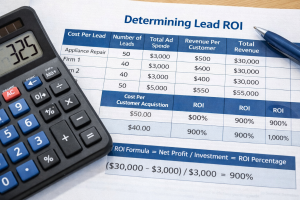
Here’s the math that matters.
Start with your average job value. Let’s say your typical appliance repair job is $300. That includes the service call, the diagnosis, and the repair.
Next, figure out your gross margin. For most appliance repair companies, that’s between 40% and 60% after accounting for parts, labor, and direct costs. Let’s use 50% to keep it simple. That means you make $150 in gross profit per job.
Now factor in your conversion rate. If you convert 1 in 3 LSA leads into a booked and completed job, your conversion rate is 33%.
Here’s the formula:
Maximum cost per lead = (Average job value x Gross margin) / Leads needed per job
Using our example:
($300 x 50%) / 3 = $50
That means you can afford to pay up to $50 per lead and still break even. Anything below that is profit. Anything above that is a loss.
This is the number you need to know before you turn on LSA. If your market charges $40 per lead and your numbers look like the example above, you’re in good shape. If your market charges $50 per lead and your average job is only $250, the math doesn’t work.
Most appliance repair owners don’t do this calculation. They just turn on LSA, see leads coming in, and assume it’s working. Then they wonder why they’re busy but not profitable.
The Hidden Costs Most People Miss
The cost per lead is the visible cost. But other costs eat into your margin.
Disputed Leads
Not every lead you pay for will be valid. Some will be spam. Some will be accidental clicks. Some will be people calling the wrong business.
Google allows you to dispute these, but the process takes time. And not every dispute gets approved. Plan for 5% to 10% of your leads to be non-refundable. That increases your effective cost per lead.
Missed Leads
If you don’t answer the phone, you still pay for the lead. If you take too long to respond, the customer books with someone else. You still pay.
Missed leads are one of the biggest hidden costs in LSA. If you’re missing 20% of your calls, you’re effectively paying 20% more per booked job.
Seasonal Swings
Appliance repair demand is seasonal. You’ll get more calls in the summer when air conditioners break and more calls in the winter when heating systems fail. You’ll get fewer calls in the spring and fall.
LSA costs tend to rise when demand is high because more companies are competing for leads. If you’re not adjusting your budget based on the season, you’ll either overspend during slow months or miss opportunities during busy months.
Technician Capacity
If you don’t have enough technicians to handle the lead volume, you’ll either turn away jobs or deliver slow service. Both hurt your conversion rate.
Some appliance repair owners turn on LSA, get flooded with leads, and can’t keep up. Their response times slip. Their reviews suffer. And their cost per booked job goes up because they’re paying for leads they can’t service.
You need to match your LSA budget to your actual capacity. If you can handle 50 jobs per week and you’re already at 40 from organic and repeat customers, you only have room for 10 more. Don’t pay for 30 leads.
What Actually Improves Your LSA Performance
If you want to lower your cost per lead or increase your conversion rate, there are a few things that actually move the needle.
Reviews
Google ranks LSA ads based partly on review count and rating. If you have 200 reviews at 4.9 stars, you’ll rank higher than a competitor with 50 reviews at 4.5 stars.
More reviews also improve conversion. Customers trust businesses with more feedback. They’re more likely to call you if they see proof that other people had a good experience.
The fastest way to improve LSA performance is to systematically ask every happy customer for a review. Not some customers. Every customer.
Service Area Accuracy
If your service area is too broad, you’ll get leads from places you don’t actually cover. You’ll pay for them, dispute them, and waste time.
If your service area is too narrow, you’ll miss opportunities.
Set your service area to exactly match where you’re willing to drive. If you serve a 20-mile radius, set it to 20 miles. Don’t round up hoping to catch a few extra leads.
Business Profile Completeness
Your LSA profile is part of your Google Business Profile. The more complete and accurate it is, the better your performance.
Make sure your hours are correct. Make sure your services are listed clearly. Make sure your photos show real technicians, real trucks, and real work.
Google uses this information to decide when to show your ad. If your profile is incomplete, you’ll show up less often.
Response Speed
This is the single biggest factor you can control. Answer your phone within 30 seconds. Respond to messages within 4 hours. Every time.
If you can’t do that with your current setup, you need a different setup. Hire someone to answer the phone. Use a call answering service. Set up automated text responses. Do whatever it takes.
Slow response times kill LSA performance. Fast response times improve it. It’s that simple.
When LSA Makes Sense and When It Doesn’t
LSA isn’t the right fit for every appliance repair business.
It works best if you have the infrastructure to respond fast, convert leads efficiently, and handle consistent volume. If you’re a one-person operation and you’re already booked out two weeks, LSA will just create stress. You’ll pay for leads you can’t service.
It works best in markets where the cost per lead is below your break-even point. If leads cost $50 and your math says you can only afford $40, don’t turn it on. Fix your pricing, improve your conversion rate, or focus on a different channel.
It works best if you’re willing to actively manage it. You can’t just turn on LSA and forget about it. You need to monitor your lead quality, dispute bad leads, adjust your budget based on capacity, and optimize your profile over time.
If you’re not willing to do that work, or if you don’t have someone on your team who can, LSA will cost you more than it makes you.
How This Fits Into a Bigger Marketing System
LSA is a tool. It’s not a strategy.
The appliance repair companies that get the most value out of LSA are the ones who use it as part of a broader system. They’re also investing in SEO so they show up organically. They’re running Google Ads search campaigns to capture high-intent keywords. They’re optimizing their Google Business Profile so they rank in the map pack.
When all of those channels work together, your cost per customer goes down. You’re not relying on any single source. You’re building a predictable flow of leads from multiple places.
LSA works best when it’s filling gaps. If your SEO is bringing in 20 calls per week and you need 40, LSA can make up the difference. If your Google Ads are converting well but you want more volume, LSA adds another layer.
But if LSA is your only source of leads, you’re vulnerable. Google can change the rules. Costs can spike. Competition can increase. And you have no backup.
What You Should Do Next
If you’re already running LSA, pull your numbers. Calculate your actual cost per booked job. Figure out your conversion rate. Compare it to your break-even point. If the math works, keep going. If it doesn’t, figure out what’s broken.
If you’re thinking about starting LSA, do the math first. Know your average job value. Know your margin. Know how many leads you need to convert one job. Then decide if the cost makes sense.
And if you’re not sure how to set it up, or if you’ve tried it and it didn’t work, that’s where we come in.
At Appliance Marketing Pros, we’ve spent years building lead generation systems specifically for appliance repair companies. We know what works. We know what breaks. And we know how to make LSA profitable even in competitive markets.
We don’t do generic marketing. We don’t work with every industry. We focus on appliance repair, HVAC, and vent cleaning because those businesses have unique challenges that require specific solutions.
If you want to know whether LSA makes sense for your business, or if you want help building a system that actually delivers predictable call volume, book a strategy call. We’ll look at your market, your numbers, and your capacity. And we’ll tell you exactly what you need to do to make it work.
No fluff. No guessing. Just a clear plan based on what actually works for appliance repair companies like yours.
About The Author


