
Blog
How to Optimize Your Google Local Services Ads for Maximum Call Volume
Why Two Appliance Repair Shops on LSAs Get Very Different Results
If you run an appliance repair business, you already know that when someone’s fridge dies or their washer floods the laundry room, they need help fast. They’re not browsing. They’re not comparing five companies. They’re looking for someone who can show up today and fix the problem.
That’s exactly why Google Local Services Ads (LSAs) exist. They put your business at the very top of Google search results, above everything else, with a green Google Verified badge that screams trust. You only pay when someone actually calls or messages you. No wasted clicks. No budget burned on tire-kickers.
But here’s the reality we see with appliance repair owners every week: just being on LSAs doesn’t guarantee a full schedule. Some companies get 20-30 qualified calls per month. Others get 3-5. Same city. Same budget. Completely different results.
The difference isn’t luck. It’s optimization.
This guide will show you exactly how to set up and optimize your Google Local Services Ads so you get more calls, better leads, and predictable revenue. Everything here is based on what actually works for appliance repair businesses, not generic marketing theory.
What Makes Google Local Services Ads Different (And Why They Matter for Appliance Repair)
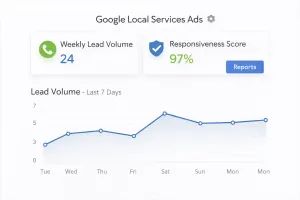
Google Local Services Ads are not the same as regular Google Ads. Understanding this difference is critical.
With traditional Google Ads, you pay every time someone clicks your ad, whether they call you or not. With LSAs, you only pay when someone contacts you directly through the ad. That’s a phone call or a message. Nothing else.
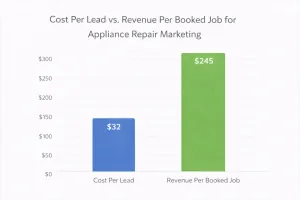
For appliance repair, this is huge. Your average service call is worth $200-$400 or more. If you’re paying $15-$40 per lead instead of $8-$15 per useless click, your economics change fast.
LSAs also show up above everything else on Google. Above regular ads. Above the map pack. Above organic results. When someone searches “appliance repair near me” or “refrigerator repair,” your business can be the first thing they see.
The Google Verified badge matters too. It tells customers that Google has verified your business, checked your insurance, and run background checks on your technicians. That builds instant trust with people who don’t know your company yet.
But none of this works if your LSA profile isn’t optimized. Google uses a ranking system to decide which businesses show up first. If you’re not showing up, you’re not getting calls.
The Five Factors That Control Your LSA Ranking
Google doesn’t randomly pick which appliance repair companies to show. They use a clear set of ranking factors. If you understand these and improve them, you’ll rank higher and get more leads.
Here are the five factors that matter most:
- Responsiveness
This is how fast you answer calls and messages. Google tracks this in real time. If you miss calls or take hours to reply to messages, your ranking drops. If you answer fast and consistently, you rank higher.
For appliance repair, this is critical. Your customers need help now. If they call you and you don’t answer, they’re calling the next company in 30 seconds.
- Review Quantity and Quality
Google looks at how many reviews you have and what your average star rating is. More reviews and higher ratings push you up. Fewer reviews or a rating below 4.5 stars hurts you.
This isn’t just about looking good. Reviews directly impact whether you show up at all.
- Proximity to the Customer
Google prioritizes businesses that are physically closer to the person searching. If someone in downtown searches for appliance repair, a company 5 miles away will usually rank higher than one 20 miles away, all else being equal.
You can’t change your location, but you can optimize your service area settings to make sure you’re showing up in the right places.
- Your Budget and Bid Settings
Google gives you two bidding options: set a maximum cost per lead, or let Google maximize your leads within your budget. Your bid affects how often you show up and in what position.
If you set your bid too low, you won’t show up at all. If you set it too high, you’ll burn through your budget on leads you can’t handle.
- Profile Completeness and Relevance
Google wants to show businesses that are legitimate, professional, and relevant to the search. If your profile is incomplete, missing photos, or uses vague service descriptions, you’ll rank lower.
For appliance repair, this means listing every service you offer (refrigerator repair, washer repair, dryer repair, dishwasher repair, etc.) and making sure your profile clearly shows you’re a real, active business.
These five factors work together. You can’t ignore one and expect the others to carry you. The companies that dominate LSAs are the ones that systematically improve all five.
How to Improve Your Responsiveness (The #1 Ranking Factor)
Responsiveness is the single most important factor in LSA ranking. It’s also the one most appliance repair owners struggle with.
Google measures two things: how often you answer calls, and how fast you reply to messages. If your answer rate drops below 80%, your ranking suffers. If you take more than a few hours to reply to messages, same problem.
Here’s what works:
Answer Every Call During Business Hours
If you’re in the field and can’t answer, you need a system. That could be a dedicated office person, a call answering service, or a virtual receptionist trained to handle appliance repair inquiries.
We’ve seen owners lose thousands of dollars in revenue because they were under a dishwasher and missed three calls in a row. Google noticed. Their ranking dropped. Calls dried up for two weeks.
Set Realistic Business Hours
If you list your hours as 7 AM to 7 PM but you stop answering at 5 PM, Google will penalize you. Set your hours to match when you can actually answer the phone.
If you want to capture after-hours leads, consider using an answering service that can book appointments on your behalf.
Reply to Messages Within 15-30 Minutes
Some customers will send a message instead of calling. Google tracks how fast you respond. Replying within 15-30 minutes keeps your responsiveness score high.
Set up mobile notifications so you see messages immediately. Treat them like phone calls.
Monitor Your Responsiveness Score
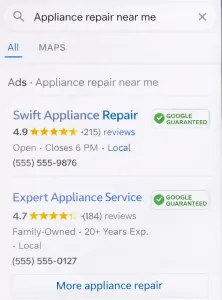
Google shows you your responsiveness percentage in the LSA dashboard. Check it weekly. If it’s dropping, figure out why and fix it immediately.
This isn’t about being perfect. It’s about being consistent. An 85-90% answer rate will keep you competitive. Anything below 80% will hurt you.
How to Optimize Your Service Area Without Killing Your Ranking
Your service area determines where your ads show up. Get this wrong and you’ll either miss opportunities or waste money on leads you can’t handle.
Most appliance repair owners make one of two mistakes:
They set their service area too small and miss good leads in nearby towns.
They set it too wide and get calls from 40 miles away that they can’t service profitably.
Here’s how to get it right:
Start With Your Actual Service Radius

Be honest about how far you’re willing to drive for a standard service call. For most appliance repair businesses, that’s 10-20 miles from your location.
If you’re in a dense metro area, you might go smaller. If you’re in a rural area, you might go wider. The key is to match your service area to what you can actually handle.
Use Zip Code Targeting for Precision
Instead of drawing a circle, use zip code targeting. This lets you include high-value areas and exclude low-value ones.
For example, if there’s a wealthy suburb 15 miles north that generates great leads, include those zip codes. If there’s a low-income area 8 miles south where you rarely get paid, exclude it.
Don’t Expand Just Because You Can
More service area does not equal more leads. If you expand your radius to 30 miles, Google will show your ads there, but your responsiveness and proximity scores will suffer. You’ll rank lower everywhere.
It’s better to dominate a smaller area than to be invisible in a large one.
Adjust Based on Lead Quality
After 30-60 days, review where your leads are coming from. If you’re getting great leads from certain zip codes, keep them. If you’re getting spam or low-quality leads from others, remove them.
Your service area should evolve as you learn what works.
How to Get More Reviews Without Begging or Breaking Google’s Rules
Reviews are the second most important ranking factor. They also directly influence whether someone calls you or scrolls past.
Here’s the problem: most appliance repair owners don’t ask for reviews consistently. They’ll ask when they remember, or when they’re desperate, but there’s no system.
That’s why some companies have 8 reviews and others have 80.
Here’s how to build a review system that works:
Ask Every Happy Customer
After you complete a job and the customer is satisfied, ask for a review. Not some customers. Every customer.
The easiest way to do this is in person, right after you finish the repair. Say something like: “I’m glad we could get your refrigerator running again. If you’re happy with the service, would you mind leaving us a quick review on Google? It really helps us out.”
Most people will say yes. Then make it easy for them.
Send a Follow-Up Text or Email
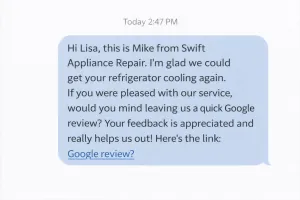
Even if they agree in person, people forget. Send a follow-up text or email within 24 hours with a direct link to your Google review page.
Keep the message short: “Hi [Name], thanks for trusting us with your appliance repair today. If you have a minute, we’d really appreciate a review. Here’s the link: [URL]. Thanks again!”
Use a Review Request Tool
If you’re doing 20-30 jobs per week, manually sending review requests gets tedious. Use a tool like Podium, Birdeye, or a simple CRM with automated SMS to send requests automatically.
The key is consistency. Every customer should get a request.
Respond to Every Review
When someone leaves a review, respond within 24-48 hours. Thank them. Acknowledge what they said. Show future customers that you care.
If you get a negative review, respond professionally. Apologize if appropriate. Offer to make it right. Don’t argue. Google and potential customers are watching.
Never Buy Reviews or Offer Incentives
Google will ban your LSA account if they catch you buying reviews or offering discounts in exchange for them. Don’t do it.
Just ask. Most happy customers will leave a review if you make it easy.
How to Set Your Budget and Bidding Strategy Without Wasting Money
LSA budgeting is simpler than Google Ads, but you can still mess it up.
Google gives you two bidding options:
Set a maximum cost per lead. You tell Google the most you’re willing to pay for a lead, and they’ll try to get you as many leads as possible at or below that price.
Set a weekly budget and let Google maximize leads. You give Google a budget and they spend it to get you the most leads possible, regardless of individual lead cost.
For most appliance repair businesses, setting a maximum cost per lead works better. Here’s why:
You have control. If leads start costing $60 each and your target is $30, Google will slow down your ads instead of burning your budget.
You can scale predictably. If you know your average lead costs $25 and converts at 40%, you can calculate exactly how much to spend to hit your revenue goals.
Here’s how to set your bid:
Start With Your Target Cost Per Lead
Figure out what you can afford to pay for a lead. If your average job is worth $300 and you close 40% of leads, each lead is worth $120 in revenue. If you want a 5x return, you can afford to pay $24 per lead.
Start your max bid at that number.
Monitor Your Lead Volume
If you’re getting plenty of leads and they’re converting well, leave your bid alone. If you’re not getting enough leads, increase your bid by $5-$10 and monitor for a week.
If leads are coming in too fast and you can’t handle them, lower your bid or reduce your weekly budget.
Adjust for Seasonality
Appliance repair has seasonal swings. Summer is busy (AC units, refrigerators). Winter is slower. Spring and fall are moderate.
Increase your budget during busy seasons when you can handle more volume. Decrease it during slow seasons to avoid wasting money on leads you can’t convert.
Track Your Actual Cost Per Booked Job
LSAs charge you per lead, but not every lead books. Some are spam. Some are price shoppers. Some call three companies and ghost all of them.
Track how many leads turn into actual booked jobs. That’s your real cost per acquisition. If it’s too high, your problem isn’t your bid, it’s your conversion process.
How to Build a Profile That Actually Converts Leads Into Calls
Your LSA profile is your first impression. If it looks sloppy or generic, people will scroll past you and call the next company.
Here’s what matters:
Use Real Photos of Your Team and Trucks
Google lets you upload photos to your profile. Use them. Show your technicians. Show your service trucks. Show actual jobs you’ve completed.
Don’t use stock photos. Customers can tell. Real photos build trust.
Write a Clear, Specific Business Description
Your description should immediately tell customers what you do and why they should call you.
Bad example: “We provide quality appliance repair services to homeowners in the area.”
Good example: “Family-owned appliance repair company serving [City] since 2015. We specialize in same-day refrigerator, washer, dryer, and dishwasher repair. All technicians are certified and background-checked. We show up on time and fix it right the first time.”
The second example is specific, credible, and tells the customer exactly what to expect.
List Every Service You Offer
Google lets you select specific services. Don’t just pick “appliance repair.” List every appliance type you service:
- Refrigerator repair
- Washer repair
- Dryer repair
- Dishwasher repair
- Oven and range repair
- Microwave repair
- Garbage disposal repair
The more services you list, the more searches you’ll show up for.
Highlight Your Unique Selling Points
What makes you different? Same-day service? 24/7 emergency availability? Certified technicians? Warranty on repairs?
Put that in your description. Make it clear why someone should call you instead of the next company.
Keep Your Profile Updated
If your hours change, update them. If you add a new service, add it to your profile. If you get new photos, upload them.
An outdated profile signals to Google (and customers) that you’re not actively managing your business.
How to Handle Leads and Turn Them Into Booked Jobs
Getting leads is only half the battle. If you’re not converting them into booked jobs, you’re wasting money.
Here’s what we see with appliance repair companies that struggle:
They answer the phone but don’t sound professional or confident.
They take too long to call back missed leads.
They don’t ask the right questions to qualify the job.
They give vague pricing or refuse to give any estimate at all.
Here’s how to fix it:
Answer With a Professional Greeting
When you answer an LSA call, the customer should immediately know they’ve reached the right place.
Say something like: “Thanks for calling [Company Name], this is [Your Name]. How can I help you today?”
Don’t just say “Hello.” That sounds unprofessional.
Ask Qualifying Questions
You need to know what appliance is broken, what the symptoms are, and where the customer is located.
Ask:
- What type of appliance is it? (Refrigerator, washer, dryer, etc.)
- What’s it doing? (Not turning on, making noise, leaking, etc.)
- What’s your address?
- When do you need service? (Today, tomorrow, this week)
This tells you if it’s a job you can handle and how urgent it is.
Set Expectations on Pricing
You don’t have to give an exact quote over the phone, but you should give a range or explain your pricing structure.
For example: “Our service call is $X, and that includes the diagnostic. If you approve the repair, that fee is waived and you just pay for parts and labor. Most [appliance type] repairs run between $Y and $Z depending on what’s wrong.”
This filters out price shoppers and sets clear expectations.
Book the Appointment Immediately
Don’t tell the customer you’ll call them back later to schedule. Book the appointment on the call.
If you’re in the field and can’t access your schedule, tell them you’ll text them within 15 minutes with available times. Then actually do it.
Follow Up on Missed Calls Fast
If you miss a call, call back within 10-15 minutes. After an hour, the customer has probably already booked with someone else.
Speed matters in appliance repair. Your customers are in crisis mode.
How to Track Performance and Know If Your LSAs Are Actually Working
You can’t improve what you don’t measure. Most appliance repair owners look at their LSA dashboard once a month, see some numbers, and assume everything is fine.
That’s not enough.
Here’s what to track:
Total Leads Per Week
How many calls and messages are you getting? Is it consistent or all over the place?
If your lead volume drops suddenly, check your responsiveness score, your budget, and your ranking. Something changed.
Cost Per Lead
What are you paying on average for each lead? Is it going up or down?
If it’s creeping up, you’re either getting outbid by competitors or your responsiveness score is dropping.
Lead-to-Booking Conversion Rate
What percentage of LSA leads turn into actual booked jobs?
If you’re getting 20 leads per week but only booking 5 jobs, your conversion rate is 25%. That’s low. You should be closer to 40-50% for appliance repair.
If your conversion rate is low, the problem isn’t LSAs. It’s your call handling or your pricing.
Revenue Per Lead
Multiply your average job value by your conversion rate. That’s how much each lead is worth to you.
If your average job is $300 and you convert 40% of leads, each lead is worth $120. If you’re paying $30 per lead, you’re making money. If you’re paying $80 per lead, you’re not.
Responsiveness Score
Check this weekly. If it drops below 85%, figure out why and fix it immediately.
Review Growth
Are you adding new reviews every week? If not, your ranking will stagnate and competitors will pass you.
Set a goal (like 4-6 new reviews per month) and track whether you’re hitting it.
Common Mistakes Appliance Repair Owners Make With LSAs (And How to Avoid Them)
We’ve worked with dozens of appliance repair companies on their LSAs. Here are the mistakes we see over and over:
Mistake #1: Setting Up LSAs and Never Touching Them Again
LSAs are not set-it-and-forget-it. Your competitors are actively optimizing. If you’re not, you’ll fall behind.
Check your dashboard weekly. Monitor your metrics. Make adjustments.
Mistake #2: Ignoring Responsiveness
If you’re not answering calls, nothing else matters. Your ranking will drop and your leads will dry up.
Fix this first before you worry about anything else.
Mistake #3: Not Asking for Reviews
You need a steady flow of new reviews to stay competitive. If you’re not asking every customer, you’re leaving money on the table.
Build a system and stick to it.
Mistake #4: Setting Your Service Area Too Wide
Bigger is not better. A tight service area with high responsiveness beats a wide service area with low responsiveness every time.
Mistake #5: Not Tracking Conversion Rates
If you don’t know how many leads turn into jobs, you don’t know if your LSAs are profitable.
Track everything. Use a CRM or a simple spreadsheet. Just track it.
Mistake #6: Competing on Price Instead of Value
Some owners think they need to be the cheapest to win LSA leads. That’s not true.
Customers care more about trust, speed, and professionalism than saving $20. Focus on being the best option, not the cheapest.
Advanced Strategies for Multi-Location or High-Volume Appliance Repair Companies
If you’re running multiple locations or doing 50+ jobs per week, you need a more sophisticated approach.
Set Up Separate LSA Accounts for Each Location
Google requires each physical location to have its own LSA account. Don’t try to run multiple locations from one account. It won’t work.
Each location should have its own profile, its own reviews, and its own service area.
Standardize Your Call Handling Across Locations
If you have multiple technicians or locations, everyone needs to answer calls the same way. Train your team on how to greet customers, qualify jobs, and book appointments.
Inconsistent call handling kills conversion rates.
Use Centralized Reporting
If you’re managing multiple LSA accounts, use a spreadsheet or dashboard to track performance across all locations.
Look for patterns. If one location is crushing it and another is struggling, figure out why and replicate what works.
Allocate Budget Based on Performance
Not all locations will perform equally. Some areas have more demand or less competition.
Put more budget into locations that are converting well. Pull back from locations that aren’t.
Monitor for Service Area Overlap
If you have two locations close together, make sure their service areas don’t overlap too much. You don’t want your own locations competing against each other.
What to Do If Your LSA Performance Suddenly Drops
Sometimes your LSA performance will drop for no obvious reason. Leads dry up. Your ranking falls. Your cost per lead spikes.
Here’s how to diagnose and fix it:
Check Your Responsiveness Score First
This is the most common culprit. If your responsiveness dropped, your ranking dropped with it.
Look at your call log. Are you missing more calls than usual? Are you taking longer to reply to messages?
Fix this immediately.
Check Your Budget and Bid
Did your budget run out? Did you lower your bid recently?
If your bid is too low, you won’t show up. Increase it and monitor for 3-5 days.
Check Your Reviews
Did you get a negative review recently? Did your star rating drop?
A single 1-star review can hurt your ranking if you don’t have many reviews to balance it out.
Respond to the negative review professionally and focus on getting more positive reviews to dilute it.
Check Your Competitors
Did a new competitor enter your market? Did an existing competitor improve their profile?
Look at who’s ranking above you. Check their review count, responsiveness, and profile quality. Figure out what they’re doing better and match it.
Check Google’s LSA Updates
Google occasionally changes how LSAs work. Check the Google Local Services Ads help center or industry news to see if there were any recent updates.
If you can’t figure it out, it might be time to bring in an expert. Sometimes an outside perspective can spot issues you’re missing.
The Bottom Line: Consistency Beats Perfection
You don’t need a perfect LSA profile to succeed. You need a good profile and consistent execution.
Answer your calls. Ask for reviews. Monitor your metrics. Make small improvements every week.
The appliance repair companies that dominate LSAs aren’t doing anything magical. They’re just doing the basics better and more consistently than their competitors.
If you set up your profile correctly, optimize your service area, maintain high responsiveness, and track your numbers, you’ll get more calls than you can handle.
And if you need help getting there, that’s exactly what we do at Appliance Marketing Pros. We’ve helped dozens of appliance repair companies optimize their LSAs, improve their lead flow, and grow their revenue.
If you want to talk through your specific situation and see where you’re leaving money on the table, book a free strategy call with us. We’ll review your LSA setup, show you what’s working and what’s not, and give you a clear plan to get more calls starting this week.
No pressure. No sales pitch. Just a real conversation about how to grow your appliance repair business.