Blog
The New LSA Verification: What Owners Must Know for 2026

If your Local Services Ads stopped running or your verification is stuck in limbo, you’re not alone. Google made major changes to how it approves appliance repair companies for Local Services Ads in 2026, and many owners are finding out the hard way.
I’ve worked with appliance repair companies across the country, and I can tell you this: the rules changed because Google is cracking down on spam. Unfortunately, legitimate businesses are getting caught in the crossfire. The companies that understand the new verification process are still getting high quality leads. The ones that don’t are stuck waiting weeks or months while their competitors run ads.
This guide walks you through exactly what changed, why appliance repair is being treated differently, and how to get your ads approved without wasting time or money.
Why Appliance Repair is Under the Microscope
Google didn’t change these rules for fun. They changed them because appliance repair, locksmith, and garage door companies had been flooded with fake listings and lead-generation spam for years. Bad actors created dozens of fake profiles, bought fake reviews, and drove up costs for legitimate businesses.
Appliance repair is now classified as a “high risk” category. That means stricter verification, longer approval times, and more documentation requirements. It’s frustrating, but it’s the reality.
The good news is that once you’re verified under the new system, your ads will perform better. Google is cleaning up the spam, which means less competition from fake companies and better lead quality for businesses that play by the rules.
The 2026 Verification Requirements (What You Actually Need)
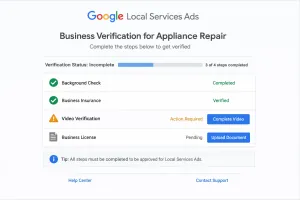
Getting approved for Local Services Ads in 2026 requires three main things: an advanced background check, proof of insurance and licensing, and in some cases, a video verification call.
The Advanced Background Check (Pinkerton or Evident)
Google now uses third party companies called Pinkerton and Evident to run background checks on appliance repair business owners. This is not the basic check they used to do. It’s more thorough but takes longer.
Expect this process to take three to five weeks. They’ll verify your identity, check for criminal history, and confirm you’re associated with the business. If you have multiple technicians, they may need to be checked individually depending on your state.
The most common reason people fail this step is mismatched information. If your driver’s license says “John Smith” but your business is registered as “J. Smith Appliance LLC,” that can trigger a rejection.
Insurance and License Matching
Your certificate of insurance and business license must match your Google Business Profile exactly. I mean character for character.
If your Google profile says “ABC Appliance Repair” but your insurance certificate says “ABC Appliance Repair LLC,” Google will reject it. If your address on your license is different from your business address on your profile, Google will reject it.
This is the number one reason appliance repair companies get stuck in verification. Double check every document before you upload it. Make sure the business name, address, and owner name are identical across all paperwork.
You’ll also need proof of general liability insurance. Most states require at least $1 million in coverage. Some require $2 million. Check your state’s requirements before you apply.
Video Verification Protocols
This is new for 2026. Google is now requiring some appliance repair companies to complete a live video verification call. Not everyone gets flagged for this, but if you do, you’ll need to be ready.
The video call is usually short, around 10 to 15 minutes. A Google representative will ask you to show your business location, verify your identity, and confirm that you actually perform appliance repair services. They may ask to see your tools, your service vehicle, or your business signage.
If you operate from home, that’s fine. Just be prepared to explain your business setup. If you use a virtual address or a PO box, that could be a problem. Google wants to see that you’re a real, operating business.

Why Your LSA Ads Aren’t Showing (Even if You’re Verified)
Getting verified is only half the battle. Many appliance repair companies get approved and then wonder why their ads aren’t showing up or why they’re not getting calls. There are a few common reasons.
The Response Rate Trap
Google tracks how quickly you respond to leads. If you miss calls or take too long to respond, your ad ranking drops. Your ads might still be active, but they’ll show up lower in the results.
The companies that rank highest respond to leads within minutes. If you can’t answer the phone during business hours, you need a system in place to handle calls. A missed call text back, an answering service, or a virtual receptionist can all help.
Google also tracks how often you dispute leads. If you’re constantly marking leads as spam or requesting refunds, that hurts your ranking. Disputing bad leads is fine, but if you’re doing it for every other call, Google assumes you’re the problem.
Review Velocity and Recency
Your Google reviews matter for Local Services Ads, not just organic rankings. Google wants to see recent reviews, not just a bunch from two years ago.
If you haven’t gotten a review in six months, your ad performance will suffer. The best companies ask for reviews after every job. They send a text with a direct link to their Google profile. They make it easy.
Responding to reviews also helps. Google tracks engagement. If you’re ignoring reviews, it signals that you’re not actively managing your business.
Budget Compression
This is a big one. Google’s algorithm now adjusts your budget based on your performance. If your response rate is low or your booking rate is weak, Google will spend your budget more slowly.
You might set a daily budget of $100, but Google will only spend $40 or $50 because they don’t think you’re converting leads effectively. This is frustrating, but it’s how the system works now.
The fix is simple: improve your conversion rate. Answer calls faster, follow up on missed leads, and close more jobs. Once Google sees that you’re converting, they’ll spend your full budget.
How to Dispute Bad Leads in 2026
The rules for disputing leads changed in 2026. You used to be able to dispute almost anything. Now, Google is much stricter about what qualifies for a refund.
You can still dispute leads if the customer was outside your service area, if they were looking for a different service, or if the lead was clearly spam. But you can’t dispute a lead just because the customer didn’t book.
Google now has a dispute dashboard inside the Local Services Ads platform. You submit your dispute there, and Google reviews it within 48 hours. If they approve it, you get a credit. If they deny it, the charge stands.
The key is documentation. If you’re disputing a lead, include screenshots of the call log, text messages, or voicemails. The more proof you have, the better your chances of getting a refund.
AMPRank Strategy: Integrating New LSA Verification with SEO
Local Services Ads work best when they’re part of a bigger strategy. A lot of appliance repair companies rely 100% on LSA and then panic when their ads stop running or their cost per lead goes up.
Consistently growing companies use a mix of Local Services Ads, Google Search Ads, and local SEO. When someone searches for “appliance repair near me,” they see your LSA ad, Google Business Profile, and website on the first page. That builds trust and increases conversion rates.
LSA is great for immediate leads, but SEO builds long term visibility. If your Google Business Profile is optimized and your website ranks organically, you’re not dependent on paid ads. You have multiple ways for customers to find you.
At Appliance Marketing Pros, we call this the AMPRank system. It’s a combination of Local Services Ads, Google Search Ads, Google Business Profile optimization, and local SEO. It’s designed to give appliance repair companies predictable, consistent lead flow without relying on one channel.
Don’t Let Red Tape Kill Your Call Volume
The new verification process is a pain, but it’s not impossible. The companies that get through it quickly are the ones that understand what Google is looking for and have their paperwork in order.
If you’re stuck in verification, check your documents first. Make sure your business name, address, and owner name match across your Google profile, insurance certificate, and business license. If you’re waiting on a background check, be patient. It takes time, but it will go through.
If you’re verified but not getting leads, check your response rate, reviews, and budget. Those are the three biggest factors in LSA performance.
And if you don’t want to deal with any of this, that’s what we’re here for. Appliance Marketing Pros manages Local Services Ads for appliance repair companies nationwide. We handle verification, optimize your profile, and ensure your ads run at peak performance.
We also build the rest of your marketing system so you’re not dependent on one lead source. If you want consistent call volume without the headaches, schedule a strategy call with our team. We’ll review your current setup, show you what’s holding you back, and build a plan to grow your business.