
Table of Contents
Mastering Google Ads to Drive Better Leads for Your Appliance Repair Business
If you run an appliance repair business, you already know the problem. One week your phone rings off the hook. The next week, crickets. You’re not sure where your leads are coming from, and when you do get calls, half of them are price shoppers or people outside your service area.
You’ve probably tried SEO. Maybe you’re running Google Ads already, or you paid someone to run them for you. But the results feel inconsistent. You’re spending money without knowing what’s actually working, and you’re not sure if the leads you’re getting are worth what you’re paying.
This guide will show you how to use Google Ads the right way to get predictable, high-quality leads for your appliance repair business. Not theory. Not generic marketing advice. Real strategies we use with appliance repair companies across the country to turn Google Ads into a reliable lead source.
Why Google Ads Works for Appliance Repair (When Done Right)
Google Ads is one of the best lead sources for appliance repair companies because of one simple reason: people search Google when their appliance breaks.
They’re not browsing. They’re not thinking about it. They need help now. Their refrigerator stopped cooling, their dryer won’t heat, or their dishwasher is leaking all over the floor. These are high-intent searches, and if your ad shows up at the right time with the right message, you win the call.
But here’s where most appliance repair owners get stuck. They either try to run ads themselves without knowing what they’re doing, or they hire a generic marketing agency that treats appliance repair like any other local service. The result is wasted budget, bad leads, and frustration.
Google Ads for appliance repair requires a specific approach. You need to target the right keywords, structure your campaigns correctly, write ads that speak to urgent needs, and send people to landing pages that convert. Miss any of these pieces, and your ad spend goes nowhere.
The Biggest Google Ads Mistakes Appliance Repair Owners Make
Before we get into what works, let’s talk about what doesn’t. These are the mistakes we see all the time when we audit Google Ads accounts for appliance repair businesses.
Running broad match keywords without negative keywords. This is the fastest way to burn through your budget. You end up paying for clicks from people searching for appliance parts, DIY repair videos, or appliance sales. None of those people are calling you for service.
Sending traffic to your homepage instead of a dedicated landing page. Your homepage talks about everything you do. A good landing page focuses on one thing: getting the person to call you right now. If someone clicks your ad for refrigerator repair and lands on a page that also mentions HVAC and vent cleaning, you’ve confused them. Confused people don’t convert.
Not tracking phone calls. Most appliance repair leads come through phone calls, not form fills. If you’re not using call tracking, you have no idea which keywords or ads are driving actual business. You’re flying blind.
Targeting too wide of a geographic area. If you cover a 30-mile radius but your ads are showing to people 50 miles away, you’re wasting money on clicks from people you can’t even serve.
Writing generic ad copy. Ads that say “Quality Appliance Repair” or “Affordable Service” don’t work. Everyone says that. Your ad needs to speak to the specific problem the person is dealing with and give them a reason to call you instead of the next guy.
Ignoring mobile users. Most people searching for appliance repair are on their phones. If your landing page isn’t mobile-friendly or your phone number isn’t clickable, you’re losing leads.
These mistakes are common, but they’re also fixable. Let’s talk about how to set up Google Ads the right way.
How to Structure Your Google Ads Campaigns for Appliance Repair
Campaign structure matters more than most people realize. A messy campaign structure makes it impossible to see what’s working, optimize performance, or scale profitably.
Here’s the structure we use for appliance repair companies.
Separate Campaigns by Appliance Type
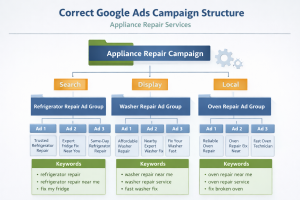
Don’t lump everything into one campaign. Create separate campaigns for each major appliance type: refrigerator repair, washer repair, dryer repair, dishwasher repair, oven and range repair. This gives you control over budgets, bids, and messaging for each service.
Why does this matter? Because the search volume, competition, and cost per click are different for each appliance type. Refrigerator repair tends to be more competitive and expensive than dryer repair. If you mix them together, Google will spend most of your budget on the higher-volume keywords and ignore the rest.
Use Tightly Themed Ad Groups
Within each campaign, create ad groups based on specific keyword themes. For example, in your refrigerator repair campaign, you might have separate ad groups for “refrigerator not cooling,” “refrigerator leaking,” and “ice maker repair.”
Each ad group should have its own set of closely related keywords and ads that speak directly to that specific problem. This improves your Quality Score, which lowers your cost per click and improves your ad position.
Target Your Service Area Precisely
Use location targeting to show your ads only in the areas you actually serve. Don’t guess. Pull up a map and define your service radius clearly. If you serve multiple cities or counties, list them specifically instead of using a broad radius.
Also, exclude areas you don’t serve. If you’re in a major metro area and there are neighborhoods or suburbs outside your range, exclude them. Every click from someone you can’t help is money down the drain.
Set Up Call Tracking from Day One
You need to know which keywords and ads are driving phone calls. Use call tracking numbers on your landing pages and in your ad extensions. This lets you see exactly which searches are turning into real business, not just clicks.
Without call tracking, you’re guessing. With it, you can double down on what works and cut what doesn’t.
Keyword Strategy: What to Target and What to Avoid
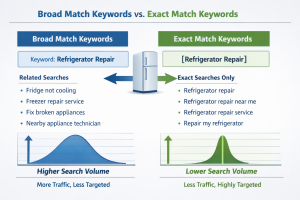
Keywords are the foundation of your Google Ads success. Target the wrong ones, and you’ll burn money fast. Target the right ones, and you’ll get a steady flow of high-quality leads.
High-Intent Keywords That Convert
Focus on keywords that show clear buying intent. These are searches from people who need service right now.
Examples:
- “refrigerator repair near me”
- “washer won’t spin”
- “dishwasher not draining”
- “oven won’t heat”
- “same day appliance repair”
These searches indicate a problem that needs solving immediately. The person isn’t researching or comparing. They’re ready to call.
Emergency and Urgency Keywords
Add keywords that include urgency signals like “emergency,” “same day,” “24 hour,” or “fast.” These tend to convert at higher rates because the person’s need is more acute.
Just make sure you can actually deliver on the promise. If you advertise same-day service but can’t schedule someone for three days, you’ll damage your reputation and waste ad spend.
Long-Tail Keywords for Cost Efficiency
Long-tail keywords are longer, more specific search phrases. They usually have lower search volume but also lower competition and cost per click.
Examples:
- “GE refrigerator not cooling”
- “Whirlpool washer error code”
- “Samsung dryer not heating”
These keywords attract people with specific problems, and they often convert well because the search intent is so clear.
Negative Keywords: What to Exclude
Negative keywords are just as important as the keywords you target. They prevent your ads from showing for irrelevant searches.
Common negative keywords for appliance repair:
- “parts”
- “DIY”
- “how to”
- “manual”
- “rental”
- “used”
- “for sale”
Review your search terms report regularly and add negative keywords whenever you see irrelevant searches eating up your budget.
Writing Google Ads That Get Clicks and Calls
Your ad copy is your first impression. It needs to grab attention, communicate value, and give people a reason to click your ad instead of someone else’s.
Speak to the Problem
Start with the problem the person is dealing with. If someone searches “refrigerator not cooling,” your headline should acknowledge that problem immediately.
Example: “Refrigerator Not Cooling? Same-Day Repair Available”
This tells the person you understand their problem and can solve it quickly.
Highlight Your Differentiators
What makes you different from the other appliance repair companies in your area? Maybe it’s same-day service, upfront pricing, a warranty on repairs, or years of experience. Whatever it is, put it in your ad.
Examples:
- “Same-Day Service Available”
- “Certified Technicians, 20+ Years Experience”
- “No Hidden Fees, Upfront Pricing”
Use a Strong Call to Action
Tell people exactly what to do next. “Call Now,” “Book Online,” or “Get a Free Quote” work well. Make it clear and direct.
Include Ad Extensions
Ad extensions give you more space to communicate and make your ad more prominent. Use:
- Call extensions (your phone number shows directly in the ad)
- Location extensions (your address and map link)
- Callout extensions (short phrases like “Licensed & Insured” or “All Brands Serviced”)
- Sitelink extensions (links to specific pages like “Refrigerator Repair” or “Service Area”)
Extensions improve your click-through rate and give people more ways to contact you.
Landing Pages That Convert Clicks into Calls
Your landing page is where the conversion happens. A good ad gets the click. A good landing page gets the call.
Match Your Landing Page to Your Ad
If your ad is about refrigerator repair, your landing page should be about refrigerator repair. Don’t send people to a generic page that talks about all your services. Keep the message consistent from ad to landing page.
Make Your Phone Number Impossible to Miss
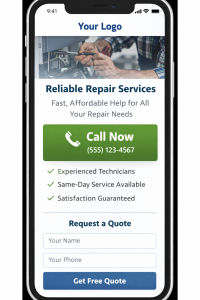
Your phone number should be at the top of the page, big and bold. On mobile, it should be a clickable button. Most people will call instead of filling out a form, so make calling as easy as possible.
Keep It Simple and Focused
Your landing page should have one goal: get the person to call you. Don’t clutter it with unnecessary information or links to other pages. Keep the message clear and the path to conversion short.
Include Trust Signals
People need to trust you before they call. Include:
- Reviews and testimonials
- Years in business
- Certifications or licenses
- Service area map
- Photos of your team or trucks
These signals reassure the person that you’re legitimate and capable.
Optimize for Mobile
Most appliance repair searches happen on mobile devices. Your landing page needs to load fast, display correctly on small screens, and make it easy to tap a button and call.
Test your landing page on your phone before you send traffic to it. If it’s hard to navigate or slow to load, fix it.
Tracking and Measuring What Actually Matters
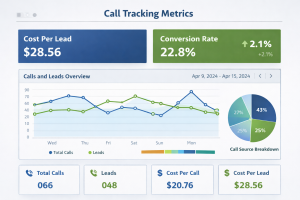
You can’t improve what you don’t measure. Tracking the right metrics tells you what’s working and where to invest more.
Cost Per Lead (CPL)
This is how much you’re paying, on average, to get one lead (a phone call or form submission). Calculate it by dividing your total ad spend by the number of leads you received.
If you spent $1,000 and got 20 leads, your CPL is $50. This number varies by market and competition, but tracking it over time helps you understand if your campaigns are getting more or less efficient.
Conversion Rate
This is the percentage of people who click your ad and then take action (call or fill out a form). If 100 people click your ad and 10 of them call, your conversion rate is 10%.
A low conversion rate usually means there’s a problem with your landing page or your ad is attracting the wrong people.
Cost Per Acquisition (CPA)
CPL tells you how much you’re paying per lead, but not all leads turn into paying customers. CPA tells you how much you’re paying to acquire an actual customer.
If your CPL is $50 and half your leads turn into jobs, your CPA is $100. This is the number that matters most because it’s directly tied to revenue.
Return on Ad Spend (ROAS)
ROAS measures how much revenue you’re generating for every dollar you spend on ads. If you spend $1,000 on ads and generate $5,000 in revenue, your ROAS is 5:1.
This is the ultimate measure of whether your Google Ads campaigns are profitable.
Track Everything from Click to Customer
Use call tracking, CRM integration, and conversion tracking to connect your ad spend to actual revenue. You should be able to see which keywords and ads are driving not just leads, but paying customers.
This level of tracking takes effort to set up, but it’s the only way to know what’s really working.
Google Local Services Ads: Another Option for Appliance Repair
Google Local Services Ads (LSA) are different from regular Google Ads. They show up at the very top of search results with a green “Google Guaranteed” badge.
LSA works on a pay-per-lead model instead of pay-per-click. You only pay when someone contacts you directly through the ad. Google also screens and verifies businesses, which adds credibility.
LSA can be a good option for appliance repair companies, especially if you’re in a competitive market where regular Google Ads are expensive. The downside is you have less control over targeting and messaging compared to search ads.
We recommend running both LSA and regular Google Ads if your budget allows. They complement each other and give you more visibility in search results.
Common Questions About Google Ads for Appliance Repair
How much should I budget for Google Ads?
It depends on your market, competition, and goals. In most markets, you should plan to spend at least $1,000 to $2,000 per month to see meaningful results. Smaller budgets can work, but they limit your reach and make it harder to gather enough data to optimize.
How long does it take to see results?
You should start seeing leads within the first week if your campaigns are set up correctly. But it takes 30 to 60 days to gather enough data to optimize performance and improve efficiency.
Can I run Google Ads myself, or do I need help?
You can run Google Ads yourself, but it takes time to learn and ongoing effort to manage. Most appliance repair owners are better off focusing on running their business and working with a specialist who knows the industry.
What’s a good cost per lead for appliance repair?
It varies by market, but $30 to $80 per lead is typical for appliance repair in most areas. Competitive markets like major metro areas will be on the higher end. Less competitive areas will be lower.
Do I need a separate landing page for each appliance type?
Ideally, yes. Dedicated landing pages improve conversion rates because they match the searcher’s intent exactly. If budget or resources are tight, start with one strong landing page and expand from there.
Why Most Appliance Repair Owners Struggle with Google Ads
The truth is, Google Ads isn’t hard because the platform is complicated. It’s hard because most people don’t understand how search behavior works for appliance repair, how to structure campaigns for service businesses, or how to track results properly.
Generic marketing agencies treat appliance repair like every other local service. They use the same templates, the same keyword lists, and the same landing pages they use for plumbers or electricians. It doesn’t work because appliance repair has different search patterns, different customer urgency levels, and different competitive dynamics.
We’ve spent years working exclusively with appliance repair companies. We know which keywords convert, what ad copy gets clicks, how to structure campaigns for profitability, and how to track results from click to customer. That specialization makes all the difference.
Ready to Get Predictable Leads from Google Ads?
If you’re tired of inconsistent call volume, wasted ad spend, or working with marketing agencies that don’t understand your business, we can help.
At Appliance Marketing Pros, we specialize in Google Ads, local SEO, and lead generation systems built specifically for appliance repair companies. We work with owner-operators and growth-stage businesses across the country to create predictable, profitable lead flow.
We don’t use generic strategies or one-size-fits-all templates. Everything we do is tailored to the appliance repair industry because that’s all we focus on.
If you want to see what a real Google Ads strategy looks like for your business, book a free strategy call with us. We’ll review your current marketing, identify what’s working and what’s not, and show you exactly how we’d drive better leads for your company.
No pressure. No sales pitch. Just a real conversation about how to grow your appliance repair business with marketing that actually works.
Book your free strategy call today and start getting the leads your business deserves.
About The Author


