Blog
How to Build a Google Ads Strategy That Actually Works
Google Ads Strategy for Appliance Repair Businesses
Consistently getting your phone to ring is the difference between a thriving appliance repair business and one that’s constantly scrambling for work. Google Ads can deliver that predictable call volume, but only if you build campaigns the right way.
Most appliance repair owners we talk to have tried Google Ads before. They spent money, got a few calls, maybe booked a couple jobs. But the math didn’t work. The cost per lead was too high, the tracking was unclear, and they couldn’t tell if they were actually making money or just feeding Google’s algorithm.
Here’s the truth: Google Ads works incredibly well for appliance repair companies when you understand what you’re doing. The problem isn’t the platform. It’s that most people set up campaigns like they’re selling shoes online, not emergency refrigerator repairs in a 15-mile radius.
This guide walks you through exactly how to build Google Ads campaigns that generate qualified calls, track real revenue, and scale profitably. We’ll cover keyword research, ad copy, landing pages, conversion tracking, and the mistakes that waste your budget.
Why Google Ads Works for Appliance Repair (When Done Right)
Google Ads puts your business in front of people who are actively searching for help right now. Someone types “dishwasher repair near me” at 9 PM because their kitchen is flooded. That’s not a casual browser. That’s a buyer.
Unlike SEO, which takes months to build momentum, Google Ads can start delivering calls within hours. You control your budget, your service area, and exactly which searches trigger your ads.
The challenge is that appliance repair is a local, high-intent service business. Your ideal customer isn’t comparing brands or reading reviews for three weeks. They need help today. Your Google Ads strategy has to reflect that urgency and geography, or you’ll waste money on clicks that never convert.
Understanding What Your Customers Are Actually Searching For

Before you write a single ad or pick a keyword, you need to understand search intent. Not all searches are created equal.
Commercial Intent: Ready to Book
These are the searches that matter most:
- “appliance repair near me”
- “refrigerator repair [city name]”
- “emergency dishwasher repair”
- “same day washer repair”
The person searching wants a technician, not information. They’re comparing options, checking reviews, and calling the first few businesses that look credible. These searches convert fast.
Investigational Intent: Diagnosing the Problem
These searches come earlier in the decision process:
- “why is my dryer not heating”
- “refrigerator leaking water inside”
- “dishwasher not draining”
The person is trying to figure out if they need professional help or if it’s a simple fix. These searches can still convert, but they require different messaging. Your ad needs to acknowledge the problem and position you as the solution.
Most appliance repair Google Ads campaigns focus only on commercial intent keywords. That’s fine if you just want quick wins. But if you want to build a system that captures customers at every stage, you need both.
Building Your Keyword Strategy: What Actually Drives Calls
Keyword research for appliance repair isn’t complicated, but it does require local thinking. You’re not targeting the entire country. You’re targeting people within your service radius who need help with specific appliances.
Start with Appliance Type Keywords
These are your foundation:
- refrigerator repair
- washing machine repair
- dryer repair
- dishwasher repair
- oven repair
- stove repair
Add your city, county, or neighborhood to each one. “Refrigerator repair Phoenix” is better than just “refrigerator repair” because it filters out searchers outside your area and typically costs less per click.
Layer in Brand-Specific Keywords
A lot of appliance repair owners skip this, but brand keywords convert extremely well:
- Samsung refrigerator repair
- Whirlpool washer repair
- LG dryer repair
- GE dishwasher repair
- Maytag appliance repair
Why? Because the person searching already knows what brand they own. They’re looking for someone who knows that brand. Even if you work on all brands, targeting these keywords shows specialization and builds trust.
Add Problem-Based Keywords
These capture people earlier in their search:
- refrigerator not cooling
- washing machine won’t drain
- dryer not heating
- dishwasher leaking
- oven won’t turn on
Pair these with location modifiers and you’ve got a powerful way to intercept customers before they even search for “repair.”
Use Urgency and Service Type Modifiers
Appliance breakdowns are urgent. Capture that urgency:
- emergency appliance repair
- same day refrigerator repair
- 24 hour appliance repair
- weekend dryer repair
Also consider service-specific terms:
- appliance repair service
- appliance technician near me
- local appliance repair
Don’t Forget Negative Keywords
This is where most budget gets wasted. You need to exclude searches that will never convert:
- appliance repair jobs
- appliance repair training
- appliance repair school
- DIY appliance repair
- appliance repair parts
- appliance repair manual
- used appliances
- appliance sales
Add these as negative keywords at the campaign level so you’re not paying for clicks from job seekers, students, or people trying to fix things themselves.
Structuring Your Campaigns for Maximum Control
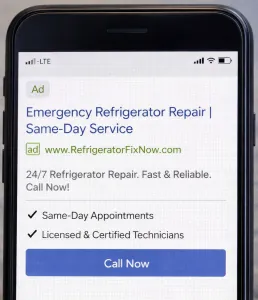
How you organize your Google Ads campaigns directly impacts your ability to optimize, track, and scale.
The biggest mistake we see is throwing all keywords into one campaign and one ad group. You lose control. You can’t see which appliances are driving calls. You can’t adjust bids based on performance. You can’t write specific ad copy.
Campaign Structure That Works
Campaign 1: Refrigerator Repair
- Ad Group: Refrigerator Repair General
- Ad Group: Refrigerator Brands (Samsung, LG, Whirlpool)
- Ad Group: Refrigerator Problems (not cooling, leaking, ice maker)
Campaign 2: Washer/Dryer Repair
- Ad Group: Washing Machine Repair
- Ad Group: Dryer Repair
- Ad Group: Washer/Dryer Brands
- Ad Group: Washer/Dryer Problems
Campaign 3: Dishwasher Repair
- Ad Group: Dishwasher Repair General
- Ad Group: Dishwasher Brands
- Ad Group: Dishwasher Problems
Campaign 4: Oven/Stove Repair
- Ad Group: Oven Repair
- Ad Group: Stove Repair
- Ad Group: Range Repair
This structure lets you control budgets by appliance type, write hyper-relevant ads, and see exactly where your best leads come from.
Geographic Targeting: Stay in Your Service Area
Set your campaigns to target only the zip codes or radius you actually serve. If you’re in Phoenix and you serve a 20-mile radius, don’t waste budget on clicks from Tucson.
Use location bid adjustments to increase bids in your highest-value areas and decrease them in the outer edges of your service zone.
Writing Ad Copy That Gets Clicks and Drives Calls
Your ad copy has one job: get the click from someone ready to call. That’s it.
Appliance repair customers don’t need clever wordplay. They need to know you’re available, you’re local, you’re fast, and you’re trustworthy.
Headline Formula That Works
Headline 1: Service + Location
Example: “Refrigerator Repair in Phoenix”
Headline 2: Differentiator or Urgency
Example: “Same-Day Service Available”
Headline 3: Trust or Proof
Example: “Licensed & Insured Technicians”
Description Copy Essentials
Your description should reinforce your headline and push toward action:
- State your service clearly
- Mention your service area
- Include a key differentiator (same-day, 24/7, certified, warranty)
- Add a strong call to action
Example:
“Fast, reliable refrigerator repair in Phoenix and surrounding areas. Our licensed technicians fix all brands. Same-day appointments available. Call now for a free estimate.”
Use Every Ad Extension Available
Ad extensions make your ad bigger, more visible, and more credible. Use:
- Call extensions: Your phone number shows directly in the ad
- Location extensions: Your address and map pin appear
- Sitelink extensions: Links to specific service pages (Refrigerator Repair, Dishwasher Repair, etc.)
- Callout extensions: Short phrases like “Same-Day Service,” “All Brands,” “Licensed & Insured”
- Structured snippets: Lists like “Services: Refrigerator, Washer, Dryer, Dishwasher”
Extensions don’t cost extra and they dramatically improve click-through rates.
Building Landing Pages That Actually Convert
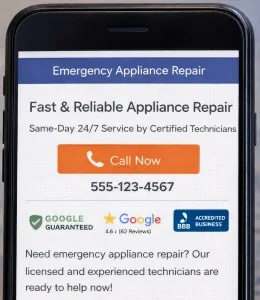
Getting the click is only half the battle. If your landing page doesn’t convert, you’re burning money.
Most appliance repair businesses send Google Ads traffic to their homepage. That’s a mistake. Your homepage is generic. It talks about everything. It doesn’t match the ad.
Landing Page Essentials
- Match the Ad Message
If your ad says “Refrigerator Repair in Phoenix,” your landing page headline should say “Refrigerator Repair in Phoenix.” Don’t make people hunt for proof they’re in the right place. - Clear Value Proposition
State what you do, who you serve, and why they should choose you in the first three seconds. - Prominent Phone Number
Big, clickable, at the top of the page. Most people will call, not fill out a form. - Trust Signals
- Customer reviews and star ratings
- Years in business
- Certifications and licenses
- Brands you service
- Service area map
- Simple Lead Form (If You Use One)
Name, phone, email, brief description. That’s it. Every extra field kills conversions. - Mobile-First Design
Most searches happen on mobile. Your page needs to load fast and be easy to navigate on a phone. - Clear Call to Action
“Call Now for Same-Day Service” works better than “Contact Us” or “Learn More.”
What Kills Landing Page Conversions
- Slow load times
- Too much text
- No phone number above the fold
- Generic stock photos
- Complicated forms
- No social proof
- Broken mobile experience
If your bounce rate is high and your conversion rate is low, start with page speed and mobile usability. Those two factors alone can double your results.
Setting Up Conversion Tracking That Actually Works
If you can’t track conversions, you can’t optimize. You’re flying blind.
Most appliance repair owners we work with have no idea which keywords or ads are driving actual booked jobs. They see clicks. They see some calls. But they don’t know if those calls turned into revenue.
What You Need to Track
- Phone Calls
Use call tracking software that assigns unique phone numbers to your Google Ads campaigns. This lets you see exactly which keywords and ads drive calls.
Track:
- Total calls
- Call duration (calls under 60 seconds are usually not qualified leads)
- Call source (which campaign, ad group, keyword)
- Form Submissions
If you have a contact form, set up conversion tracking in Google Ads so every form submission is logged. - Booked Appointments
This is the hardest to track but the most important. Calls don’t equal revenue. Booked jobs do.
If possible, track which leads turned into actual service calls. This tells you your true cost per acquisition, not just cost per lead.
Understanding Your Cost Per Lead
Once tracking is in place, calculate your cost per lead (CPL):
CPL = Total Ad Spend / Total Qualified Leads
A qualified lead is a call or form that could realistically turn into a job. Wrong number? Not in your service area? Looking for parts only? Not qualified.
Then calculate your cost per acquisition (CPA):
CPA = Total Ad Spend / Total Booked Jobs
This is your real number. If your average job is worth $300 and your CPA is $50, you’re profitable. If your CPA is $150, you need to optimize or raise prices.
Budgeting and Bidding: How Much Should You Spend?
There’s no universal answer, but here’s how to think about it.
Start with Your Service Capacity
If you have two technicians and you’re already booked three days out, don’t dump $5,000 into Google Ads. You’ll generate leads you can’t service and waste money.
Start with a budget that matches your capacity to take on new work. As you grow, scale your ad spend.
Understand Cost Per Click in Your Market
Appliance repair CPCs vary by location and competition. In a small town, you might pay $3-$8 per click. In a major metro area, expect $10-$25 or more.
Run the math:
- If your CPC is $15 and your conversion rate is 10%, your CPL is $150.
- If your close rate is 50%, your CPA is $300.
- If your average job is worth $350, your margin is tight.
This is why conversion rate optimization matters. Improving your landing page from 10% to 15% conversion cuts your CPL by a third.
Bidding Strategies
When you’re starting out, use Manual CPC bidding. This gives you full control and helps you learn which keywords perform.
Once you have conversion data (at least 30 conversions), you can test automated strategies like:
- Maximize Conversions: Google adjusts bids to get you the most conversions within your budget
- Target CPA: Google tries to keep your cost per conversion at a specific number
Automated bidding works, but only if your conversion tracking is accurate and you have enough data.
Avoiding the Mistakes That Waste Your Budget
We’ve audited hundreds of appliance repair Google Ads accounts. Here are the most common problems:
- No Negative Keywords
You’re paying for clicks from job seekers, DIYers, and people looking for parts. - Sending Traffic to Your Homepage
Your homepage doesn’t match the ad. Conversions suffer. - No Call Tracking
You have no idea which keywords drive actual calls. - Broad Match Keywords with No Strategy
Broad match can work, but only if you’re actively managing search terms and adding negatives. Most people just bleed budget. - Ignoring Mobile Experience
Your landing page looks great on desktop but is a disaster on mobile. Most of your traffic is mobile. - Not Using Location Extensions
You’re missing free visibility and credibility. - Running Ads 24/7 with No After-Hours System
If you’re not answering the phone at 10 PM, don’t run ads at 10 PM. Use ad scheduling to match your availability. - No Follow-Up System
Someone calls, you miss it, you never call back. That’s a wasted lead and wasted ad spend.
When to Bring in an Expert
Google Ads isn’t set-it-and-forget-it. It requires ongoing optimization, testing, and tracking.
If you’re a small owner-operator, you might be able to manage your own campaigns if you’re willing to invest the time to learn. But most appliance repair owners don’t have that time. You’re running service calls, managing technicians, handling customer issues, and trying to grow your business.
That’s where a specialized agency makes sense.
At Appliance Marketing Pros, we’ve spent years building Google Ads systems specifically for appliance repair companies. We know which keywords convert. We know how to structure campaigns for maximum control. We know how to track calls and optimize for actual revenue, not just clicks.
Our AMPRank system combines Google Ads with local SEO, Google Business Profile optimization, and AI-powered visibility tools to create predictable, scalable lead flow.
If you’re tired of inconsistent call volume, unclear ROI, and marketing tactics that don’t work for your business, let’s talk. We’ll walk you through exactly how we’d build your system, what results to expect, and how we track everything.
Ready to build a Google Ads system that actually drives revenue?
Schedule a free strategy call with our team. We’ll review your current marketing, identify what’s working and what’s not, and show you exactly how we’d build a system that delivers consistent, qualified leads for your appliance repair business.
No pressure. No sales pitch. Just a clear plan and honest advice from people who’ve done this hundreds of times.