Blog
Advanced Lead Generation and Conversion Strategies
You already know the problem. Some weeks your phone rings nonstop. Other weeks it’s crickets. You’re stuck between paying $40 for a shared lead from HomeAdvisor where four other guys got the same call, or sitting around hoping your Google Business Profile does something.
Most appliance repair owners treat lead generation like a slot machine. They throw money at Facebook ads, buy leads from aggregators, or hope their nephew’s SEO work eventually pays off. Then they wonder why their cost per job keeps climbing while their booking rate drops.
Here’s the truth: lead generation for appliance repair isn’t about getting more leads. It’s about building a system that delivers the right leads at a predictable cost, so you can staff your trucks properly and stop guessing what next month looks like.
Appliance repair lead generation and conversion strategies walk you through exactly how to do that, using the same approach we’ve refined working exclusively with appliance repair companies across the United States.
Why Most Appliance Repair Lead Generation Fails
Before we talk about what works, let’s address why most owners are frustrated with their current setup.
The Lead Aggregator Trap
Services like Angi, HomeAdvisor, and Thumbtack sell the same lead to multiple contractors. You pay $25 to $50 for a “lead” that’s really just permission to compete with three or four other companies for the same job.
The homeowner gets bombarded with calls. Whoever answers first and quotes the lowest price usually wins. Your profit margin gets destroyed, and you’re training customers to shop on price alone.
Even worse, many of these leads are low-intent. The homeowner might be “just checking prices” or not ready to book for weeks. You pay regardless.
Rented Land vs. Owned Assets
When you rely entirely on lead aggregators, you’re renting access to customers. You have no control over lead quality, pricing, or volume. If they raise prices or change their algorithm, your business suffers immediately.
Compare that to owned assets like your website, Google Business Profile, or a well-structured Google Ads account. These are systems you control. Once they’re dialed in, they generate leads month after month without someone else setting the rules.
The “Just Do SEO” Myth
Local SEO works well for appliance repair, but it’s not a quick fix. Ranking in the top three map pack spots takes time, consistent effort, and a solid foundation (citations, reviews, optimized GBP, service pages).
Many owners get sold on SEO, wait six months, see minimal movement, and give up. Or they hire someone who doesn’t specialize in appliance repair and wastes time targeting the wrong keywords or building spammy links.
SEO is part of the system, but it’s not the whole system.
The Three-Pillar Lead Generation System
If you want predictable, exclusive leads for your appliance repair business, you need three components working together: immediate lead capture, long-term visibility, and a follow-up system that doesn’t let opportunities slip away.
Pillar 1: Google Local Services Ads (Your Fastest Path to Exclusive Leads)
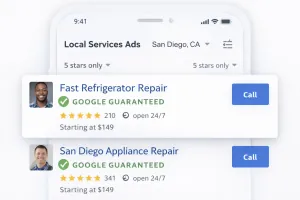
Google Local Services Ads (LSA) should be your first priority if you’re not already running them. This is the Google Verified badge that appears at the very top of search results, above even regular Google Ads.
Why LSA Works for Appliance Repair
You only pay when someone calls you directly from the ad. There’s no cost-per-click guessing game. If the lead is invalid (e.g., incorrect service area, spam), you can dispute it and be credited.
The Google Guarantee badge builds instant trust. Homeowners see that Google has vetted your business, and they’re far more likely to call you over a competitor without the badge.
LSA leads are exclusive. When someone clicks your profile and calls, that lead belongs to you. You’re not competing with five other companies at the same time.
What LSA Actually Costs
Cost per lead varies by market, but most appliance repair companies see LSA leads in the $25 to $60 range. In competitive metro areas, it can go higher. In smaller markets, you might pay closer to $20.
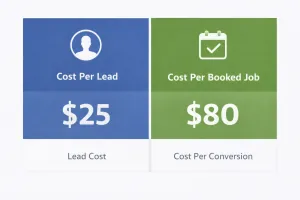
The key metric isn’t cost per lead. It’s the cost per booked job. If you’re paying $40 per lead and booking 50% of them, your customer acquisition cost is $80. That’s extremely efficient for most appliance repair businesses, especially if your average ticket is $250 or higher.
Common LSA Mistakes
Many owners set up LSA, get a few leads, then turn it off because they “didn’t see results.” Usually, the issue is one of three things:
- They didn’t respond fast enough (LSA leads expect immediate contact)
- Their booking process was disorganized (no scripts, no follow-up)
- They didn’t track which leads actually turned into jobs
LSA works when it’s part of a system, not a one-off experiment.
Pillar 2: Search-Intent Google Ads (Capture the Emergency)
Google Ads is where you capture high-intent searches like “refrigerator repair near me” or “washer won’t drain fix today.” These are people with an immediate problem who need a technician now.
Why We Focus on Search Campaigns Only
Most agencies will try to sell you on Performance Max or Display campaigns because they’re easier to set up and generate lots of “impressions.” But for appliance repair, those campaigns waste money.
Performance Max spreads your budget across YouTube, Gmail, the Display Network, and random placements unrelated to someone needing a repair right now. You end up paying for clicks from people outside your service area or not ready to book.
Search campaigns let you target exact phrases that indicate buying intent. When someone types “dishwasher repair [your city],” they want a technician today. That’s the traffic you want.
Structuring Campaigns by Appliance Type
Don’t lump all your services into one campaign. Break them out:
- Refrigerator repair
- Washer and dryer repair
- Dishwasher repair
- Oven and range repair
This gives you control over budgets, ad copy, and landing pages. If refrigerator repair is your most profitable service, you can allocate more budget there. If dryer vent cleaning has a lower ticket, you can bid more conservatively.
What Good Google Ads Performance Looks Like
For appliance repair, you should aim for:
- Click-through rate (CTR) of 8% or higher
- Cost per click is between $5 and $15, depending on the market
- Conversion rate (call or form) of 10% to 20%
If your CTR is below 5%, your ads aren’t relevant enough to the search. If your cost per click is above $20, you’re either in an extremely competitive market or bidding on the wrong keywords.
The real number that matters is the cost per booked job. If you’re spending $100 in ad spend to book a $300 job, and your cost of goods is reasonable, that’s a winning campaign.
Pillar 3: Local SEO and Google Business Profile (The Long Game)
Local SEO is what keeps your phone ringing even when you’re not actively spending on ads. It’s the foundation of long-term lead generation.
Google Business Profile Optimization
Your GBP is often the first thing a potential customer sees. If it’s incomplete, outdated, or buried on page two of the map pack, you’re losing jobs to competitors who have optimized.
Here’s what actually moves the needle:
Complete Every Section
Business name, address, phone number, website, hours, service area, categories, attributes, and description. Google favors profiles that are 100% filled out.
Categories Matter
Your primary category should be “Appliance Repair Service.” Add secondary categories such as “Refrigerator Repair Service” or “Washer & Dryer Repair Service” if applicable. Don’t add irrelevant categories just to game the system. Google will penalize you.
Photos and Posts
Upload high-quality photos of your trucks, technicians, completed jobs, and service area. Post updates regularly (weekly is ideal). Google treats active profiles as more relevant than stale ones.
Reviews (The Biggest Ranking Factor)
Review volume and recency are massive ranking signals. A business with 150 reviews and an average of 4.7 stars will almost always outrank a competitor with 30 reviews, even if the competitor has a perfect 5.0.
Ask every satisfied customer for a review. Make it easy by sending a direct link via text or email. Respond to every review, good or bad, within 48 hours.
Service Pages That Actually Rank
Your website needs individual service pages for each appliance type and each city you serve. A single “Services” page won’t cut it.
Each page should include:
- Primary keyword in the H1 (e.g., “Refrigerator Repair in [City]”)
- Clear description of the service
- Common problems you fix
- Why customers choose you
- Service area mentioned naturally
- Call to action (phone number, booking button)
Don’t stuff keywords. Write like a human explaining the service to a homeowner. Google’s algorithm is smart enough to understand context.
Why Local SEO Takes Time
SEO isn’t a sprint. It takes three to six months to see meaningful movement in most markets, and up to a year in highly competitive areas.
But once you rank in the top three map pack spots, you’ll get a steady stream of organic leads every single day. These are the highest-quality leads you can get because the customer found you, not the other way around.
Understanding Lead Costs and ROI
Let’s talk numbers, because this is where most owners get confused.
What You Should Actually Pay Per Lead
Lead costs vary by source and market:
- Google Local Services Ads: $25 to $60 per lead
- Google Ads (Search): $40 to $80 per lead (based on CPC and conversion rate)
- Lead aggregators (Angi, HomeAdvisor): $20 to $50 per lead (shared)
- Organic SEO: Essentially free after the upfront investment
But cost per lead is meaningless without context. What matters is the cost per booked job.
The Real Math: Cost Per Booked Job
Let’s say you’re running Google Ads and paying $50 per lead. If your booking rate is 40%, your cost per booked job is $125.
Now compare that to a $25 shared lead from HomeAdvisor. If your booking rate on those is 10% (due to competition from other contractors), your cost per booked job is $250.
The “cheaper” lead is actually twice as expensive.
Booking Rate Is Everything
Your booking rate depends on three things:
- Lead quality (is this person ready to book?)
- Response speed (did you call back within 5 minutes?)
- Your sales process (do you sound confident and professional on the phone?)
Most appliance repair companies book between 30% and 50% of inbound leads. If you’re below 30%, the problem isn’t your marketing. It’s your follow-up.
Tracking What Actually Works
You need call tracking. Period.
Use a service like CallRail or CallTrackingMetrics to assign unique phone numbers to each lead source (Google Ads, LSA, organic, etc.). This shows which channel drives booked jobs, not just calls.
Without tracking, you’re flying blind. You might be spending $2,000 a month on Google Ads that generate 10 jobs, while your GBP is quietly generating 15 jobs for free. You’d never know without data.
The Follow-Up System (Where Most Leads Die)
Here’s an uncomfortable truth: most appliance repair businesses lose more leads due to poor follow-up than poor marketing.
Speed to Contact Is Non-Negotiable
When someone searches for appliance repair, they’re usually in crisis mode. The fridge is leaking. The washer won’t spin. They need help today.
If you don’t answer the phone or return the call within 5 to 10 minutes, they’ve already called the next company. Studies show that response time is one of the biggest factors in conversion rates.
What Happens to Leads You Don’t Book Immediately
Not every lead books on the first call. Maybe they’re getting multiple quotes. Maybe they need to check their schedule. They may not be sure whether to repair or replace.
If you don’t have a follow-up system, those leads disappear.
Here’s what a basic follow-up system looks like:
- Day 1: Initial contact (phone call)
- Day 2: Follow-up text or email if no response
- Day 3: Second phone call
- Day 7: Final follow-up message
You’d be surprised by how many jobs are booked at the second or third touchpoint.
Automation Helps, But Don’t Overdo It
Tools such as Housecall Pro, ServiceTitan, and Jobber can automate some of this. You can set up text reminders, email sequences, and booking confirmations.
But don’t rely entirely on automation. A personal phone call from a real human still converts better than a text message. Use automation to make sure nothing falls through the cracks, but lead with human contact.
Beyond New Leads: Your Existing Customer Database
Every appliance repair business has a goldmine sitting in its CRM or filing cabinet: past customers.
Why Past Customers Are Your Best Lead Source
Someone who hired you once already trusts you. They know your work. They have your number. If their dryer vent needs cleaning or their fridge starts acting up again, you should be the first call they make.
But most owners do nothing to stay in front of past customers. They finish the job, send the invoice, and never follow up.
Simple Reactivation Tactics
Send a quarterly email or postcard reminding customers about seasonal maintenance:
- Spring: Refrigerator coil cleaning, AC prep
- Summer: Dryer vent cleaning (fire safety)
- Fall: Furnace and appliance check before holidays
- Winter: Reminder about ice maker and heating appliance maintenance
Include a small discount or free inspection to give them a reason to respond.
You can also text past customers when you’re in their neighborhood. “Hi [Name], we’re doing a repair nearby this week and have an opening. Need anything checked while we’re in the area?”
This approach books jobs at virtually zero acquisition cost.
How to Choose the Right Lead Generation Mix
Not every appliance repair business needs the same lead generation strategy. Your mix depends on your current stage and goals.
If You’re Just Starting Out (1 to 2 Technicians)
Focus on speed and immediate results:
- Google Local Services Ads (turn on today, get leads this week)
- Google Business Profile optimization (start building your foundation)
- Ask every customer for a review
Hold off on big SEO investments until you have a consistent cash flow. Get your phone ringing first, then build long-term assets.
If You’re Growing (3 to 10 Technicians)
Layer in predictability and scale:
- Keep LSA running
- Add Google Ads Search campaigns (target high-value appliance types)
- Invest in local SEO (service pages, content, citations)
- Build a follow-up system so you don’t waste leads
At this stage, you should be tracking everything. Know your cost per lead, cost per booked job, and lifetime customer value for each channel.
If You’re Established (10+ Technicians)
Optimize for efficiency and brand:
- Refine Google Ads to focus on your most profitable services
- Dominate local SEO in your core service area
- Build content that establishes you as the local expert
- Implement database reactivation campaigns
- Consider expanding the service area with targeted campaigns
You should have enough data at this point to know exactly what’s working. Double down on your best channels and cut anything that’s not delivering ROI.
What to Avoid (Tactics That Waste Money)
Not every marketing channel works for appliance repair. Here’s what to skip.
Facebook and Instagram Ads
Social media ads can work for brand awareness, but they’re terrible for lead generation in appliance repair. People don’t scroll Facebook looking for a refrigerator repair company. They go to Google when something breaks.
If an agency pitches you on Facebook lead gen, run.
Nextdoor and Craigslist
Nextdoor can generate some leads, but the quality is inconsistent, and the platform doesn’t scale. Craigslist is mostly tire kickers and price shoppers.
Your time and budget are better spent on Google.
SEO “Packages” from Generic Agencies
Beware of agencies that sell cookie-cutter SEO packages with vague promises like “we’ll get you on page one.” If they don’t specialize in home services or appliance repair specifically, they don’t understand your business.
They’ll waste months building links to irrelevant directories, writing blog posts on topics no one searches for, and optimizing for keywords that don’t drive job applications.
Build a System with Proven Lead Generation and Conversion Strategies
The appliance repair companies that grow consistently aren’t chasing leads. They’ve built systems that generate predictable call volume month after month.
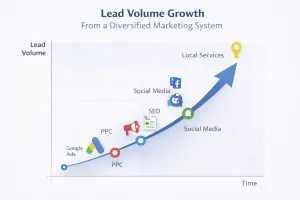
That system starts with Google Local Services Ads to get immediate traction, adds Google Ads Search campaigns to capture high-intent traffic, and layers in local SEO for long-term organic growth. It tracks every lead source, follows up relentlessly, and doesn’t let opportunities slip away.
And it treats past customers as assets, staying in front of them so you’re the first call when they need help again.
If you’re tired of the feast-or-famine cycle and want a clear plan for predictable growth, we can help. Appliance Marketing Pros specializes exclusively in marketing for appliance repair, HVAC, and vent cleaning companies. We’ve built this exact system for businesses across the country.
Get a free marketing analysis of your current setup. We’ll show you exactly where you’re losing leads, what’s working, and how to build a system that delivers consistent results. No generic advice. No long-term contracts. Just a clear roadmap based on what actually works in your market.
Visit appliancemarketingpros.com or call us today. Let’s build your lead generation system the right way.