Blog
Get Found First: Your Blueprint for Local SEO Success
How to Achieve Local SEO Success
You’re running a solid appliance repair business. Your technicians know their stuff. You fix refrigerators, washers, dryers, and ovens faster than most shops in town.
But here’s the problem: when someone’s refrigerator breaks at 9 PM and they grab their phone to search “appliance repair near me,” they’re not finding you first. They’re finding your competitor. Or worse, they’re finding a lead generation company that’s going to sell their information to five other shops.
That’s the gap local SEO fills. It’s not about getting more website visitors. It’s about getting found by people who are ready to book a repair right now, in your service area, before they call someone else.
This guide walks you through exactly how to show up first when it matters most.
Why Local SEO Matters More for Appliance Repair Than Most Industries
Appliance repair is different from other home services.
When someone’s refrigerator stops cooling, they’re not researching for three weeks. They’re not comparing blog posts. They’re searching, calling, and booking within an hour.
That means local SEO for appliance repair isn’t about brand awareness or long-term nurturing. It’s about being visible when someone needs help.
Here’s what makes local search critical for your business:
High intent searches. People searching “washing machine repair near me” aren’t browsing. They need a technician today.
Geographic competition. You’re not competing with every appliance shop in the country. You’re competing with the handful of businesses Google shows in your city.
Mobile-first behavior. Most appliance repair searches happen on phones, often while standing next to a broken appliance.
Map Pack dominance. The Google Map Pack (the three businesses that appear with map pins) receives more clicks than almost everything below it.
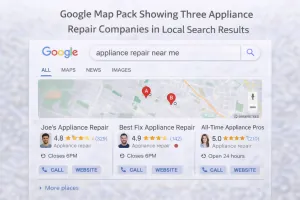
If you’re not showing up in that Map Pack or in the top five organic results, you’re losing jobs to competitors who are.
The Foundation: Your Google Business Profile Controls Everything
Your Google Business Profile is the single most important factor in local search visibility.
Not your website. Not your ads. Your GBP.
When someone searches for appliance repair in your area, Google decides who to show based heavily on your profile’s completeness, relevance, and authority.
Here’s what most appliance repair owners get wrong: they claim their profile, fill in the basics, and forget about it. That’s not enough.
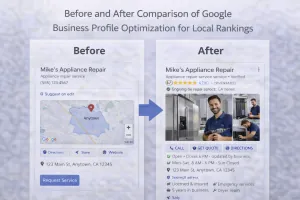
How to Optimize Your Google Business Profile the Right Way
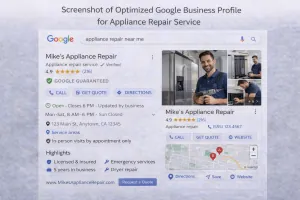
Claim and verify your profile. If you haven’t done this yet, stop reading and do it now. Go to google.com/business and follow the verification steps. You’ll usually get a postcard with a code.
Choose the right primary category. This matters more than most people realize. Your primary category should be “Appliance Repair Service.” Don’t choose “Small Appliance Repair Service” unless that’s truly all you do. You can add secondary categories such as “Refrigerator Repair Service” or “Washer & Dryer Repair Service,” but your primary category determines how Google classifies your business.
Fill out every section completely. Business name, address, phone number, website, hours, service area. If Google gives you a field, fill it in. Incomplete profiles rank lower.
Write a keyword-rich business description. You have 750 characters. Use them. List the appliances you repair (refrigerators, washers, dryers, ovens, dishwashers), the areas you serve, and what sets you apart. Write for customers, not Google, but include the phrases people actually search for.
Example: “We provide fast, reliable appliance repair throughout [City] and surrounding areas. Our certified technicians repair all major brands of refrigerators, washing machines, dryers, dishwashers, and ovens. Same-day service available.”
Add high-quality photos. Google prioritizes profiles with recent, high-quality images. Upload photos of your team, your service vehicles, completed repairs, and your service area. Businesses with photos get significantly more engagement than those without.
Use Google Posts weekly. Most repair shops ignore this feature. That’s a mistake. Google Posts let you share updates, promotions, and service highlights directly in your profile. Post at least once a week about common repairs, seasonal tips, or service reminders. It signals to Google that your business is active.
The Reviews Problem (And How to Fix It)
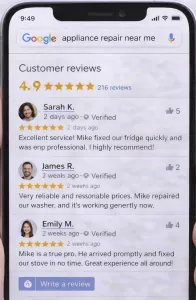
Reviews are the second-biggest ranking factor after relevance.
But here’s what most appliance repair owners do wrong: they wait for reviews to happen naturally. They don’t.
You need a system for asking every satisfied customer to leave a review. Not some customers. Every customer.
Here’s a simple process that works:
- Finish the job and make sure the customer is happy
- Send a follow-up text or email within 24 hours thanking them
- Include a direct link to your Google review page
- Make it one click, no friction
The businesses that dominate local search have 50+ reviews. If you have 12 reviews and your competitor has 60, you’re losing jobs even if your service is better.
Respond to every review. Positive or negative, respond within 48 hours. Thank people for positive reviews. Address concerns in negative reviews professionally and offer to make it right. Google watches response rates and factors them into rankings.
Your Website: The Second Half of Local Visibility
Your Google Business Profile helps you appear in the Map Pack. Your website appears in the organic results below.
Both matter. You need both.
Here’s the truth about appliance repair websites: most are terrible. They’re slow, confusing, hard to use on mobile, and don’t answer the questions customers actually have.
If your website was built five years ago and hasn’t been updated since, you’re losing jobs.
What Your Website Needs to Rank Locally
Mobile-first design. More than 70% of appliance repair searches happen on mobile. If your site doesn’t load fast and look clean on a phone, you’re done. Test your site on your phone right now. If you have to pinch and zoom to read anything, it’s broken.
Click-to-call functionality. Every page should have your phone number at the top, and it should be clickable. When someone taps it, their phone should dial immediately. This may seem basic, but half the repair sites we audit lack it.
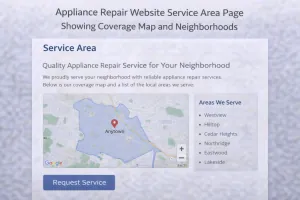
Service area pages. If you serve multiple cities or neighborhoods, you need a dedicated page for each one. Not a list. Individual pages.
Each page should include:
- The city or neighborhood name in the H1 and title tag
- Specific landmarks or areas you serve within that location
- The appliances you repair in that area
- Unique content (not copied from other pages)
Example: “Appliance Repair in [Neighborhood Name]” with content about serving that specific area.
These pages help you rank for searches like “appliance repair in [specific city]” and demonstrate to Google that you serve those areas.
Appliance-specific pages. Create separate pages for each major appliance type you repair. One for refrigerator repair. One for washing machine repair. One for dryer repair.
Why? People search for specific appliances, not the generic “appliance repair.”
Someone with a broken dishwasher searches “dishwasher repair near me,” not “appliance repair near me.”
Each page should:
- Target one appliance type
- List common problems you fix for that appliance
- List the major brands you service (e.g., Whirlpool, GE, Samsung, LG).
- Include a clear call to action
Fast loading speed. Google prioritizes fast websites. If your site takes more than three seconds to load, you’re losing both rankings and customers. Use Google PageSpeed Insights to test your site speed and fix the issues it flags.
Building Local Authority Beyond Your Website
Google doesn’t just look at your website and GBP. It looks at your entire online presence.
That means citations, backlinks, and local signals all factor into where you rank.
NAP Consistency: The Boring Thing That Matters
NAP stands for Name, Address, Phone Number.
Google checks whether your business information is consistent across the web. If your address is “123 Main St” on your website but “123 Main Street” on Yelp, that’s a consistency problem.
It sounds nitpicky, but Google uses NAP consistency as a trust signal. Inconsistent information makes Google less confident about your business.
Here’s what to do:
- Choose one exact format for your business name, address, and phone number
- Use that exact format everywhere (website, GBP, Yelp, Facebook, directories)
- Don’t abbreviate your address in some places and spell it out in others
- Use the same phone number everywhere
Citations: Getting Listed in the Right Places
Citations are mentions of your business on other websites. Think Yelp, Yellow Pages, Angi, and industry-specific directories.
You don’t need hundreds of citations. You need the right ones.
Focus on:
- Major directories (Yelp, Yellow Pages, Bing Places)
- Industry-specific directories (appliance repair or home services directories)
- Local directories (chamber of commerce, local business associations)
Ensure your NAP is consistent across all listings.
Avoid spammy directories or sites that feel sketchy. Quality matters more than quantity.
Local Backlinks: The Hardest Part (But Worth It)
Backlinks are when another website links to yours.
Google sees backlinks as votes of confidence. The more quality sites that link to you, the more Google trusts your site.
Local backlinks are links from other local businesses, news sites, or community organizations.
Here are a few realistic ways to earn them:
- Sponsor a local sports team or charity event (they’ll usually link to your site)
- Get featured in local news or blogs (offer expert commentary on appliance care tips)
- Partner with local businesses (property managers, real estate agents, home builders)
Don’t buy links. Don’t spam directories. Focus on real relationships and genuine value.
Content That Attracts Local Customers
Most appliance repair websites have the same five pages: Home, About, Services, Contact, and maybe a generic blog.
That’s not enough to compete.
You need content that answers the questions your customers are actually asking.
Blog Strategy: Answer Real Questions
When someone’s refrigerator stops working, they often troubleshoot before calling a repair shop.
“Why is my refrigerator not cooling?”
“Why is my washing machine leaking?”
“How do I know if my dryer needs repair?”
If you create helpful blog posts that answer these questions, you can rank for those searches and capture customers before they even know they need a repair.
Here’s what works:
Target long-tail keywords. Instead of trying to rank for “refrigerator repair” (too competitive), target specific questions like “why is my fridge making a loud noise.”
Provide real value first. Explain the problem, common causes, and whether it’s something they can fix themselves or need a professional for. Don’t just pitch your services.
End with a clear next step. After you’ve helped them, invite them to call you if they need expert help.
Keep it simple. Write like you’re talking to a customer on the phone. No jargon. No technical specifications unless necessary.
Post consistently. One blog post a month is better than ten posts once and then nothing for a year.
FAQ Section: Quick Answers Build Trust
Add an FAQ section to your website with common questions like:
- Do you offer same-day service?
- What brands do you repair?
- Do you service my area?
- How much does a typical repair cost? (Answer generally without specific pricing)
Short, direct answers build trust and improve visibility in featured snippets in Google search results.
Measuring What Actually Matters
Here’s what doesn’t matter: your website ranking for a keyword you never mentioned.
Here’s what does matter: phone calls, booked appointments, and revenue.
Too many appliance repair owners obsess over rankings and traffic without connecting it to actual business results.
Track the Right Metrics
Phone calls. Use call tracking to see which marketing channels drive calls. If you’re getting 20 calls a week but don’t know where they’re coming from, you can’t make smart decisions.
Appointment bookings. Calls are good. Booked jobs are better. Track how many calls turn into scheduled appointments.
Conversion rate. If 100 people visit your website and only two call, something’s broken. Your site should convert at least 3-5% of visitors into calls or form submissions.
Cost per lead. If you’re also running Google Ads, track the cost per lead. Local SEO leads are “free” after the upfront work, but you still need to know your numbers.
Realistic Timelines for Local SEO Results
Local SEO is not instant.
If someone promises you first-page rankings in 30 days, they’re lying or using tactics that will get you penalized.
Here’s a realistic timeline:
Month 1: Optimize your Google Business Profile, fix NAP consistency, start getting reviews.
Month 2-3: Build citations, create service area pages, start publishing content.
Month 4-6: Start seeing consistent improvement in Map Pack visibility and organic rankings.
Month 6+: Steady, predictable lead flow from local search.
Some markets are more competitive than others. If you’re in a major city with 50 other appliance repair shops, it takes longer. If you’re in a smaller market, you can see results faster.
The key is consistency. Local SEO isn’t a one-time project. It’s an ongoing system.
Why Most Appliance Repair SEO Fails (And What to Do Instead)
We’ve worked with hundreds of appliance repair businesses. Most come to us after trying SEO on their own or hiring a generic marketing agency.
Here’s what usually goes wrong:
Generic advice that doesn’t fit appliance repair. Most SEO guides are written for e-commerce or B2B companies. Appliance repair has different customer behavior, search patterns, and conversion cycles.
Focusing on the wrong metrics. Traffic and rankings don’t pay your bills. Booked jobs do. Too many agencies optimize for vanity metrics instead of revenue.
Ignoring Google Business Profile. Some agencies still treat GBP as an afterthought and focus only on your website. That’s backwards for local service businesses.
No review strategy. You can’t rank consistently without reviews. If your marketing partner isn’t helping you build a review system, they’re not doing local SEO right.
One-time optimization. Local SEO isn’t a project you finish. It’s a system you maintain. Your competitors are working on their SEO every month. If you stop, you fall behind.
Your Next Step: Get Found First
If you’re reading this, you already know your online visibility isn’t where it should be.
Maybe you’re showing up on page two. Maybe your competitor with worse technicians is getting more calls. Maybe you’re spending money on shared leads from Angi or HomeAdvisor because you don’t have enough organic leads coming in.
Local SEO fixes all of that. But it takes expertise, consistency, and a strategy built specifically for appliance repair businesses.
At Appliance Marketing Pros, we’ve spent over 20 years helping appliance repair companies show up first in local search, generate qualified leads, and build predictable growth systems.
We don’t do generic SEO. We don’t work with every industry. We focus exclusively on appliance repair, HVAC, and vent cleaning companies because we understand how your customers search, what drives conversions, and what actually works in your market.
If you’re ready to stop losing jobs to competitors and start owning your local market, let’s talk.
Schedule a free strategy call and we’ll walk you through exactly what’s holding your business back and how to fix it.
No pressure. No generic pitch. Just a clear plan for getting found first when it matters most.