
Blog
Building and Scaling Your Professional Service Team
Finding good appliance repair technicians is hard. Training them is harder. But if you want to grow your business beyond what you can personally handle, you need a system that turns new hires into reliable, professional techs who can represent your company.
Most appliance repair business owners fall into one of two traps. Either they hire only experienced techs (who are expensive and hard to find), or they hire cheap labor and hope for the best (which leads to callbacks, bad reviews, and lost money).
The smarter approach is building your own training system. This guide walks you through exactly how to do that, from hiring the right people to getting them field-ready in a structured, profitable way.
Why Training Matters More Than Hiring Experience
You have probably heard the advice: hire experienced technicians and avoid the headache of training.
That sounds good in theory. In reality, experienced appliance repair techs are hard to find, expensive to hire, and often come with bad habits from previous employers. They might know how to fix a washer, but if they are rude to customers or take shortcuts on installs, your reputation suffers.
Training your own technicians gives you control. You teach them your standards, your diagnostic process, and your customer service expectations from day one. The result is better consistency, lower callbacks, and a team that actually represents your brand the way you want.
The other benefit: retention. People stay longer at companies that invest in them. When you give someone a real career path instead of just a job, they stick around.
What You Are Really Training For
Appliance repair is not just about fixing machines. You are training technicians to do three things well:
Diagnose problems accurately. This is the skill that separates amateurs from professionals. A good tech does not just swap parts until something works. They follow a logical troubleshooting process, use a multimeter correctly, and read schematics to confirm the fault before ordering anything.
Communicate with customers professionally. Your tech is the face of your business. If they show up late, park on the lawn, track mud through the house, or talk down to the homeowner, you will get a bad review no matter how good the repair is. Soft skills matter as much as technical ability.
Work efficiently and safely. Speed matters in appliance repair because your techs get paid per job, and customers do not want to wait. But rushing leads to mistakes. You need to train techs to move fast without cutting corners, and to follow safety protocols around electricity, gas, and heavy equipment.
If your training program covers those three areas, you will build a team that makes you money instead of costing you callbacks and reputation damage.
Hire for Character, Train for Skill
The biggest mistake appliance repair owners make is hiring based only on experience. You post a job ad asking for five years of experience, then complain when no one applies or the people who do apply want $30 per hour.
A better approach: hire people with the right attitude and work ethic, then train them yourself.
Look for candidates who show up on time, ask good questions, and care about doing things right. You can teach someone how to test a compressor. You cannot teach them to care about quality or treat customers with respect.
Some of the best appliance repair techs started with zero experience. They came from construction, HVAC, or even retail. What they had was mechanical aptitude, a willingness to learn, and a strong work ethic. That is your ideal hire.
During the interview, focus less on what they have fixed before and more on how they think. Ask them to describe a time they solved a difficult problem. Ask what they do when they do not know the answer. You want people who troubleshoot logically and are not afraid to admit when they need help.
The Four-Phase Training Model
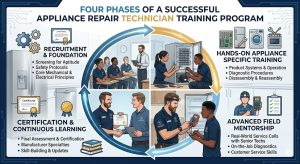
Training a new appliance repair technician takes time. Rushing the process leads to expensive mistakes, damaged equipment, and frustrated customers. A structured, multi-phase approach keeps your business safe while the trainee builds real competence.
Phase 1: Hiring, Orientation, and Safety
The first week is about setting expectations and building foundational knowledge. Do not send a new hire into the field yet.
Start with paperwork, policies, and basic safety training. Cover electrical safety, how to handle refrigerants (even if they are not EPA certified yet), and how to lift heavy appliances without injuring themselves or damaging floors.
Introduce them to your tools. Show them how you organize the van, where parts are stored, and what they are responsible for maintaining. Walk them through your dispatch system and how jobs get assigned.
This is also when you explain your service standards. What does a completed job look like? How do you expect them to treat customers? What should they do if something goes wrong?
Do not skip this phase. A solid orientation prevents confusion and bad habits later.
Phase 2: Theoretical Training and Foundational Skills
Before someone can fix appliances, they need to understand how appliances work.
This phase is about building technical knowledge. Teach the basics of electricity: voltage, current, resistance, and how circuits behave. Show them how to use a multimeter to test components. Walk them through common appliance systems like motors, pumps, timers, and control boards.
Schematics are critical here. A tech who cannot read a wiring diagram will struggle with anything more complex than a simple part swap. Spend time teaching them how to trace circuits, identify components on a schematic, and use diagrams to guide their troubleshooting.
You do not need to teach everything at once. Focus on the appliances you service most. If 80% of your calls are washers and dryers, start there. Refrigerators and dishwashers can come later.
This is also a good time to introduce online training resources. Programs like Master Samurai Tech offer structured courses that cover appliance theory in detail. You can assign modules as homework and then review the material together.
Phase 3: Hands-On Practice and Ride-Alongs
Book learning only goes so far. Phase three is where trainees start working on real equipment under supervision.
Start with shop-based practice if you have the space. Let them tear down old appliances, test components, and practice reassembly without the pressure of a customer watching. This is where they make mistakes safely.
Once they have basic competence, move to ride-alongs. Pair the trainee with your best technician and have them shadow real service calls. The trainee watches, asks questions, and helps with simple tasks like moving appliances or handing tools.
Gradually increase their responsibility. Let them perform parts of the repair under supervision. Have them test components, trace circuits, and explain their diagnosis before they take action. Correct mistakes in real time.
Ride-alongs also teach soft skills. The trainee sees how your experienced tech greets the customer, explains the problem, handles objections, and asks for payment. They learn the non-technical parts of the job that no manual covers.
Plan for at least four to six weeks of ride-alongs before a trainee goes solo. Rushing this phase is expensive. An unsupervised mistake can cost you more in callbacks and reputation damage than you save by putting someone in the field early.

Phase 4: Transition to Independence
Once a trainee has proven competence under supervision, you can start giving them solo jobs. But do not throw them into complex repairs right away.
Start with low-risk calls. Simple dryer repairs, dishwasher installs, or diagnostic-only visits are good entry points. These jobs build confidence without risking major damage if something goes wrong.
Set clear benchmarks. What does the trainee need to demonstrate before they handle refrigerators? What about gas appliances? Be specific about your expectations.
Check in regularly. Review their work, look at callback rates, and get customer feedback. If you see patterns (like repeated misdiagnoses or customer complaints), address them immediately with additional coaching.
Most trainees take six to nine months to reach full independence. Some take longer. Do not rush it. A well-trained tech who takes ten months to develop is better than a half-trained tech who creates problems after four.
Certifications That Matter
Not all certifications are equally important. Some are legally required. Others just look good on a resume.
EPA Section 608 Certification is mandatory if your techs work on sealed refrigeration systems. This covers refrigerators, freezers, and anything with a compressor and refrigerant. You cannot legally buy or handle refrigerants without this certification.
The good news: apprentices working under a certified technician are exempt while they are learning. Once they are ready to work independently, they need to get certified. The test is not hard, and prep courses are available online.
NASTeC (National Appliance Service Technician Certification) is not required, but it adds credibility. It shows customers and manufacturers that your techs have been tested on industry standards. Some manufacturer warranty programs prefer or require NASTeC-certified techs.
NASTeC covers four categories: cooking, refrigeration, laundry, and dishwashers. Techs can get certified in one category or all four. Certification lasts two years and requires renewal.
Manufacturer-specific training is worth pursuing if you work closely with certain brands. Companies like Whirlpool, Samsung, and LG offer training programs for authorized servicers. These programs teach brand-specific diagnostics and give you access to technical support and proprietary parts.
Do not overwhelm new techs with certifications upfront. Focus on getting them competent first. Certifications can come later as they specialize.
The Soft Skills Gap
Most training programs focus only on technical ability. That is a mistake.
Your technician can be the best diagnostician in the state, but if they are rude, messy, or unprofessional, you will lose customers. Soft skills are not optional. They are part of the job.
Teach your techs to communicate clearly. When they explain a problem to a customer, they should use simple language, not technical jargon. The customer does not need to understand how a thermal fuse works. They need to understand what is broken, how much it costs, and how long the repair will take.
Teach them to respect the customer’s home. Wear shoe covers. Park in the driveway, not on the grass. Do not leave tools scattered across the floor. Clean up any mess before you leave.
Teach them to handle objections professionally. If a customer questions the price or wants to think about it, your tech should stay calm and explain the value without being pushy. Aggressive sales tactics backfire in service businesses.
Teach them to ask for reviews. After a successful repair, a simple “If you are happy with the service, we would appreciate a review on Google” goes a long way. Most satisfied customers are willing to leave a review, but they will not do it unless you ask.
These skills do not come naturally to everyone. Role-play common scenarios during training. Give feedback after real calls. Make it clear that professionalism is just as important as technical skill.
Measuring Success: KPIs for Trainees
You cannot manage what you do not measure. Track specific metrics to evaluate whether your training program is working.
First-call fix rate is the most important metric. This measures how often a tech solves the problem on the first visit without needing to return for parts or additional work. Industry average is around 75%. Best-in-class techs hit 85% to 90%.
If a trainee’s first-call fix rate is low, they are either misdiagnosing problems or not carrying the right parts. Both issues are fixable with better training and inventory management.
Callback rate measures how often a customer calls back with the same problem after a repair. High callback rates mean the original repair was done incorrectly or a diagnostic was missed. This is expensive. Every callback costs you time, money, and reputation.
Jobs per day tracks productivity. Experienced techs should complete four to six jobs per day depending on complexity and drive time. Trainees will be slower at first, but they should improve steadily. If someone is stuck at two jobs per day after three months, something is wrong.
Customer satisfaction scores matter. After each job, follow up with a quick survey or review request. If a trainee consistently gets complaints about attitude or communication, address it immediately. Technical skills are useless if customers do not want to work with that person.
Set clear benchmarks for each training phase. A trainee in month three should not be held to the same standard as a six-month trainee. But they should be improving. If you see no progress, figure out why.
Structuring Compensation for Trainees
How you pay trainees affects both retention and performance.
Most appliance repair businesses pay experienced techs on commission: a percentage of each job or a flat rate per completed repair. That works well for productive techs, but it is a bad fit for trainees who are still learning.
Start trainees on an hourly wage. This keeps them focused on learning instead of rushing through jobs to maximize pay. It also protects them during the slow early weeks when they are mostly shadowing instead of generating revenue.
Plan for a gradual transition. As the trainee starts taking solo jobs, shift them toward commission-based pay. You might start with a hybrid model: a lower base hourly rate plus a small commission per job. Once they hit full independence, move them to straight commission if that is your company’s structure.
Set clear pay milestones. Let trainees know exactly what they need to achieve to earn raises or move to commission. Transparency prevents frustration and keeps people motivated.
Do not underpay. Even entry-level appliance repair techs should earn a livable wage. If you try to get by paying $12 per hour, you will attract low-quality candidates and lose them to better opportunities. Expect to pay $18 to $22 per hour for trainees, more in high-cost markets.
Common Training Mistakes to Avoid
Rushing the process. The biggest mistake is sending someone into the field before they are ready. You save a few weeks of training time, but you lose months dealing with callbacks, bad reviews, and damaged customer relationships.
Skipping the fundamentals. Some owners assume new hires already know basic electrical theory or how to use a multimeter. Do not assume. Test their knowledge and fill in gaps before they start diagnosing real problems.
Ignoring soft skills. Technical ability does not matter if the customer hates the experience. Train for professionalism from day one.
Not tracking progress. If you are not measuring first-call fix rates, callbacks, and customer feedback, you have no idea whether your training is working. Set up tracking systems early.
Overloading with certifications. Do not force a new hire to get EPA and NASTeC certified in their first month. Let them build competence first, then pursue credentials.
Ongoing Development After Training Ends
Training does not stop when someone becomes independent. The best appliance repair businesses invest in continuous development.
Hold regular team meetings to discuss common problems, new techniques, and tricky repairs. Encourage techs to share what they have learned and ask questions about jobs that stumped them.
Send techs to manufacturer training when new models launch. Appliances change constantly. A tech who stops learning becomes outdated fast.
Create a culture where asking for help is normal. If someone encounters an unfamiliar appliance or a problem they cannot solve, they should feel comfortable calling a more experienced tech for guidance. That is not a sign of weakness. It is how you prevent expensive mistakes.
Reward improvement. If a tech increases their first-call fix rate or consistently gets great reviews, recognize it. Public praise, bonuses, or small perks go a long way toward keeping people engaged.
Building and Scaling Your Professional Service Team
If you want to grow past a few techs, you need a training system that works without your constant involvement.
Document your process. Write down your training steps, create checklists for each phase, and build a library of resources (videos, diagrams, troubleshooting guides). This makes it easier to train the next person without starting from scratch.
Assign a lead technician to oversee training. This person should be your best tech and a natural teacher. Give them extra pay for mentoring and make it clear that developing others is part of their role.
Use technology to track progress. Field service management software can log completed jobs, callback rates, and customer feedback. This gives you real data to evaluate trainees instead of relying on gut feeling.
A scalable training system means you can hire and develop multiple techs at once without things falling apart. That is how you grow from three trucks to ten.
The Bottom Line: Training Is an Investment, Not a Cost
Training appliance repair technicians takes time and money upfront. But the alternative is worse.
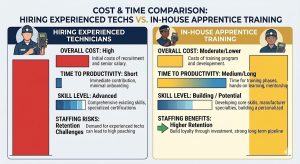
Hiring only experienced techs limits your growth and keeps labor costs high. Hiring cheap labor without training leads to callbacks, bad reviews, and lost customers. Neither option scales.
Building your own training system gives you control over quality, consistency, and culture. It lets you hire people with potential instead of waiting for perfect candidates who might never apply. And it creates loyalty. Techs who feel invested in will stick around and help you grow.
If you want a team that represents your business the way it should be represented, training is not optional. It is the foundation of everything else.
Ready to Build a Team That Drives Growth?
Training technicians is just one piece of building a profitable appliance repair business. You also need consistent lead flow, clear tracking, and marketing that actually works.
At Appliance Marketing Pros, we help appliance repair companies build predictable growth systems using local SEO, Google Ads, and Google Business Profile optimization. If you are ready to stop worrying about where the next call is coming from, let’s talk.
Schedule a free strategy call and we will show you exactly how to get more calls, better leads, and stronger ROI from your marketing.