
Blog
Mobile-First Emergency Service Web Design
Why Your Mobile Website is Costing You Appliance Repair Jobs (And How to Fix It)
You just spent $800 on Google Ads last week. Your phone rang maybe four times.
Two were spam calls. One was someone looking for a part you don’t sell. The other one actually booked, but the customer went MIA when your tech showed up.
Meanwhile, your competitor down the street runs half the budget you do and stays booked three days out.
The difference isn’t always the ads. It’s what happens after someone clicks. If your site doesn’t immediately hook them, you are just burning cash. That is where high-converting emergency service web design comes into play.
If your website loads slowly on a phone, confuses people, or makes them hunt for your phone number, you’re paying for clicks that turn into nothing. You’re buying traffic and losing it before anyone ever calls.
Most appliance repair business owners don’t realize their mobile website is the weak link. They assume the problem is the ad copy, the keywords, or the budget. But when a homeowner’s refrigerator is leaking all over the kitchen floor, they grab their phone in a total panic. They don’t have time to wait for a slow site or dig through five pages to find a way to contact you.
They need help now.
If your platform lacks intentional emergency service web design that loads instantly and makes it dead simple to call, they’re gone. And so is your money.

The Anatomy of an Emergency Service Web Design
Appliance repair is not a planned purchase. Nobody wakes up thinking, “I should research dishwasher repair companies today.”
They call because something broke. The washer is flooding. The oven won’t heat. The freezer is thawing, and they’re about to lose $400 worth of food.
This creates what we call emergency search intent. The customer is stressed, moving fast, and making decisions in seconds. They’re typing “appliance repair near me” or “emergency refrigerator repair” into Google while standing in front of the problem.
Your mobile website has one job in that moment. Make it easy to call you. Right now. No thinking required.
Here’s what kills most appliance repair websites during emergency searches:
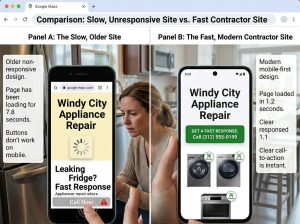
Slow load times. If your site takes more than three seconds to load on a phone, half the people clicking your ad are gone before they even see your business name.
Hidden phone numbers. If someone has to scroll, zoom, or tap three times to find your number, you’ve already lost the job.
Confusing navigation. Menus with eight dropdown options and pages buried under “Services” don’t work when someone is panicking.
No click to call button. If your phone number isn’t a tappable button in the top corner of every page, you’re making people work too hard.
The companies that dominate local appliance repair markets understand this. Their websites are built around one goal. Get the call. Everything else is secondary.
Your Google Business Profile matters too. When someone searches “appliance repair near me” on their phone, Google shows a map with three businesses at the top. If your profile is incomplete, your reviews are outdated, or your service areas aren’t set correctly, you won’t show up in that critical three-pack.
A strong emergency appliance repair marketing strategy connects your Google Ads, your Google Business Profile, and your mobile website into one smooth system. The ad gets the click. The profile builds trust. The website gets the call.
Why a “Click to Call” Website is Your Best Sales Rep
You don’t need a fancy website. You need one that works.
The single most important feature on an appliance repair website is a click to call button that stays visible no matter where someone scrolls. This is called a sticky header, and it’s the difference between a site that converts and one that burns money.
Here’s what happens without it.
A homeowner clicks your Google Ad. Your site loads. They scroll down looking for your number. They find it halfway down the page in small gray text. Now they have to highlight it, copy it, open their phone app, paste it, and dial.
That’s six steps. Most people quit by step three and hit the back button. Your competitor’s site has a big orange “Call Now” button at the top of the screen. One tap, and the phone is ringing.
You just paid $12 for that click and got nothing.
A click to call website eliminates all the friction. The phone number is always visible. It’s big enough to see without zooming. One tap connects the call. That’s it.
This isn’t a luxury feature. It’s the baseline for any contractor website in a distress-driven industry like appliance repair.
We’ve seen appliance repair companies double their booked jobs just by fixing this one thing. Same ad spend. Same keywords. Same Google Business Profile. The only change was making the call button impossible to miss.
If you pull up your website on your phone right now and you have to scroll or squint to find your number, you’re losing jobs every single day.
3 Reasons a Fast Loading Contractor Website Lowers Your Cost Per Lead
Google Ads doesn’t just charge you for clicks. It charges you based on how good your landing page is.
If your mobile website is slow, confusing, or unhelpful, Google raises your cost per click. If it’s fast and relevant, Google lowers your cost per click. This is called Quality Score, and it directly impacts how much you pay for appliance repair leads.
Here’s how it works.
Reason 1: Slow sites increase your bounce rate, which increases your cost per lead.
Bounce rate is the percentage of people who land on your site and leave without doing anything. If your page takes five seconds to load, most people are gone before they see your content. Google tracks this. If a lot of people are bouncing, Google assumes your page isn’t helpful and makes you pay more for the next click.
A fast loading contractor website keeps people on the page long enough to read your headline, see your number, and call. A lower bounce rate means a better Quality Score. A higher Quality Score means a lower cost per lead.
Reason 2: Mobile speed is a ranking factor in Local SEO and Google Business Profile visibility.
Google uses something called Mobile-First Indexing. That means it judges your website based on how it performs on a phone, not a desktop. If your mobile site is slow or hard to use, Google ranks you lower in local search results and shows your competitors instead.
We’ve seen appliance repair companies disappear from the local three-pack just because their mobile site failed Google’s Core Web Vitals test. Core Web Vitals measure page speed, visual stability, and responsiveness. If you fail, you lose visibility. If you pass, you rank higher and get more organic calls without paying for ads.
Reason 3: Speed directly impacts conversion rate, which determines your return on ad spend.
Let’s say you’re spending $1,000 a month on Google Ads. You get 100 clicks. If your mobile site is slow and only 2 percent of people call, that’s 2 leads for $1,000. If you fix the speed and your conversion rate goes to 5 percent, that’s 5 leads for the samebudget.
Same clicks. Same keywords. Better website. Lower cost per lead.
Speed isn’t a nice-to-have. It’s the difference between profitable ads and wasted budget.
Responsive vs. Mobile-First: Emergency Service Web Design
Most appliance repair websites are responsive. That means they were designed for desktop computers and programmed to shrink when viewed on a phone.
Responsive design sounds good in theory, but in practice it creates problems. The buttons are too small. The text is hard to read. Images take forever to load. Navigation menus are clunky.
Mobile-first design is different. It’s built for the phone from the ground up. Every element is designed to work with a thumb, not a mouse. The layout is simple. The buttons are big. The most important information is at the top.
Here’s a real example.
A responsive appliance repair website might have a hero image, three service boxes, a testimonial slider, and a footer with ten links. On a phone, all of that content stacks vertically. The user has to scroll through six screens just to find the phone number.
A mobile-first website puts the phone number, a one-sentence value proposition, and a call button at the very top. Below that, a simple list of services. Below that, a few reviews. That’s it. No clutter. No guessing.
The mobile-first approach is built around emergency search intent. It assumes the person viewing your site is standing in front of a broken appliance and needs help now. Every design choice reflects that urgency.
Responsive design assumes people have time to browse. Mobile-first design assumes they don’t.
If your website was built more than three years ago, it’s almost certainly responsive, not mobile-first. That’s fine for some industries. For appliance repair, it’s costing you booked jobs.
What a High-Converting Mobile Website for Appliance Repair Actually Looks Like
You don’t need to guess what works. There’s a proven formula.
Here’s what every high-converting appliance repair mobile website includes.
A sticky click to call button that never disappears. It stays at the top or bottom of the screen no matter where the user scrolls. Big, bold, impossible to miss.
A clear headline that matches the search query. If someone searched “refrigerator repair near me,” your headline should say something like “Fast Refrigerator Repair in [Your City].” Not “Welcome to Our Family-Owned Business.” Match the intent.
Service area visibility in the first screen. If you serve three counties, say that up front. Don’t make people dig through your footer to find out if you cover their zip code.
Proof of reliability. A Google star rating. A simple line like “Over 500 five-star reviews.” A trust badge like “Licensed and Insured.” Something that answers the question, “Can I trust this person to show up?”
Minimal navigation. Two or three menu options max. Services. About. Contact. That’s it. Anything more creates decision fatigue.
Fast load time. Under two seconds. Compress your images. Use modern code. Don’t load ten tracking scripts that slow everything down.
This isn’t subjective. This is what works when tested across hundreds of appliance repair companies in real markets with real ad spend.
The companies that follow this formula see higher call volume, lower cost per lead, and better ROI from every dollar spent on Google Ads or Local SEO.
The companies that ignore it keep wondering why their marketing doesn’t work.
AMP Up Your Growth: How the AMPRank System Turns Traffic into Dispatch Calls
At Appliance Marketing Pros, we’ve spent over 20 years working exclusively with appliance repair, HVAC, and vent cleaning companies. We don’t do generic marketing. We don’t work with dentists or lawyers or retail shops.
We focus on one thing. Helping service businesses like yours get more booked jobs from Google.
Our AMPRank system combines local SEO, Google Ads, Google Business Profile optimization, and mobile-first web design into one predictable lead generation system. Everything is built around the same goal. Make the phone ring with customers who are ready to book, not tire kickers or spam leads.
Here’s how it works.
We start by auditing your current setup. Your mobile site speed. Your Google Business Profile. Your ad account. Your tracking. Most appliance repair companies are losing 30 to 50 percent of their leads to fixable problems they don’t even know exist.
Then we rebuild the weak points. If your mobile site is slow, we fix it. If your Google Ads are targeting the wrong keywords, we tighten them. If your GBP isn’t optimized for emergency searches, we handle it.
Finally, we track everything. You’ll know exactly how many calls came from Google Ads, how many from organic search, and how many turned into booked jobs. No guessing. No vanity metrics. Just clear ROI.
We’re not a vendor. We’re a partner. If your business grows, we grow. If your call volume increases, we’ve done our job.
If you’re tired of inconsistent call volume, unclear ROI, and marketing agencies that don’t understand your business, we can help.
Book a free strategy call with Appliance Marketing Pros. We’ll review your mobile site, your Google Ads, and your Local SEO setup, and show you exactly where you’re losing money. No sales pitch. Just a clear breakdown of what’s working, what’s broken, and what to fix first.
AMP Up Your Growth. Let’s turn your traffic into dispatch calls.