
Blog
Why Your Service Business Needs a Flawless Smartphone Experience

Your customer’s freezer is leaking water all over the kitchen floor. It’s 8 PM on a Tuesday. They grab their phone, search “appliance repair near me,” and click on your Google Business Profile.
Your website loads. And loads. And loads.
They pinch to zoom just to read your phone number. The “Contact Us” button is hidden under three layers of menu. The form doesn’t work on mobile.
They hit the back button and call your competitor instead.
You just lost a $400 job because your mobile site failed a two-second test.
Most appliance repair owners think having a “mobile-friendly” website is enough. It’s not. Your customers aren’t sitting at a desktop computer researching appliance repair like they’re buying a car. They’re stressed, in a hurry, and using their phone while standing in front of a broken washer.
If your mobile experience isn’t flawless, you’re bleeding leads to competitors who figured this out years ago.
The Truth About Mobile Traffic for Appliance Repair
Here’s what we see across every appliance repair client we work with: 60% to 75% of all website traffic comes from mobile devices. That number jumps even higher on nights and weekends when most emergency calls happen.
Google knows this. That’s why they switched to mobile-first indexing years ago. They look at the mobile version of your site to decide where you rank in local search and Google Maps. If your mobile site is slow, broken, or frustrating to use, Google assumes your business is too.
This isn’t theory. We’ve audited hundreds of appliance repair websites. The ones losing rankings almost always have mobile problems: slow load times, forms that don’t work, phone numbers that aren’t clickable, or layouts that force users to zoom and scroll just to find basic information.
Your ranking isn’t just about keywords and backlinks anymore. It’s about whether Google thinks your mobile experience will satisfy the searcher. If it won’t, you won’t rank.
What “Mobile-Friendly” Actually Means (And Why You’re Probably Failing)
Most website builders will tell you your site is “mobile-friendly” because it technically loads on a phone. That’s a low bar.
Mobile-friendly means it doesn’t break. Flawless means it converts.
Here’s the difference:
A mobile-friendly site loads on a phone and displays all the content. A flawless mobile site loads in under three seconds, shows your phone number at the top of the screen without scrolling, makes that number clickable so customers can call with one tap, and removes every unnecessary step between the customer finding you and contacting you.
Speed matters more than you think. If your site takes longer than three seconds to load, half your visitors are gone. They’re not waiting. They’re calling the next company on the list.
We’ve tracked this with call tracking data. Sites that load in under two seconds get 40% more phone calls than sites that take five seconds. You’re not losing customers because they don’t want your service. You’re losing them because they got impatient before your site even finished loading.
The Three Things Breaking Your Mobile Experience Right Now
Most appliance repair sites fail in the same three ways.
Your phone number isn’t easy to find or click. If a customer has to scroll, pinch, or hunt for your phone number, you’ve already lost. The number should be at the top of every page in a sticky header that stays visible as they scroll. It should be clickable. On mobile, that means using a proper click-to-call link, not just displaying the number as text.
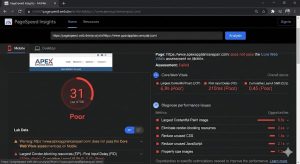
Your site is slow. Images that aren’t optimized for mobile, too many plugins, cheap hosting, or outdated code all add up. Every extra second your site takes to load costs you jobs. Run your site through Google’s PageSpeed Insights tool. If your mobile score is below 80, you have work to do.
Your forms are a nightmare. Filling out a form on a phone is already annoying. If your form has ten fields, requires typing an essay, or doesn’t autofill basic information, people will give up. The best mobile forms ask for name, phone number, and maybe zip code. That’s it. You can get the rest on the call.
Why Click-to-Call and SMS Booking Matter More Than You Think
The easiest way to turn mobile traffic into booked jobs is to make it dead simple for customers to reach you.
Click-to-call buttons work. When someone taps your phone number on mobile, their phone app opens immediately and they can call without copying and pasting or memorizing the number. This sounds basic, but you’d be shocked how many appliance repair sites still display phone numbers as images or unlinked text.
We’ve seen click-to-call buttons increase call volume by 30% or more just by removing one step from the process.
SMS booking is even better for certain customers. Some people hate talking on the phone. Some are at work and can’t make a call. Giving them the option to text you instead opens the door to jobs you’d otherwise miss.
You don’t need to build this from scratch. Most modern scheduling tools integrate with your website and allow customers to text or request a callback. If you’re running Google Ads or Local Service Ads, you can enable text messaging directly through those platforms.
The goal is simple: meet the customer where they are. If they want to call, make calling easy. If they want to text, let them text. Don’t force them into a single channel and hope they follow through.
How a Slow Mobile Site Kills Your Google Ads ROI
Let’s say you’re spending $3,000 a month on Google Ads. You’re getting clicks. Traffic is hitting your site. But your conversion rate is terrible and you don’t know why.
We see this all the time. The ads are fine. The targeting is fine. The problem is your landing page loads too slowly on mobile, so people bounce before they even see your offer.
Google tracks this. If your mobile landing page has a high bounce rate because it’s slow or hard to use, Google lowers your Quality Score. That means you pay more per click and your ads show up less often. You’re literally paying a penalty for having a bad mobile site.
The fix isn’t always complicated. Sometimes it’s as simple as compressing images, removing unnecessary scripts, or switching to faster hosting. But if you don’t know what’s slowing you down, you’re just guessing.
This is one reason we pushclients to use dedicated landing pages for Google Ads instead of sending traffic to their homepage. A landing page built specifically for mobile with one clear goal (get the customer to call or fill out a form) will always outperform a cluttered homepage.
The “Thumb Zone” and Why Your Website Layout Matters
Here’s something most web designers ignore: people use phones with one hand. Usually their thumb.
There’s a zone on the screen that’s easy to reach with your thumb and a zone that’s awkward or impossible without adjusting your grip. If your most important buttons (call now, book online, get a quote) are in the hard-to-reach zone, you’re making your customers work harder than they should.
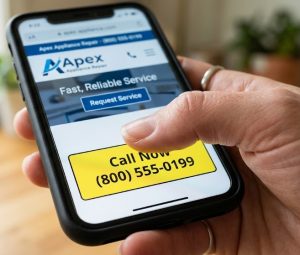
The easiest area to tap is the bottom third of the screen and the center. The hardest area is the top corners. If your call button is in the top right corner, you’re doing it wrong.
Sticky headers help. A sticky header stays at the top of the screen as the user scrolls, so your phone number and call button are always visible. Sticky footers work too. Some mobile sites put a big call button at the bottom of the screen that follows you as you scroll.
The point is this: if the customer has to think about how to contact you, you’ve already made it too hard.
What a Flawless Mobile Experience Looks Like in Practice
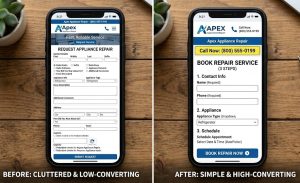
Let’s walk through what happens when a customer finds you on mobile and your site is actually built to convert.
They search “appliance repair near me” on their phone. Your Google Business Profile shows up. They tap through to your website.
Your site loads in under two seconds. The first thing they see is your company name, a big clickable phone number, and a headline that tells them exactly what you do. No guessing. No hunting.
As they scroll, they see trust signals: years in business, certifications, a few short reviews. They don’t need to read a novel. They need to know you’re legit.
Halfway down the page, there’s a simple form. Three fields: name, phone, zip code. A button that says “Get a Call Back in 10 Minutes.” They fill it out in 15 seconds.
At the bottom of the page, there’s a sticky call button that never disappears. If they change their mind and want to talk now, they can tap it and call immediately.
This isn’t complicated. It’s just intentional. Every element is designed to remove friction and make contacting you as easy as possible.
How Mobile Experience Affects Your Google Business Profile and Local Rankings
Your Google Business Profile doesn’t exist in a vacuum. Google looks at what happens after someone clicks through to your website.
If people click your profile, land on your site, and immediately bounce because it’s slow or broken, Google notices. They assume your business isn’t a good match for that search. Over time, your profile gets shown less often.
If people click through, stay on your site, and take action (call you, fill out a form), Google sees that as a signal that your business is relevant and helpful. Your profile gets shown more often.
This is why mobile experience directly impacts your local SEO. A fast, well-designed mobile site doesn’t just convert better. It helps you rank higher because Google sees real engagement instead of frustrated bounces.
We’ve had clients improve their Google Maps rankings just by fixing their mobile site. No new backlinks. No content changes. Just a faster, cleaner mobile experience that kept visitors on the page.
The ROI of Fixing Your Mobile Site: Real Numbers
Let’s say you get 500 mobile visitors a month from Google. Your current conversion rate (people who call or fill out a form) is 3%. That’s 15 leads.
You fix your mobile site. Load time drops from six seconds to two. Your call button is now sticky and impossible to miss. Your form is simplified.
Your conversion rate jumps to 6%. That’s 30 leads. You just doubled your lead volume without spending another dollar on ads or SEO.
If your average job is worth $300 and you close 50% of leads, you went from $2,250 in monthly revenue to $4,500 just by improving your mobile site.
This isn’t hypothetical. We see this pattern over and over. A small investment in mobile optimization pays for itself in weeks because you’re no longer wasting the traffic you already have.

Stop Losing Jobs to Competitors with A Flawless Smartphone Experience
Most appliance repair owners don’t realize how much money they’re leaving on the table.
You’re paying for Google Ads. You’re working on SEO. You’re active on your Google Business Profile. But if your mobile site is slow, clunky, or confusing, all that effort is wasted because customers bounce before they ever contact you.
Your competitors aren’t smarter than you. They just figured out that a flawless mobile experience is the easiest way to turn traffic into phone calls.
Here’s what you should do today:
Pull up your website on your phone. Try to find your phone number without scrolling. Time how long it takes for the page to load. Try filling out your contact form. If any part of that experience feels slow, frustrating, or unclear, your customers feel it too.
Run your site through Google’s PageSpeed Insights tool and check your mobile score. If it’s below 80, you’re losing leads.
Check your call tracking data (if you have it). Look at the difference between desktop and mobile conversion rates. If mobile is significantly lower, your site is the problem, not your marketing.
You don’t need to rebuild your entire website. Most mobile problems can be fixed with targeted improvements: faster hosting, optimized images, a sticky call button, and a simplified form.
If you’re not sure where to start or you want an expert to audit your mobile site and show you exactly what’s costing you jobs, we can help. At Appliance Marketing Pros, we’ve spent years optimizing mobile experiences for appliance repair companies just like yours. We know what works because we’ve tested it hundreds of times.
A flawless mobile experience isn’t a luxury. It’s the baseline for staying competitive. If you’re serious about growing your business and getting more value from your marketing, your mobile site is the first thing you should fix.