Blog
Luxury Appliance Repair Marketing: Win High-Value Clients
Marketing to the Elite: How to Generate High-Value Lead Generation
You ever notice how a service call in Paradise Valley can run $600 while the same repair in a middle-class ZIP code barely hits $200?
It’s not just about the appliances being fancier. It’s that the entire customer profile is different.
Most appliance repair companies compete on speed and price. That attracts exactly the kind of client you don’t want: price-shoppers who cancel appointments, complain about everything, and never call you back.
Affluent homeowners need appliance repair too. They have Sub-Zero refrigerators that break down. Wolf ranges that stop igniting. Miele dishwashers throwing error codes.
But they research differently. They buy differently. They evaluate service providers on completely different criteria than someone searching “cheap appliance repair near me.”
If you want consistent, high-value leads from wealthy neighborhoods, you need a marketing strategy built around how these clients actually behave. Not generic local SEO tips, but a complete approach to positioning, targeting, and delivering premium service.
This guide breaks down exactly how to identify affluent markets, reach the right clients through digital and non-digital channels, and build the systems to make this sustainable.
Why Affluent Homeowners Are Different (And Why It Matters for Your Marketing)
Let’s start with what most repair shop owners get wrong.
They assume wealthy clients are just “better customers” who pay more and don’t argue about pricing. That’s partially true, but it misses the bigger picture.
Affluent homeowners operate in a completely different ecosystem. And if your marketing doesn’t account for that, you’re invisible to them.
They Don’t Search the Way You Think They Do
Most middle-income homeowners panic when an appliance breaks. They open Google, type “appliance repair near me,” and call the first three companies that show up.
Affluent clients rarely start with Google.
They ask their property manager. They text their concierge service. They call the appliance dealer who sold them the $18,000 Sub-Zero and ask for a referral.
When they do search, they’re not looking for “appliance repair.” They’re searching for brand-specific expertise: “authorized Sub-Zero repair Scottsdale” or “Wolf range service near me.”
They want specialists, not generalists. And they want someone their network has vetted or someone with clear manufacturer credentials.
This completely changes how you need to show up in the market. A generic Google Business Profile optimized for “appliance repair” won’t cut it. You need positioning that signals expertise with the brands they own.
They Value Different Things Than Price-Shoppers
Affluent clients aren’t price-insensitive. They just prioritize different factors when evaluating service providers.
Discretion and privacy matter. They don’t want a service van parked in their driveway broadcasting to the neighbors that something’s broken. Some clients specifically request unmarked vehicles.
Relationship continuity is huge. Once they find a technician they trust, they want the same person every time. That’s why subscription maintenance plans work so well in wealthy neighborhoods.
Risk aversion with premium appliances. A botched repair on a $15,000 Sub-Zero isn’t just an inconvenience. It voids warranties, causes secondary damage, and creates headaches with extended service contracts. They’d rather pay more for a factory-certified technician than gamble with someone who “works on all brands.”
Time sensitivity, not price sensitivity. They’ll pay a premium for same-day service because their time is valuable. But they’re also far less likely to cancel or no-show because they respect your time too.
These aren’t small differences. They fundamentally change how you market, price, and deliver service.
They Have Higher Service Expectations
You can’t deliver the same service experience to a $5 million home in Paradise Valley that you’d deliver to a rental property in a working-class neighborhood.
Affluent clients expect white-glove service. That doesn’t mean you need to wear a tuxedo, but it does mean:
Professional presentation matters. Clean uniforms. Well-maintained vehicles (ideally newer models, no dents or rust). Technicians who communicate clearly and respectfully.
Appointment punctuality is non-negotiable. If you say you’ll arrive between 10 and 12, you better show up in that window. Send a text 30 minutes before arrival. Confirm the day before.
Communication throughout the process. Explain what you’re doing, why you’re doing it, and what the homeowner should expect next. No jargon, no condescension.
This isn’t difficult to deliver. But if your current systems don’t support this level of consistency, you’ll struggle to retain affluent clients even if you manage to land them.
The Real Math: Why High-Value Clients Change Your Business Model
Let’s talk numbers, because this is where the strategy either makes sense or falls apart.
Customer Acquisition Cost (CAC) vs Lifetime Value (LTV)
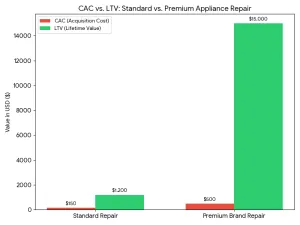
Most appliance repair shops target broad areas and generic keywords to keep their cost per lead low. They might spend $50 to $80 to acquire a customer.
Marketing to affluent neighborhoods costs more upfront. You’re competing for fewer searches, and the keywords (“Sub-Zero repair,” “Wolf service,” specific wealthy ZIP codes) have higher CPCs. Your CAC might be $120 to $180.
Here’s why that’s fine.
Average ticket value is 2-3x higher. Middle-income repair jobs average $250 to $400. Affluent clients with premium appliances routinely hit $600 to $1,200 per service call.
Repeat service rates are higher. Wealthy homeowners often have 4-6 high-end appliances (Sub-Zero fridge and freezer, Wolf range, Miele dishwasher, wine cooler, warming drawer). That’s 3-5 service calls per year vs 1-2 for an average household.
Lifetime value is dramatically higher. A client you land through broad targeting might be worth $400 over their lifetime. An affluent client with multiple premium appliances is worth $3,000 to $6,000.
When LTV is 5-10x higher, you can afford a higher CAC and still come out way ahead.
Profitability Per Service Call
Let’s look at what happens when you shift from volume to value.
Labor efficiency improves. Instead of running 6-8 low-value calls per day across a wide service area, you’re doing 3-4 high-value calls in a concentrated geographic cluster. Less drive time, better margins.
Premium pricing power when you specialize. If you’re known as “the Sub-Zero specialist” in your market, you command higher rates. Clients don’t push back on pricing because they understand they’re paying for expertise, not just labor.
Lower cancellation and no-show rates. Affluent clients respect appointments and understand the value of professional service. You’re not dealing with “I’ll just call someone cheaper” cancellations.
Put this together and you’re looking at 40-50% profit margins on affluent service calls vs 20-30% on generic repair work.
What This Means for Your Marketing Budget
Here’s a realistic scenario.
Let’s say you allocate $3,000/month to a Google Ads campaign targeting affluent ZIP codes with brand-specific keywords.
At a $150 CAC, you generate 20 new clients per month. If half of those turn into repeat clients worth $3,000 lifetime value, you’re looking at $30,000 in LTV from one month of ad spend.
Compare that to $3,000/month on broad “appliance repair” campaigns. You might get 40-50 leads, but LTV per client is $500. You’re generating $20,000 to $25,000 in LTV from the same budget.
The math favors affluent targeting once you have the positioning and service delivery to back it up.
Finding Your Target: Geographic Targeting Beyond ZIP Codes
Okay, so you’re convinced wealthy clients are worth pursuing. How do you actually find them?
Start with Affluent ZIP Code Data
Every market has identifiable wealthy neighborhoods. You just need to know where to look.
Start with median home values and household income data. You can pull this from:
- U.S. Census Bureau data (free, but clunky)
- Zillow or Realtor.com market reports (easier to navigate)
- Your local chamber of commerce or real estate market reports
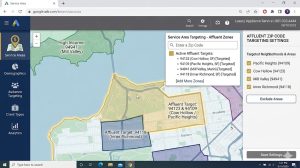
Look for ZIP codes where median home values are $800K+ and median household income is $150K+. In most markets, there are 3-8 ZIP codes that fit this profile.
Examples by market:
- Phoenix/Scottsdale: 85253, 85255, 85262 (Paradise Valley, North Scottsdale)
- Atlanta: 30327, 30305, 30342 (Buckhead, Tuxedo Park)
- Dallas: 75205, 75225, 75230 (Highland Park, University Park)
- South Florida: 33109, 33139, 33480 (Miami Beach, Palm Beach)
Start your targeting here. But don’t stop here.
Go Deeper: Micro-Targeting Within ZIP Codes
Not every house in a “wealthy ZIP code” is actually wealthy.
Scottsdale 85255 includes $2 million custom homes in Silverleaf and $400K townhomes near the edges. Those are completely different customer profiles.
To get more precise:
Identify gated communities and luxury planned developments. These are goldmines. Everyone in the community has similar income levels, and word-of-mouth spreads fast once you land one client.
Use property value filters. In your Google Ads geo-targeting or Local Service Ads, you can layer on radius targeting around specific addresses or landmarks (country clubs, luxury shopping centers). Target homes within a 2-3 mile radius of those landmarks.
Map custom kitchen remodels and new construction. Areas with active luxury home building or high-end kitchen remodels are filled with premium appliances that will eventually need service.
Drive-time radius optimization. Don’t just think ZIP codes. Think about where you can efficiently deliver same-day service. A 15-20 minute drive-time radius from your location to the wealthiest clusters in your market is ideal.
Where Premium Appliances Live
Here’s a shortcut: follow the premium appliance dealers.
If there’s a Sub-Zero/Wolf showroom in your market, the surrounding neighborhoods are likely filled with those brands. Same with Miele dealers or high-end kitchen design firms.
Build relationships with those dealers (we’ll cover that later). But also use their locations as a proxy for where affluent clients with premium appliances are concentrated.
Google Ads Strategies for Affluent Areas (Without Wasting Budget on Tire-Kickers)
Let’s talk about how to actually structure a Google Ads campaign for high-value neighborhoods.
This isn’t “set it and forget it” local service advertising. It requires precise targeting and constant optimization.
Geo-Targeting That Actually Works
Do not run city-wide appliance repair campaigns if you want affluent clients. You’ll burn through budget on low-value leads.
Instead:
Set up radius targeting around specific affluent ZIP codes. In Google Ads, use radius targeting (3-5 miles) centered on the wealthiest neighborhoods in your market.
Use location bid adjustments to prioritize wealthy areas. If you’re running broader campaigns, set bid adjustments of +50% to +100% for affluent ZIP codes. This ensures your ads show more frequently where it matters.
Exclude lower-income ZIP codes. Actively exclude areas that don’t match your target profile. This prevents budget waste on clicks that won’t convert into high-value jobs.
Test this over 60-90 days and track cost per lead and conversion rates by geography. You’ll quickly see which areas produce profitable leads.
Keyword Strategy for High-Value Leads
Generic keywords attract generic leads.
If you’re bidding on “appliance repair near me” or “dishwasher repair,” you’re competing with every shop in your market and attracting price-shoppers.
Shift to brand-specific and premium-signal keywords:
Brand-specific repair keywords:
- “Sub-Zero repair near me”
- “Wolf range service [city name]”
- “Miele dishwasher repair [ZIP code]”
- “Thermador oven repair [neighborhood]”
Warranty and authorization keywords:
- “authorized Sub-Zero repair”
- “factory certified Wolf service”
- “warranty appliance repair [brand]”
Urgency keywords with brand modifiers:
- “emergency Sub-Zero repair”
- “same-day Wolf range service”
- “24-hour Miele repair”
These keywords have lower search volume but drastically higher conversion rates and lead quality.
Negative Keywords to Protect Your Budget
Negative keywords are just as important as the keywords you bid on.
Add these to filter out low-intent and price-shopping traffic:
Price-focused terms:
- cheap
- affordable
- discount
- budget
- free estimate (sometimes)
- coupon
DIY searchers:
- how to fix
- troubleshooting
- repair guide
- DIY
Low-intent queries:
- appliance parts
- used appliances
- appliance stores
- manuals
This keeps your campaigns focused on people ready to hire a professional, not tire-kickers.
Ad Copy That Speaks to Affluent Clients
Your ad copy should signal expertise and premium service, not low prices.
Emphasize specialization and credentials:
- “Factory-Certified Sub-Zero Repair Specialists”
- “Authorized Wolf & Sub-Zero Service | Serving Scottsdale Since 2015”
- “Expert Miele Repair | White-Glove Service for Premium Appliances”
Trust and authority signals:
- Years in business
- Specific neighborhoods served
- Manufacturer certifications
- Same-day availability
Service quality over price:
- “Same-Day Service Available”
- “Protecting Your Investment”
- “Certified Technicians, Premium Results”
Avoid mentioning price in ads. If someone clicks because you’re advertising “starting at $99,” they’re not your target client.
Local SEO and Google Business Profile Optimization for Premium Visibility
Google Ads get you in front of high-intent searchers. Local SEO makes sure you’re visible when affluent clients research you after getting a referral or seeing your name elsewhere.
Optimize Your GBP for Affluent Neighborhoods
Your Google Business Profile is often the first impression a potential client gets. Make it count.
Service area settings: List the specific affluent ZIP codes and neighborhoods you serve. Don’t just select your entire city. Call out “Paradise Valley,” “North Scottsdale,” “Buckhead,” etc.
Business description: Mention the premium brands you specialize in and the high-end neighborhoods you serve. Example: “Factory-certified Sub-Zero and Wolf repair serving Paradise Valley, Silverleaf, and North Scottsdale since 2012.”
Photos matter more than you think. Upload high-quality photos of premium appliances you’ve serviced, your clean service vehicles, and your professional technicians. No generic stock photos.
Service categories: Select specific categories like “Sub-Zero repair service” or “Wolf appliance repair” if available. Don’t just use “appliance repair service.”
Reviews That Build Trust with High-Value Clients
Affluent clients absolutely check reviews before hiring anyone.
But they’re not just looking at star ratings. They’re reading the actual content of reviews to see if you serve clients like them.
Encourage reviews that mention specific brands and neighborhoods. After completing a job on a Sub-Zero in Paradise Valley, ask the client to mention those details in their review.
Respond to every review professionally. This signals that you take customer feedback seriously, which matters to high-end clients.
Feature 5-star reviews on your website. Pull testimonials from clients in affluent areas and showcase them prominently.
You don’t need 500 reviews. You need 30-50 high-quality reviews that demonstrate expertise with premium brands in wealthy neighborhoods.
Local Content Strategy
Create content that targets brand-specific and neighborhood-specific search queries.
Service area pages for affluent neighborhoods:
- “Sub-Zero Repair in Paradise Valley, AZ”
- “Wolf Appliance Service in Buckhead, Atlanta”
- “Miele Dishwasher Repair in Highland Park, Dallas”
These pages should include:
- Specific neighborhoods and landmarks
- Premium brands commonly found in those areas
- Customer testimonials from that neighborhood
- Clear CTAs for scheduling service
Blog content targeting premium brand queries:
- “What to Do When Your Sub-Zero Refrigerator Stops Cooling”
- “Common Wolf Range Problems and When to Call a Professional”
- “Is Your Miele Dishwasher Worth Repairing?”
Schema markup: Use LocalBusiness schema with service area and brand-specific service type markup. This helps Google understand what you specialize in and where you serve.
Brand Specialization: Your Fastest Path to Premium Pricing and Trust
Here’s the truth: if you work on “all brands,” you’re a commodity.
Affluent clients with $15,000 Sub-Zero refrigerators don’t want a generalist. They want a specialist.
Why Specialization Beats Generalization
Think about it from the client’s perspective.
Option A: A shop that advertises “we repair all major appliance brands.”
Option B: A shop that says “Sub-Zero and Wolf factory-certified specialists serving Paradise Valley for 10 years.”
Which one feels safer when you’re dealing with a $12,000 appliance and an active warranty?
Specialization signals three things:
You have deep expertise. You’re not figuring things out on the fly. You’ve seen every common (and uncommon) issue with these brands.
You have the right parts. Affluent clients don’t want to wait a week for parts to arrive. Specialists stock common components.
You protect their warranty. Manufacturer warranties often require authorized service. Specialists have those relationships.
This lets you charge 20-30% more than generalists without pushback.
How to Position as a Premium Brand Specialist
You can’t just claim specialization. You need credentials.
Get factory-certified. Sub-Zero, Wolf, Miele, and Thermador all offer training and certification programs for service providers. Complete them. Display the certifications on your website, vehicles, and marketing materials.
Build relationships with local premium appliance dealers. When someone buys a $20,000 kitchen suite from a high-end dealer, the salesperson often recommends a service provider. Be that provider.
Join manufacturer service networks. Some brands have authorized service provider directories. Get listed.
Attend brand-specific training annually. Technology changes. New models have different diagnostics. Stay current.
This isn’t just marketing. It’s building a legitimate competitive advantage.
The Inventory and Training Investment
Fair warning: specialization requires upfront investment.
You need to stock parts for the brands you specialize in. A basic Sub-Zero parts inventory (control boards, thermistors, relays, etc.) might cost $3,000 to $5,000.
Training programs cost $500 to $2,000 per technician depending on the brand.
But here’s the ROI: you close more jobs, charge higher rates, and get more referrals from dealers and past clients.
Most shops see payback within 6-9 months if they commit to specialization.
Start with 1-2 premium brands common in your market. Build expertise and inventory. Then expand if it makes sense.
Marketing Channels Wealthy Homeowners Actually Use (Beyond Google)
Let’s address the elephant in the room.
Most affluent clients don’t find their service providers through Google. They find them through referrals and professional networks.
If all your marketing is digital, you’re missing the majority of the opportunity.
Property Manager and Concierge Partnerships
High-end property management companies oversee multiple luxury homes. When an appliance breaks, the property manager coordinates the repair.
Land one property management relationship and you could get 10-20 service calls per year from high-value properties.
How to build these relationships:
Identify luxury property management firms in your market. Look for companies managing vacation rentals, second homes, and investment properties in affluent areas.
Reach out with a simple pitch: you specialize in premium appliances, offer priority scheduling, and provide detailed service reports for property owners.
Offer a dedicated contact for property managers so they’re not waiting in a phone queue.
Concierge services work the same way. Luxury buildings, high-end HOAs, and private concierge companies maintain vendor lists. Get on those lists.
Luxury Real Estate and Designer Networks
When someone buys a $3 million home, the real estate agent often provides a list of recommended service providers.
When someone does a $150,000 kitchen remodel, the designer specifies appliances and recommends service providers to protect the investment.
Build relationships with:
- High-end real estate agents (luxury home specialists, not general realtors)
- Kitchen designers and architects who spec premium appliances
- Custom home builders who install Sub-Zero, Wolf, and Miele as standard
Attend local luxury home shows and industry networking events. These relationships take time to build but produce extremely high-quality referrals.
Country Clubs and Private Community Boards
Affluent communities are tight-knit. Word spreads fast when someone finds a reliable service provider.
Ways to get visibility:
- Sponsor or advertise in country club member newsletters
- Join private community HOA boards (if you live in the area)
- Attend charity events and fundraisers in affluent neighborhoods
This feels slow compared to running Google Ads. But one referral from a respected community member can turn into 5-10 clients through word-of-mouth.
Strategic Referral Programs
Don’t leave referrals to chance. Systematize them.
Offer referral incentives to existing affluent clients. Something like “$100 credit toward your next service for every referral” works well.
Partner with appliance dealers. Offer a referral fee or reciprocal arrangement where you send buyers their way and they send service calls your way.
Build relationships with home builders. Builders don’t want callbacks on appliances in new luxury homes. If you provide white-glove service for their clients, they’ll refer you repeatedly.
Non-digital channels take longer to build. But they produce better leads with lower CAC over time.
Positioning Your Service as Premium Without Sounding Salesy
Let’s be clear about what premium positioning actually means.
It’s not slapping a “luxury” label on the same service you’ve always provided and charging double.
It’s delivering a genuinely differentiated experience that justifies higher pricing.
What Premium Positioning Actually Means
Affluent clients can smell fake premium from a mile away.
Premium service is about:
Expertise and competence. You solve problems correctly the first time. You don’t guess or experiment on their appliances.
Professionalism and respect. You show up on time, communicate clearly, and treat their home and time with respect.
Convenience and responsiveness. You make it easy to schedule, you’re available when they need you, and you follow up.
You’re not selling luxury. You’re selling peace of mind and reliability.
Service Delivery Standards for Affluent Clients
Here’s what premium service delivery looks like in practice.
Appointment scheduling:
- Offer flexible scheduling, including early morning and evening slots
- Confirm appointments 24 hours in advance via text or email
- Send a “technician on the way” text 30 minutes before arrival
Technician presentation:
- Clean, branded uniforms (no ratty t-shirts)
- Well-maintained service vehicles (consider newer models or even unmarked vehicles if clients request)
- Professional demeanor (respectful, friendly, competent)
Communication throughout the job:
- Explain what you’re diagnosing and what you find
- Provide transparent pricing before starting work
- Walk the client through what you did and what to expect next
Discretion:
- Some clients prefer unmarked vehicles (especially for second homes or rental properties)
- Minimal disruption (clean up after yourself, don’t leave a mess)
- Confidentiality (don’t gossip about clients or their homes)
None of this is complicated. But it requires systems and consistency.
Website and Marketing Materials That Signal Premium
It needs to immediately signal that you’re not a commodity service provider.
High-quality photography: Show premium appliances you’ve serviced, your professional technicians, and clean, well-maintained vehicles. No generic stock photos.
Case studies and success stories: Feature repairs on high-end brands in affluent neighborhoods. Show problem-solving, not just “we fixed this.”
Showcase certifications and credentials: Display factory certifications, manufacturer partnerships, and years of experience prominently.
Avoid aggressive sales language: Ditch “call now for 20% off” and “limited time offer.” Use consultative language like “schedule a service consultation” or “speak with a specialist.”
Your messaging should communicate confidence and competence, not desperation.
What Affluent Clients Expect (And How to Deliver It Consistently)
Let’s get specific about service delivery expectations.
Speed and Responsiveness
Same-day or next-day service is table stakes for affluent clients.
They’re not going to wait three days for someone to look at their broken Sub-Zero. They’ll call someone else.
Systems you need:
- Answer calls during business hours (8am-6pm minimum). No voicemail-only during the day.
- Offer online scheduling for non-emergency appointments
- Provide emergency after-hours service for critical appliances (refrigeration, cooking appliances)
- Keep utilization rates reasonable so you have capacity for urgent calls
This doesn’t mean you’re on call 24/7. It means you’re reliably available when clients need you.
Technical Expertise and Problem-Solving
Affluent clients expect accurate diagnostics on the first visit.
They don’t want to hear “I need to order parts and come back next week” unless it’s genuinely necessary.
How to deliver this:
- Stock common parts for the brands you specialize in
- Invest in proper diagnostic tools (multimeters, temperature sensors, brand-specific diagnostic equipment)
- Train your technicians continuously on new models and common failure modes
When you do need to order parts, explain why, provide a timeline, and follow up proactively when parts arrive.
Competence isn’t flashy, but it’s what keeps affluent clients coming back.
Warranty Preservation and Long-Term Value
Many high-end appliances come with extended warranties or manufacturer service contracts.
Position your service as protecting their investment, not just fixing a problem.
Ways to do this:
- Explain how using non-certified service can void warranties
- Offer preventive maintenance plans for households with multiple premium appliances
- Keep detailed service records and provide copies to clients
- Educate clients on proper care and usage to extend appliance life
Affluent clients value long-term thinking. Frame your service as part of protecting a $50,000+ appliance investment, not just a one-time repair.
The Lead Tracking and CRM Systems Premium Marketing Needs
You can’t scale premium client acquisition without systems.
Here’s what you need in place.
Lead Tracking and Attribution
You need to know which marketing channels are generating affluent leads vs price-shoppers.
Track these metrics by source:
- Cost per lead
- Conversion rate (calls to booked jobs)
- Average ticket value
- Repeat customer rate
- Lifetime value
Use call tracking to know which Google Ads campaigns, keywords, and geographic areas drive calls. Use CRM tagging to know which referral partnerships produce results.
This lets you double down on what works and cut what doesn’t.
CRM and Customer Relationship Management
A basic spreadsheet won’t cut it once you start building a base of high-value clients.
What your CRM should track:
- Client appliance inventory (what brands and models they own)
- Service history (what you’ve repaired, when, parts used)
- Preventive maintenance schedules (schedule proactive outreach for annual checkups)
- Referral source (how they found you)
- Lifetime value (total revenue from this client)
Segment clients by value and service history. Your top 20% of clients should get proactive outreach and priority scheduling.
Technician Training and Quality Control
Your technicians are your brand when they’re in someone’s $4 million home.
Systems to maintain quality:
- Ongoing training on premium brands (annually minimum)
- Service delivery checklists (appointment confirmation, arrival text, cleanup standards)
- Customer satisfaction follow-up (survey or call within 48 hours of service)
- Performance tracking tied to customer satisfaction, not just speed
Pay your technicians well enough to retain them. Affluent clients value consistency. Having the same technician build a relationship with them over multiple service calls is a massive trust advantage.
Common Mistakes Repair Shops Make When Moving Upmarket
Let’s talk about where most shops go wrong when they try to move upmarket.
Treating Affluent Marketing Like Regular Marketing
You can’t just flip a switch and start attracting wealthy clients.
It requires repositioning your brand, upgrading service delivery, and often investing in specialization.
Most shops run one Google Ads campaign targeting “Sub-Zero repair Paradise Valley” for 30 days, get mediocre results, and give up.
This is a 6-12 month strategy, not a quick win. You’re building brand awareness, referral networks, and client relationships.
Competing on Price in Wealthy Neighborhoods
If you advertise “lowest prices” or “$99 service calls,” you’re attracting the wrong segment even in affluent ZIP codes.
Wealthy clients aren’t looking for the cheapest option. They’re looking for the best option.
Discounting signals low quality and erodes trust. It also kills your margins, which defeats the entire purpose of targeting high-value clients.
Price confidently. Justify pricing through expertise, credentials, and service quality.
Ignoring Non-Digital Channels
If your entire strategy is Google Ads and SEO, you’re missing most of the market.
Affluent clients are more likely to hire based on referrals from their property manager, real estate agent, or neighbor than from a Google search.
Build the digital foundation (Google Ads, GBP, website). But invest time in relationship-building with property managers, designers, and dealers.
Lack of Consistency and Systems
One-off premium jobs don’t build a business.
You need consistent lead generation, reliable service delivery, and systems to manage client relationships.
Most shops land a few high-value clients through luck or referrals, deliver great service, but never systematize it. So growth stalls.
Document your processes. Train your team. Build systems that don’t depend on you personally handling everything.
Is This Strategy for High-Value Lead Generation Right for Your Market?
Let’s be honest. This approach isn’t for everyone.
When Affluent Targeting Makes Sense
This strategy works if:
Your market has identifiable wealthy neighborhoods. If you serve a small town with no affluent clusters, this won’t work.
You have (or can develop) premium brand expertise. You don’t need to be certified in 10 brands, but you need legitimate expertise in 1-2.
You can deliver higher service standards. If your current operations are chaotic, fix that first before targeting demanding clients.
Your current marketing isn’t producing the margins you need. If you’re stuck competing on price and fighting for scraps, this is a viable path to better economics.
When to Wait
Don’t pursue this strategy if:
You’re brand new and still figuring out operations. Build basic competence first.
Your market lacks meaningful affluent clusters. Not every market has enough wealthy households to make this work.
You can’t afford the upfront investment. Specialization, systems, and premium positioning require investment. If you’re bootstrapped with zero runway, stabilize first.
How to Test Before Committing
You don’t have to go all-in immediately.
Start small:
- Pick one affluent ZIP code and run a targeted Google Ads campaign for 90 days
- Build one referral partnership (appliance dealer or property manager)
- Get certified in one premium brand (Sub-Zero or Wolf)
Track results. If you’re landing jobs, closing them at higher margins, and getting repeat business, scale up.
If it’s not working, you’ve limited your downside.
Ready to Build a System That Actually Works?
Here’s the bottom line.
Affluent homeowners represent a completely different customer segment. They research differently, buy differently, and evaluate service differently than price-shoppers.
Capturing these clients requires more than running a few Google Ads. You need shifts in positioning, marketing channels, service delivery, and business systems.
But the economics work. Higher lifetime value, better margins, more predictable revenue.
This isn’t a quick win. It’s a business model shift that takes 6-12 months to fully realize. But once you build the systems, it’s sustainable and scalable.
If you’re tired of competing on price and dealing with low-quality leads, this is the path forward.
At Appliance Marketing Pros, we help appliance repair companies build marketing systems that attract high-value clients consistently. We’ve worked with shops across the country to implement exactly what’s outlined in this guide.
If you want to explore whether this strategy makes sense for your market and current situation, book a Strategy Call. We’ll evaluate your positioning, identify the highest-leverage opportunities, and map out a realistic plan to shift toward premium client acquisition.
No generic agency pitch. Just an honest conversation about what it takes to make this work in your business.