
Blog
How to Create Content That Ranks
Building Content That Ranks in Search
You already know your business needs more visibility online. You’ve probably been told to “post more content” or “start a blog.” Maybe you’ve even tried it and saw nothing happen.
Here’s the truth: most content marketing advice for service businesses is useless. It’s written by people who have never booked a service call, never dealt with a no-show lead, and never had to explain to a customer why their 15-year-old dryer isn’t worth fixing.
Content that actually works for appliance repair companies does two things at once. It ranks in Google so people find you when they search. And it converts those visitors into phone calls and booked jobs.
This guide will show you exactly how to create that kind of content, based on what actually works for appliance repair businesses across the country.
Why Most Appliance Repair Content Fails
Most appliance repair companies approach content in one of two ways, and both fail.
The first group posts randomly. They write about whatever comes to mind, share a few photos on Facebook, and hope something sticks. There’s no strategy, no keyword research, and no connection to what customers are actually searching for.
The second group hires a generic marketing agency or freelancer who knows nothing about appliance repair. They get blog posts about “the importance of regular maintenance” that sound like they were written for every service business on earth. The content is bland, generic, and doesn’t answer the specific questions your customers ask.
Both approaches waste time and money because they ignore the two requirements for content that actually drives business:
Search intent alignment. Your content has to match what people are typing into Google when they need appliance repair.
Conversion focus. Every piece of content should move someone closer to calling you, not just “raising awareness.”
When you nail both of these, content becomes a lead generation system instead of a chore.
What Appliance Repair Customers Actually Search For
Before you write a single word, you need to understand the search behavior of people who need appliance repair.
Most searches fall into three categories.
Emergency problem searches. These are high-intent, right-now queries. “Refrigerator not cooling,” “washing machine won’t drain,” “dryer making loud noise.” The person searching has a broken appliance and needs help fast.
Repair vs replace research. Homeowners trying to decide if it’s worth fixing their appliance. “How much does it cost to fix a dishwasher,” “when should I replace my refrigerator,” “is it worth repairing a 10-year-old dryer.”
Local service searches. Direct searches for providers. “Appliance repair near me,” “refrigerator repair in [city],” “same day appliance repair.”
If your content doesn’t target at least one of these search types, it won’t bring you business.
Generic blog posts like “5 Ways to Extend the Life of Your Appliances” might get a few clicks, but they don’t capture people who are ready to book a service call. You want content that intercepts customers at the exact moment they realize they need professional help.
The Content Types That Actually Drive Calls
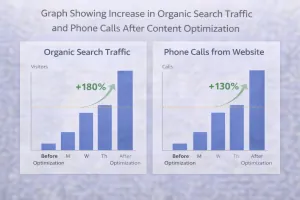
Not all content formats work equally well for appliance repair. Based on what ranks and what converts, here are the formats that consistently perform.
Problem-Solving Guides
These are in-depth articles that explain a specific appliance problem, why it happens, and what to do about it.
Examples:
- Why Is My Refrigerator Not Cooling But the Freezer Works?
- Washing Machine Won’t Spin: 5 Common Causes and Solutions
- Why Does My Dryer Take Forever to Dry Clothes?
These work because they match high-intent search queries. Someone searching for these problems needs help now. Your guide educates them, builds trust, and positions your company as the solution.
The structure that works best:
Start with the problem and acknowledge the frustration. “You open your fridge and realize it’s warmer than it should be. Your food is at risk and you need answers fast.”
Explain the most common causes in plain language. No jargon, no assumptions about technical knowledge.
Give simple troubleshooting steps they can try. This builds trust because you’re helping even before they hire you.
Explain when to call a professional. Be honest about what’s DIY-friendly and what requires a technician.
End with a clear call to action. “If you’ve tried these steps and your refrigerator still isn’t cooling, we can diagnose and fix the problem today. Call [phone number] or book online.”
Repair vs Replace Decision Guides
These target people who are on the fence about whether to fix or replace their appliance. This is a critical decision point, and if you help them think it through, you become their trusted advisor.
Examples:
- Should You Repair or Replace Your Dishwasher? A Cost Comparison
- When to Replace vs Repair Your Refrigerator: The Real Numbers
- Is Your Dryer Worth Fixing? Here’s How to Decide
The key to these articles is honesty. Don’t just push repair because that’s what you do. Give them a real framework based on age, repair cost, and appliance condition.
A good structure:
Acknowledge the dilemma. “You just got a repair quote and you’re wondering if you should just buy a new appliance instead.”
Provide a simple decision framework. “If the repair costs more than 50% of replacement and your appliance is over 10 years old, replacement usually makes more sense.”
Break down the math with real examples. Show how a $300 repair on a 6-year-old dishwasher is a smart investment, but a $400 repair on a 14-year-old unit might not be.
Address common concerns. “What about energy efficiency? What about reliability?”
End with an offer to help either way. “Whether you decide to repair or replace, we can give you an honest assessment. Call us for a diagnostic.”
Local Service Pages
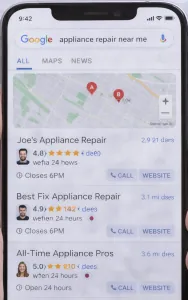
These aren’t blog posts. They’re location-specific landing pages that target searches like “appliance repair in [city]” or “refrigerator repair near me.”
Each page should cover:
The specific service (refrigerator repair, washer repair, etc.)
The city or neighborhood you serve
What makes your service reliable (same-day availability, certified technicians, warranty on repairs)
Customer reviews and trust signals
A strong call to action with your phone number prominently displayed
These pages need to be unique for each location you serve. Don’t just copy and paste the same content with different city names. Google will catch that and it won’t rank.
Instead, mention local landmarks, neighborhoods, and service areas naturally. “We serve homeowners throughout [City], including [Neighborhood 1], [Neighborhood 2], and surrounding areas.”
Seasonal Maintenance Content

This content targets people before they have an emergency. It’s educational, builds trust, and can generate leads during slower seasons.
Examples:
- How to Prepare Your Appliances for Summer Heat
- Fall Appliance Maintenance Checklist for Homeowners
- Winterizing Your Appliances: What You Need to Know
These articles work best when they’re practical and specific. Don’t just say “clean your dryer vent.” Explain why it matters (fire risk, efficiency), how often to do it, and signs that it needs professional attention.
How to Structure Content for SEO and Conversions
Good content for appliance repair follows a predictable structure that satisfies both Google and potential customers.
Start with the problem or question. Your opening paragraph should immediately confirm to the reader that they’re in the right place. If they searched “why is my dishwasher not draining,” your first sentence should acknowledge that exact problem.
Provide clear, scannable information. Use short paragraphs, subheadings, and bullet points. Most people skim before they read. Make it easy for them to find what they need.
Answer the question completely. Don’t hold back information to force a phone call. If someone can fix a simple problem themselves, tell them how. This builds trust and makes them more likely to call you for the issues they can’t handle.
Include trust signals throughout. Mention your experience, certifications, service area, and customer satisfaction. Don’t wait until the end to establish credibility.
End with a clear next step. Every article should guide the reader toward contacting you. Make it easy with a phone number, online booking link, or simple contact form.
Keyword Research for Appliance Repair Content
You can’t rank if you’re not targeting the right keywords. But keyword research for local service businesses is different from e-commerce or SaaS.
Start with the problems your customers actually tell you about. Look at your service call history. What are the most common issues? Those are your content topics.
Use Google’s autocomplete and “People Also Ask” features. Start typing “refrigerator not” and see what Google suggests. Those suggestions are real searches from real people.
Look at local search modifiers. Add your city name, “near me,” and neighborhood names to your core keywords. “Appliance repair Phoenix” and “refrigerator repair in Scottsdale” are different opportunities.
Check search volume, but don’t obsess over it. A keyword with 50 monthly searches in your service area is more valuable than a keyword with 5,000 searches nationally if those 50 searches are from local homeowners who need help now.
Focus on long-tail keywords that signal intent. “Appliance repair tips” is a research query. “Samsung refrigerator not cooling repair cost” is someone ready to hire.
Writing Content That Sounds Like a Real Human
One of the biggest mistakes appliance repair companies make is publishing content that sounds like it was written by a robot or a marketing intern who’s never held a wrench.
Your content should sound like you’re talking to a customer in your service van or on a phone call. Clear, direct, and helpful.
Use simple language. You know what a compressor and a condenser coil are. Your customers don’t, and they don’t need to. Explain things in terms anyone can understand.
Be specific. Don’t say “many appliances.” Say “most refrigerators last 10 to 15 years.” Don’t say “common issues.” Say “we see this problem in Samsung and LG front-load washers all the time.”
Show your experience. Reference real situations. “We’ve fixed hundreds of dryers that won’t heat, and 80% of the time it’s the heating element or thermal fuse.”
Avoid marketing fluff. No one cares that you’re “committed to excellence” or “passionate about customer service.” They care that you show up on time, fix the problem, and charge a fair price. Show that through your content, don’t just claim it.
Optimizing Content for Local SEO
For appliance repair companies, local SEO is everything. You’re not trying to rank nationally. You’re trying to rank in your city and surrounding areas.
Include location keywords naturally. Mention your city, neighborhoods, and service areas in your content. Don’t force it, but make it clear where you operate.
Create separate pages for each service area. If you serve multiple cities, build unique content for each one. This helps you rank in multiple local markets.
Link to your Google Business Profile. Your GBP listing is a critical ranking factor. Make sure your website and your GBP information match perfectly.
Get local backlinks. Links from local news sites, business directories, and community organizations help your local rankings. Sponsor a little league team, join the chamber of commerce, and get listed in local business roundups.
Use schema markup. This is technical, but it matters. Schema tells Google exactly what your business does, where you’re located, and what services you offer. If you’re using WordPress, plugins like Yoast or RankMath make this easier.
How to Turn Content Visitors Into Service Calls
Ranking is only half the battle. You also need to convert visitors into paying customers.
Make your phone number visible. It should be in your header, in your content, and in your footer. Don’t make people hunt for it.
Use clear calls to action. At the end of every article, tell people exactly what to do next. “Call us now for same-day service,” “Book your repair online,” or “Get a free diagnostic.”
Show proof. Include customer reviews, before-and-after photos, or examples of similar repairs you’ve completed. Social proof reduces hesitation.
Offer easy next steps. Some people want to call. Some want to text. Some want to fill out a form. Give them options.
Remove friction. Don’t require people to fill out a 10-field form to get a quote. Ask for name, phone number, and a brief description of the problem. That’s it.
Measuring What Actually Matters
You need to track the right metrics, or you won’t know if your content is working.
Organic traffic to key pages. Are people finding your problem-solving guides and service pages?
Phone calls from organic search. Use call tracking to see which pages generate calls. This tells you what content is actually driving business.
Form submissions. If you have an online booking system or contact form, track how many submissions come from blog content.
Rankings for target keywords. Are you moving up for the searches that matter? Track your position for your main service and location keywords.
Time on page and bounce rate. If people land on your content and leave immediately, it’s not resonating. If they stick around and read, you’re on the right track.
Don’t obsess over vanity metrics like total page views or social media shares. Those don’t pay the bills. Focus on metrics that connect directly to phone calls and booked jobs.
Common Content Mistakes to Avoid
Even companies that commit to content marketing often make mistakes that kill their results.
Writing for everyone instead of your specific customer. Generic advice doesn’t rank and doesn’t convert. Write for homeowners in your service area who need appliance repair.
Publishing inconsistently. One article every six months won’t move the needle. You need a steady flow of content to build authority and rankings.
Ignoring search intent. If someone searches “refrigerator not cooling,” they don’t want a history of refrigeration technology. They want to know why their fridge is broken and how to fix it.
Forgetting mobile users. Most local searches happen on phones. If your content is hard to read on mobile, you’re losing customers.
Not updating old content. Appliance models change. Prices change. Best practices change. Go back and refresh your top-performing content every year.
Building a Sustainable Content System
The companies that win with content don’t just publish randomly. They build a system.
Start with a content calendar. Plan out topics based on seasonality, common service calls, and keyword opportunities. You should know what you’re publishing for the next three months.
Batch your content creation. It’s easier to write three articles in one focused session than to start from scratch every week.
Repurpose your content. Turn a blog post into a video, a social media post, and an email. Get maximum value from every piece.
Track what works and do more of it. If your “refrigerator not cooling” guide drives 10 calls a month, create similar guides for other appliances and problems.
Invest in quality over quantity. One great, comprehensive guide is worth more than five shallow posts.
Why This Matters for Your Business
Most appliance repair companies compete on price, speed, or availability. Those are all important, but they’re also easy for competitors to copy.
Content gives you a different advantage. When someone searches for help with their broken appliance and finds your detailed, helpful guide, you’ve already started building trust before they ever call.
You’re not just another name in the search results. You’re the company that helped them understand their problem and gave them clear options.
That trust translates into phone calls, booked jobs, and customers who are less price-sensitive because they already see you as the expert.
And unlike paid ads that stop working the moment you stop paying, good content keeps working for months or years. A guide you publish today can generate leads for your business long after you’ve moved on to other priorities.
Ready to Build Content That Actually Works?
Creating content that ranks and converts isn’t complicated, but it does require strategy, consistency, and an understanding of what your customers actually need.
If you’re an appliance repair business owner who’s tired of inconsistent call volume and unclear ROI from your marketing, content is one of the most reliable ways to build predictable lead flow.
At Appliance Marketing Pros, we’ve built content systems for appliance repair companies across the country. We understand the searches your customers make, the questions they ask, and how to turn website visitors into booked service calls.
We handle the strategy, the writing, and the optimization so you can focus on running your business.
Want to see how a real content system could work for your company? Schedule a free strategy call and we’ll walk you through exactly what we’d build for your market.