
Blog
If You're Not Tracking Phone Calls, You're Flying Blind
I’ve worked with appliance repair companies for years. Some are busy year-round. Others have weeks when the phone rings constantly and months when it goes quiet. The difference usually comes down to one thing: tracking.
Most appliance repair owners spend thousands on marketing every month. Google Ads, local SEO, their Google Business Profile, maybe some Facebook ads or local mailers. But when I ask them which channel brings in the most jobs, they guess. They say things like “I think most calls come from Google Maps” or “We get a lot from word of mouth.”
That’s a problem. You can’t grow what you don’t measure. If you’re not tracking every phone call back to its source, you’re wasting money. You’re making decisions based on gut feeling instead of real data. And in a competitive market, that’s how you lose.
Why Most Appliance Repair Owners Don’t Track Calls

The main reason is simple. Most owners think call tracking is expensive, complicated, or only for big companies. They assume they’ll have to change their phone number or mess up their local SEO. Some have never even heard of dynamic number insertion or call attribution.
Others think they’re already tracking because they use Google Analytics on their website. But analytics only shows you website visitors. It doesn’t tell you which visitor picked up the phone, what number they called, or whether that call turned into a booked job.
Some owners rely on asking customers “How did you hear about us?” during the call. That’s better than nothing, but it’s not reliable. Customers forget. They say “Google” when they actually saw a Facebook ad first. They say “referral” when they found you through a search.
If you’re basing your marketing budget on customer memory, you’re guessing.
What Call Tracking Actually Does
Call tracking assigns unique phone numbers to different marketing channels. When someone calls one of those numbers, the system logs where that call came from, what time it happened, how long the call lasted, and whether it was answered.
The best systems also record the call so you can listen later. That means you can hear whether your CSR is booking jobs or letting good leads slip away. You can catch spam calls that waste time. You can identify patterns in how customers describe their problems.
For appliance repair businesses, this is critical. A homeowner with a broken refrigerator is calling multiple companies. If your team doesn’t answer fast or doesn’t sound confident, that call goes to your competitor. Call tracking helps you fix those issues because you can actually hear what’s happening.
Dynamic Number Insertion Protects Your Local SEO

One of the biggest fears appliance repair owners have about call tracking is that it will hurt their local SEO. They’ve been told to keep their NAP (name, address, phone number) consistent everywhere online. Changing your phone number sounds like it would break that.
Dynamic number insertion solves this. It swaps phone numbers on your website based on how the visitor arrived, but it leaves your real business number alone everywhere else. Your Google Business Profile, Yelp, local citations, and directory listings all stay the same.
When someone finds you through a Google search, they see one number. When someone clicks your ad, they see a different number. When someone types in your website directly, they might see your main line. Each number tracks back to the source, but your NAP stays consistent.
This is how professional agencies protect SEO while proving ROI.
The Difference Between Google Ads Tracking and Google Business Profile Tracking
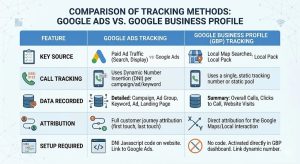
Most appliance repair owners run Google Ads at some point. The platform shows you clicks, impressions, and cost per click. But it doesn’t show you which clicks turned into phone calls unless you set up conversion tracking properly.
Even when you do set up Google Ads call conversions, it only tracks calls from ads. It doesn’t tell you anything about calls from your Google Business Profile, your organic search rankings, or any other channel.
That’s where call tracking fills the gap. You can see:
How many calls came from Google Ads versus GBP
Which ad campaigns drive actual service calls
What time of day generates the most calls from paid ads versus organic
Whether your Local Services Ads (LSA) calls are worth the cost
Without this breakdown, you’re treating all calls the same. But a call from someone searching “refrigerator repair near me” is different from a call from someone who saw your truck and Googled your company name. The first one costs you ad spend. The second one doesn’t.
Knowing the difference helps you allocate budget correctly.
Stop Paying for Spam and Junk Leads
One of the biggest frustrations I hear from appliance repair owners is junk calls. Telemarketers. Wrong numbers. People asking if you work on cars or lawn mowers. Competitors fishing for pricing.
When you’re not tracking calls, you can’t prove how bad the problem is. You just know your team is answering the phone a lot but not booking as many jobs as you’d expect.
Call tracking shows you exactly how many calls are legitimate appliance repair requests versus spam. It also shows you whether certain marketing channels bring in more junk leads than others. For example, some Yelp leads are great. Others are tire kickers who call six companies and ghost all of them.
Once you have data, you can make decisions. You can stop advertising in places that waste your time. You can train your CSR to handle common objections. You can add a service area filter on your website so you’re not getting calls from three states away.
Measure Marketing ROI the Right Way
Return on ad spend (ROAS) is the number that actually matters. If you spend $2,000 on Google Ads and book $10,000 in jobs from those calls, your ROAS is 5x. That’s worth continuing.
But if you spend $2,000 and only book $3,000 in jobs, you’re barely breaking even after labor and parts. That campaign needs fixing or cutting.
You can’t calculate ROAS without knowing which calls came from which source. Call tracking ties everything together. You see the marketing channel, the call, and the outcome.
Some advanced systems integrate with dispatch software so you can track calls all the way to completed jobs. That’s the ideal setup. You know exactly which marketing dollar brought in which repair ticket.
Most appliance repair companies don’t need that level of integration right away. Just tracking calls back to marketing source is enough to make smarter decisions.
Training Your Dispatch Team with Real Call Data
Call recording is one of the most underrated features of call tracking. It’s not just about accountability. It’s about training.
When your CSR or dispatcher answers the phone, are they friendly? Do they ask the right questions? Do they offer same-day or next-day service? Do they confirm the address and give a time window? Do they explain your warranty or mention financing if the job might be expensive?
Most owners assume their team is doing fine because calls are getting answered. But when you listen to recordings, you hear the gaps. You hear the homeowner ready to book and the CSR saying “We’ll call you back to schedule.” That’s a lost job.
You also hear patterns. Maybe most missed bookings happen on Friday afternoons when everyone is rushing. Maybe your team struggles with a specific appliance type and needs better scripting. Maybe customers keep asking about pricing upfront and your CSR doesn’t have a good response.
Recording calls gives you the information you need to coach, adjust, and improve booking rates. A 10 percent increase in booking rate is worth more than any new marketing campaign.
Why Appliance Marketing Pros Includes Tracking Phone Calls in Every Campaign
At Appliance Marketing Pros, call tracking is built into everything we do. It’s not an add-on or an upsell. It’s a required part of proving ROI.
When we run Google Ads for an appliance repair client, we set up dedicated tracking numbers for search campaigns, Local Services Ads, and remarketing. When we optimize a Google Business Profile, we track GBP calls separately so you know how much value your local SEO is delivering.
We don’t guess. We don’t rely on “How did you hear about us?” We show you exactly where your leads are coming from, how much each channel costs, and which ones are worth scaling.
That’s how we help appliance repair companies go from inconsistent call flow to predictable growth. You see what’s working. You double down on it. You cut what’s not. It’s simple once the data is clear.
What to Do Next
If you’re not currently tracking phone calls, start now. The longer you wait, the more money you waste on marketing that might not be working.
You don’t need a complicated system. You need accurate attribution, call recording, and a dashboard you can check weekly. Most call tracking platforms cost less than one wasted Google Ads campaign.
If you’re already working with a marketing agency and they’re not providing call tracking, that’s a red flag. Any agency running paid ads or SEO for service businesses should be proving results with real call data.
If you want to see exactly where your appliance repair leads are coming from and how to increase booked jobs without increasing ad spend, let’s talk. Appliance Marketing Pros specializes in appliance repair marketing with full tracking, transparent reporting, and strategies that actually work for blue-collar business owners.
Schedule a strategy session and we’ll review your current setup, show you what’s holding back your call flow, and build a plan to grow your business predictably.