
Blog
Replace Low-Paying Warranty Work with COD

You finished fixing a refrigerator compressor. The job took three hours. You used $120 worth of parts. The warranty company’s flat rate for that repair is $185. After parts, you made $65. Now you have to wait 45 days to get paid, assuming the warranty company does not reject your claim over a technicality in the paperwork.
This is the cycle most appliance repair owners are stuck in. You are trading your time, your expertise, and your cash flow for pennies. Meanwhile, the homeowner next door is calling someone else and paying $450 cash for the exact same repair because they are not on a warranty plan.
The difference between those two jobs is not your skill. It is your lead source.
Warranty companies control your pricing, delay your payment, and flood your schedule with low-margin work that keeps you busy but barely profitable. Cash on delivery customers pay retail prices, pay immediately, and value your expertise. If you want to grow your appliance repair business, you need to replace warranty volume with COD volume.
This guide explains why warranty work is killing your cash flow, how to target out-of-warranty customers using Google Ads and local SEO, and how to build a system that fills your schedule with high-paying jobs instead of flat-rate authorizations.
The Hidden Cost of Appliance Warranty Work
Most appliance repair owners I talk to started out doing warranty work because it seemed like guaranteed volume. The warranty companies promised steady calls, no marketing expense, and consistent work. That sounds great until you look at the actual numbers.
Warranty work has three major hidden costs that most owners do not account for until they are already locked in.
Why Low Flat Rates and Slow Pay Are Killing Your Cash Flow
Warranty companies pay flat rates. They decide what a compressor replacement is worth, what a control board swap is worth, and what a drain pump repair is worth. You do not get to negotiate. You do not get to adjust for difficult installs or premium brands. You take the flat rate or you lose the authorization.
For most appliance repairs, the flat rate is 30 to 50 percent below what a retail customer would pay. A job that should bring in $400 pays $180. A job that should bring in $250 pays $110. The margin is so thin that one bad diagnosis or one extra trip erases your profit entirely.
Then there is the payment timeline. Most warranty companies pay on a 30 to 60 day cycle. Some drag it out even longer if they dispute your claim or request additional documentation. You are fronting the labor, the parts, and the fuel, and you are waiting two months to recover those costs.
If you run a small operation with one or two trucks, this delay destroys your cash flow. You cannot pay your technicians on time. You cannot restock parts. You cannot invest in marketing or equipment. You are constantly chasing money that is owed to you instead of growing your business.
The Time Wasted on Third-Party Authorizations
Warranty work does not just pay less. It also takes longer to complete because of the authorization process.
Before you can even start the repair, you have to call the warranty company, explain the problem, get approval for diagnostics, submit your findings, wait for parts authorization, and then schedule a follow-up visit. Some warranty companies require photos. Some require multiple rounds of approval. All of it takes time that you are not getting paid for.
I have worked with appliance repair owners who spend 15 to 20 hours per week on warranty paperwork and authorization calls. That is time their technicians could be running additional service calls. That is time the owner could be improving their operations or building relationships with retail customers.
The administrative burden of warranty work is invisible until you track it. Once you do, you realize you are working a second unpaid job just to maintain the volume the warranty companies promised you.
Why Replace Low-Paying Warranty Work with COD
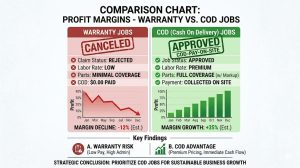
Cash on delivery customers are fundamentally different from warranty customers. They are homeowners who own their appliances outright, pay retail pricing, and expect professional service. They do not have a warranty company negotiating on their behalf. They are paying you directly, which means you control the pricing, the payment terms, and the customer relationship.
The financial difference between warranty work and COD work is dramatic.
The Math: Warranty Margins vs. Retail Margins
Let me walk you through the real numbers.
A typical refrigerator compressor replacement for a warranty customer might pay a flat rate of $200. After parts, your gross profit is $80. After labor, fuel, and overhead, your net profit is closer to $20 to $30.
The same repair for a retail COD customer should be priced between $400 and $550 depending on your market and the appliance brand. After the same parts cost, your gross profit is $280 to $430. After labor, fuel, and overhead, your net profit is $150 to $250.
That is a 5x to 10x difference in net profit for the exact same work.
Now multiply that across 20 service calls per week. If you replace half of your warranty volume with COD volume, you can cut your weekly call count in half and still increase your total revenue. Your technicians are less stressed. Your trucks last longer. Your cash flow improves immediately because you are getting paid the same day.
The math is simple. Warranty work keeps you busy. COD work makes you profitable.
How to Use Google Ads for COD Leads
The fastest way to generate high-paying appliance repair jobs is Google Ads. When someone searches for same day refrigerator repair or emergency appliance repair near me, they are not calling a warranty company. They are looking for a technician who can fix the problem today and they are willing to pay retail prices.
These searches have strong buyer intent. The homeowner already decided they need professional help. Your job is to show up at the top of the search results and make it easy for them to call you.

Targeting Out-of-Warranty Search Terms
Not all appliance repair searches are equal. Some searches come from people with active warranty plans who are just looking for an authorized service provider. Others come from homeowners whose appliances are out of warranty or who never bought a warranty plan in the first place.
You want the second group.
The best way to target out-of-warranty customers is by focusing on urgency-based keywords and appliance age indicators.
High-intent keywords for COD leads include:
Same day refrigerator repair
Emergency appliance repair
Washer repair near me today
Dishwasher not draining fix now
Appliance repair weekend service
These searches indicate urgency. The homeowner needs help immediately and they are not going to wait two days for a warranty company to authorize a service call. They are ready to pay retail pricing to get their appliance fixed today.
You can also target brand-specific and premium appliance keywords. Homeowners who own Sub-Zero, Wolf, Viking, or Thermador appliances typically do not have third-party warranty plans. They expect specialized service and they are used to paying premium prices.
Examples:
Sub-Zero refrigerator repair near me
Wolf range repair service
Thermador oven not heating
These keywords have lower search volume, but the leads are significantly more valuable. A single Sub-Zero compressor replacement can bring in $800 to $1,200. That is five times the revenue of a typical warranty call.
Using Negative Keywords to Block Renters and Price Shoppers
Targeting the right keywords is only half the strategy. You also need to block the wrong traffic.
Renters rarely pay for appliance repairs themselves. Their landlord or property manager handles it, which usually means they are looking for the cheapest possible option or they are required to use a specific vendor. You do not want to waste ad spend on renter searches.
Price shoppers are another problem. These are people who search for cheap appliance repair or appliance repair cost before they even know what is wrong. They are not buyers. They are researchers. They will call you, ask for a quote over the phone, and then hang up when you explain that you charge for diagnostics.
Add these negative keywords to your Google Ads campaigns to filter out low-intent traffic:
Cheap
Free
DIY
Rental
Apartment
Landlord
Cost estimate
How much
By blocking these terms, you reduce wasted clicks and focus your budget on high-intent searchers who are ready to book a service call today.
Optimizing Local SEO for High Paying Appliance Repair Jobs
Google Ads delivers fast results, but local SEO builds long-term lead flow. When your Google Business Profile ranks in the top three spots of the Local Pack, you get free visibility every time someone searches for appliance repair in your area.
The key to ranking for high-paying jobs is optimizing your profile and website for the same urgency-based signals that attract COD customers.
Promoting Same-Day and Emergency Service on Your GBP
Your Google Business Profile is the first thing potential customers see when they search for appliance repair near me. If your profile does not communicate speed and availability, they will call the next company on the list.
Make sure your GBP highlights:
Same-day service availability
Weekend and after-hours service
Emergency response times
Brands you specialize in
Your service area coverage
Add these details to your business description, your services list, and your Google Posts. Update your posts weekly with messages like “Same-day refrigerator repair available today” or “Emergency washer repair this weekend.”
Photos also matter. Upload images of your technicians working on high-end appliances, your fully stocked service van, and completed repairs. Homeowners want to see that you are professional, prepared, and experienced with their specific appliance brand.
The more signals you send that you are fast, reliable, and specialized, the more likely you are to attract retail customers instead of warranty customers.
Stop Doing Appliance Warranty Work: The Transition Plan
If you are currently relying on warranty companies for the majority of your call volume, you cannot just quit overnight. You need a transition plan that gradually replaces warranty volume with COD volume without leaving gaps in your schedule.
Here is the step-by-step process I recommend.
How to Pre-Qualify Callers and Collect Payment Upfront
One of the biggest differences between warranty work and COD work is customer expectations. Warranty customers expect free diagnostics because the warranty company covers it. COD customers expect to pay for your time and expertise.
You need to train your dispatcher to pre-qualify callers and set clear payment expectations before you send a technician.
When a potential customer calls, your dispatcher should ask:
Is your appliance still under warranty or do you have a home warranty plan?
If yes, refer them to their warranty provider or politely decline the work if the flat rate does not meet your minimum.
If no, confirm that they understand there is a trip charge and that payment is due at the time of service.
This simple qualifying question filters out warranty customers and ensures that every call you book is a retail customer who is ready to pay your full rate.
You should also make payment terms clear on your website, your Google Business Profile, and during the booking process. Use language like:
We specialize in out-of-warranty appliance repair and offer same-day service for cash-paying customers.
All service calls include a diagnostic fee, payable at the time of service.
This transparency eliminates sticker shock and reduces the number of no-shows or payment disputes.
Once you start booking more COD calls, you can gradually reduce the number of warranty authorizations you accept each week. Set a floor for your flat-rate minimums. If a warranty company will not pay at least $150 for a service call, decline the work. As your COD volume increases, raise that floor to $200, then $250, and eventually stop accepting warranty work altogether.
Build a Predictable COD Lead Machine With AMPRank
Transitioning from warranty work to COD work requires a complete marketing system. You need Google Ads campaigns targeting high-intent keywords, a Google Business Profile optimized for same-day service, service pages that convert searchers into callers, and call tracking to measure which marketing channels are delivering the best leads.
That is exactly what we built with AMPRank.
AMPRank is our proprietary system for appliance repair companies that combines:
Google Ads campaigns structured around urgency-based and premium brand keywords
Negative keyword filtering to block renters, price shoppers, and DIY searchers
Google Business Profile optimization to dominate the Local Pack for same-day and emergency searches
Service pages optimized for out-of-warranty customers and high-end appliance brands
Call tracking and lead attribution so you know exactly which campaigns are generating COD leads
We have worked with appliance repair companies that went from 80 percent warranty work to 80 percent COD work within 12 months. The result was higher revenue per truck, better cash flow, and less stress from chasing warranty company payments.
If you are tired of working for flat rates and waiting two months to get paid, schedule a strategy call with Appliance Marketing Pros. We will review your current lead sources, show you where the highest-margin opportunities are in your market, and build a plan to replace your warranty volume with predictable, high-paying COD leads.