
Blog
Sales Script to Close More Service Calls with Confidence

The Appliance Repair Sales Script That Actually Books Jobs (Not Just Answers Phones)
You already know this: if your phone rings and nobody books, your marketing is burning money.
It doesn’t matter how good your Google Ads are, how optimized your Google Business Profile is, or how high you rank for “appliance repair near me.” If the person answering your phone doesn’t have a proven system, you are losing 40% to 60% of your inbound calls to competitors, price shoppers, or flat-out confusion.
Most appliance repair owners treat the phone like an information desk. They answer questions, offer vague timelines, and let the customer hang up to “think about it.” That’s not sales. That’s just being polite while someone shops you against three other companies.
This guide gives you the exact sales script framework we’ve seen consistently book more jobs across appliance repair businesses nationwide. It’s built for real calls, real objections, and real business owners who don’t have time for theory.
Why Most Appliance Repair Businesses Lose Calls They Should Win
Your marketing is doing its job. The phone is ringing. The lead came in through Google, clicked your ad, or found your listing. They have a broken appliance and they need help.
But here’s what happens in most shops:
The call gets answered by someone who’s friendly but not trained. The customer asks questions. The person answering tries to be helpful. The customer says they’ll call back. They don’t.
Or worse, the customer asks, “How much do you charge to fix a refrigerator?” and your team gives a range. Now you’ve anchored them to the low end of that range, and when the actual repair costs more, they’re upset. Or they take your range and call the next company to see if they can beat it.
Neither scenario books the job.
The problem isn’t your people. The problem is that nobody taught them what the goal of the call actually is. And the goal is not to answer every question. The goal is to book the appointment.
The One Thing Your Team Must Understand Before They Pick Up the Phone
You cannot diagnose an appliance over the phone.
You cannot give an accurate repair price over the phone.
You cannot tell a homeowner what’s wrong with their washer, dryer, fridge, or dishwasher without seeing it, testing it, and identifying the failed part.
So stop trying.
The only thing you are selling on that first call is the appointment. That’s it. You are selling the chance for a qualified technician to show up, assess the problem, and give the homeowner real answers.
Everything else is noise.
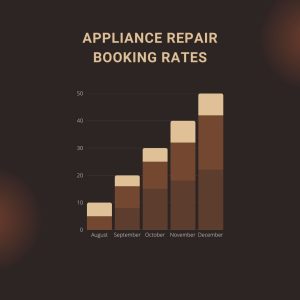
This is the mindset shift that separates companies with 70% booking rates from companies with 30% booking rates. Train your team to control the conversation and guide it toward a single outcome: locking in a name, address, phone number, and time slot.
The Sales Script Framework (Phase by Phase)
This isn’t a word-for-word robot script. It’s a framework your team can adapt to sound like themselves while staying on track. The structure works because it mirrors how buying decisions actually happen: someone has a problem, wants help, and needs to feel confident that the help is coming.
Phase 1: The Greeting and Energy Reset
The first five seconds set the tone for the entire call. If your team answers with low energy, monotone, or sounds distracted, the caller assumes your service will be the same way.
Here’s the structure:
“Thanks for calling [Your Company Name], this is [Name]. How can I help you today?”
Short. Clear. Confident.
Some variations we’ve seen work well:
“Good morning, [Company Name], this is [Name], what can I help you with?”
“[Company Name], this is [Name], what’s going on with your appliance?”
The goal is to sound like someone who knows what they’re doing and is ready to solve a problem. Not someone filling time between TikTok videos.
Phase 2: Let Them Vent (But Stay in Control)

Once the customer starts explaining the issue, let them talk. They’re frustrated. The fridge isn’t cooling. The washer is leaking. The dryer is making a horrible noise. They need to say it out loud.
Your job is to listen and insert small confirmations that show you’re tracking with them:
“Okay, got it.”
“That makes sense.”
“Yeah, that’s frustrating.”
But don’t let them spiral into a 10-minute story about every appliance problem they’ve ever had. After 20 to 30 seconds, guide them back:
“Okay, I understand. Let me get someone out there to take a look and figure out exactly what’s going on.”
You’re not being rude. You’re being helpful. You’re moving them toward a solution.
Phase 3: The Transition to Booking
This is where most teams lose the call. They wait for the customer to ask about availability. Or they answer a pricing question. Or they start explaining how repairs work.
Don’t wait. Transition immediately into booking mode.
“Let me check my schedule and see when I can get a tech out to you. Can I grab your address real quick?”
This is called an assumptive close. You assume they want the appointment. You assume they’re ready to move forward. And you start collecting information like it’s already decided.
Most customers will give you their address without hesitation because you sound confident and helpful. You’re not asking “Would you like to schedule?” You’re asking, “What’s your address?”
There’s a massive difference.
Phase 4: Locking in the Time
Once you have the address, move to availability:
“Okay, I’ve got a technician in your area tomorrow. I can do morning between 9 and 12, or afternoon between 1 and 4. Which works better for you?”
Give them two options. Not ten. Not “whenever works for you.” Two clear windows.
This does two things. It shows you’re busy (social proof), and it makes the decision easy. People don’t want to think hard. They want someone to guide them.
Once they pick a window, confirm:
“Perfect. I’ve got you down for [day] between [time window]. I’ll have [Technician Name] give you a call about 30 minutes before he heads your way. And I’ve got your number as [repeat number], is that right?”
Repetition locks it in. It also gives them a chance to correct anything before you hang up.
Phase 5: Handling the Objection Everyone Knows Is Coming
At some point, the price question will come up. Maybe at the beginning. Maybe right before you lock in the time. It sounds like this:
“How much is this going to cost?”
“What do you charge?”
“Can you give me a ballpark?”
Here’s the script that works:
“I totally understand. Here’s the thing: I can’t give you an honest number without seeing the machine. Every appliance is different. If I guess low, I’m lying to you. If I guess high, I’m scaring you off for no reason. What I can tell you is that our technician will come out, diagnose the issue, and give you an exact price before any work is done. If it makes sense, we fix it. If not, no pressure. Fair enough?”
This script works because:
It validates their concern (you’re not dodging the question).
It explains why you can’t answer it (logic they can’t argue with).
It reassures them there’s no risk (they’ll get a real answer soon).
It ends with a trial close (“Fair enough?”).
Most customers will say, “Okay, that makes sense” and move forward. The ones who push back with “Well, just give me a rough estimate” are price shoppers. They’re calling five companies. You’re not going to win them by guessing a number. Let them go.
What to Do When They Say “I Need to Think About It”
This is the second most common objection. It usually means one of three things:
They’re scared of the cost.
They’re calling other companies.
They’re not actually ready to fix it yet.
Your response should narrow it down:
“Of course. Can I ask what you’re thinking about? Is it the timing, or are you checking around on price?”
If it’s timing, offer flexibility:
“No problem. When were you thinking? I can hold a spot for you.”
If it’s price, loop back to the previous script about why you can’t quote over the phone.
If they’re just not ready, let them go but make it easy to come back:
“Totally understand. If it gets worse or you want to get it looked at, just give us a call back. We’ll get someone out fast.”
Don’t beg. Don’t offer discounts. Just make it easy and move on.
The Biggest Mistake That Kills Booking Rates (And How to Fix It)
The biggest mistake is answering the phone like you’re doing the customer a favor.
If your team sounds bored, distracted, or unsure, the customer will assume that’s how your service works too. They’ll book with the company that sounded confident and ready to help, even if that company charges more.
Energy and confidence matter more than people think.
Here’s how to fix it:
Roleplay the script. Don’t just hand someone a piece of paper and expect them to use it. Run through scenarios. Have them practice the assumptive close. Practice the price objection. Make it muscle memory.
Listen to recorded calls. If you’re using a call tracking system (and you should be), listen to your calls every week. Identify where your team is losing control. Identify where they’re doing great. Use real examples in your training.
Track the booking rate by person. If one person on your team books 70% of their calls and another books 30%, there’s a skill gap. Figure out what the high performer is doing and teach it to the rest of the team.
This isn’t complicated. It’s just intentional.
Why This Matters More Than Your Marketing Budget
You can spend $5,000 a month on Google Ads, rank #1 for every keyword in your city, and have 500 five-star reviews. But if your booking rate is 40%, you’re wasting half of it.
Let’s say you’re getting 100 inbound calls a month. At a 40% booking rate, that’s 40 jobs. If your average ticket is $300, that’s $12,000 in revenue.
Now, let’s say you improve your booking rate to 60% using the script framework in this guide. Same 100 calls. Now you’re booking 60 jobs. That’s $18,000 in revenue.
You didn’t spend more on marketing. You didn’t get more calls. You just closed more of the calls you already had. That’s a $6,000 monthly increase from better phone handling.
And that number compounds every single month.
What This Looks Like in a Real Appliance Repair Business
We work with appliance repair companies across the country. The ones who treat phone handling like a system, not a personality contest, consistently outperform their local competitors.
They don’t hire “friendly people.” They hire coachable people and train them on structure. They track booking rates. They listen to calls. They optimize.
And when they combine strong phone handling with consistent lead flow from Google Ads and local SEO, they create a predictable growth engine that doesn’t rely on referrals, luck, or slow months.
That’s the difference between a company that survives and a company that scales.
Ready to Fill Your Schedule with Qualified Calls?
If you’re serious about growing your appliance repair business, the script is only half the equation. You also need consistent, high-quality calls coming in. That’s where we come in.
At Appliance Marketing Pros, we specialize in driving qualified leads for appliance repair companies using Google Ads, local SEO, and Google Business Profile optimization. We don’t work with everyone. We work with owners who are ready to grow, track results, and treat their marketing like a system.
If that’s you, let’s talk.
Schedule a free strategy call and we’ll walk through exactly how we’d increase your call volume, improve your cost per lead, and help you dominate your local market.
No fluff. No long-term contracts. Just clear strategy and execution from people who’ve done this hundreds of times.