Blog
Scaling Marketing From Tech to CEO
How to Scale an Appliance Repair Business: From Tech to CEO
You started your appliance repair business to fix things and make good money doing it. Now you’re working 60-hour weeks, fielding calls at 9 PM, and still wondering why your revenue hasn’t reached the next level.
The problem isn’t your technical skill. It’s that you’re stuck in the truck.
Scaling an appliance repair business means building systems that generate revenue whether you’re on a service call or not.
It means transitioning from technician to business owner, and it requires changes in three core areas:
- operations
- team building
- marketing
This guide walks you through the exact steps that appliance repair owners take to grow from a solo operator to a scalable company, with a focus on what actually moves the needle.
The Owner-Operator Trap: Why You Can’t Scale Yourself
When you’re the only technician, your revenue has a ceiling. You can only run so many calls per day. You can only cover so much territory. And every hour you spend answering the phone, ordering parts, or doing paperwork is an hour you’re not billing.
Most appliance-repair owner-operators hit a wall at around $150,000 to $200,000 in annual revenue. That’s the point where demand exists, but capacity doesn’t. You’re booked solid, turning away work, and still not making the profit you expected.
The solution isn’t working harder. It’s building a business that works without you in every service call.
Scaling requires three things: reliable technicians, efficient systems, and consistent lead flow. Skip any one of these, and growth stalls.
Step 1: Hire and Retain Top Technicians
Your first hire is the hardest. You’re trusting someone else to represent your brand, handle your customers, and generate revenue while you’re not there. That’s a big psychological shift.
Here’s what matters when hiring appliance repair techs:
- Look for problem solvers, not just part replacers. The best technicians can diagnose issues methodically and explain solutions to customers in plain language. They don’t just swap components and hope it works.
- Hire for attitude, train for skill. You can teach someone how to troubleshoot a compressor. You can’t teach someone to show up on time, communicate clearly, or care about the customer experience.
- Pay competitively. Technician churn is expensive. Every time someone leaves, you lose the investment in training, uniforms, tools, and the trust they built with repeat customers. Paying $2 more per hour costs far less than constantly replacing people.
- Set clear performance metrics. Track first-time fix rate, average ticket value, and customer satisfaction scores. Techs should know what success looks like and how they’re being measured.
Retention comes down to respect and clarity. Technicians stay when they feel valued, when expectations are clear, and when they see a path to earn more as the company grows.
Step 2: Implement Dispatching and Routing Software
Once you have multiple technicians, you need a system to manage who goes where and when. Running this from a notebook or a group text doesn’t scale.
Good dispatching software does a few critical things:
- Reduces truck roll costs. Every time a truck leaves the shop, you’re burning fuel, time, and labor. Smart routing clusters jobs geographically and minimizes drive time between calls.
- Improves first-time fix rate. When dispatchers can see technician skill sets, parts inventory, and job history, they can assign the right person to the right call. That means fewer return trips and higher customer satisfaction.
- Gives you real-time visibility. You should be able to see where every tech is, what jobs are pending, and how the day is tracking without making a single phone call.
Popular options for appliance repair businesses include ServiceTitan, Housecall Pro, and Jobber. The right choice depends on your size, budget, and whether you need integrated marketing tools or just dispatching and invoicing.
The key is adoption. If your techs don’t use it consistently, the system fails. Build it into onboarding, make it easy, and enforce it from day one.
Step 3: Optimize Your Appliance Repair Marketing Budget
This is where most appliance repair businesses waste money.
They throw $1,500 a month at Google Ads without tracking which calls book. They pay for SEO and never see rankings move. They buy shared leads from Angi or HomeAdvisor and compete with three other companies for the same job.
Scaling your appliance repair business requires predictable, exclusive lead flow. That means controlling your marketing instead of renting attention from lead aggregators.
Stop Buying Shared Leads (The Problem with Angi and Yelp)
Shared leads feel easy. You pay $15 to $40 per lead, and someone sends you a name and phone number. But you’re one of three to five companies receiving the same information.
That means:
- Low conversion rates. The homeowner is price shopping, not choosing you based on trust or reputation.
- High cost per acquisition. Even if you win the job, your effective cost per lead is much higher once you account for all the leads that didn’t convert.
- No long-term asset. You’re renting visibility. The moment you stop paying, the leads stop. You’ve built nothing.
Exclusive leads cost more upfront but convert at 3x to 5x the rate of shared leads. And they come from channels you own, like your Google Business Profile, your website, and your search ads.
Focus on Exclusive Calls with Local SEO and Google Business Profile
Most appliance repair searches happen on Google Maps. Someone’s fridge stops cooling, they search “appliance repair near me,” and they call one of the top three results.
If your Google Business Profile isn’t optimized, you’re invisible.
Here’s what moves the needle:
- Complete, accurate business information. Name, address, phone number, hours, and service area must be correct and consistent across every platform.
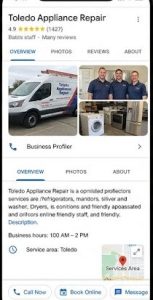
- High-quality photos. Show your branded trucks, your team, your workspace. Avoid generic stock images. Real photos build trust.
- Consistent review generation. You need a system to ask happy customers for reviews immediately after the job. Businesses with 50+ reviews and a 4.5+ star average dominate local search.
- Service area optimization. Google needs to understand where you operate and what you fix. Use posts, Q&A, and service listings to make that crystal clear.
Local SEO and Google Business Profile work together. When someone searches “LG refrigerator repair in Dallas,” Google decides which businesses to show based on relevance, distance, and prominence. You control relevance and prominence. Distance is just geography.
Investing in these channels builds a long-term asset. Every ranking improvement, every review, every optimized listing compounds over time.
Run Search-Only Google Ads (No Display, No YouTube, No Spam)
Google Ads works for appliance repair when it’s done right. The problem is that most agencies waste your budget on display ads, YouTube pre-rolls, and broad-match keywords that attract tire-kickers.
Search-only campaigns target people actively looking for appliance repair right now. They’ve typed “Samsung washer won’t drain” or “GE oven not heating” into Google. They need help today.
Here’s what makes Google Ads effective for appliance repair:
Exact and phrase match keywords. Target specific problems and appliance brands. Avoid broad match unless you have deep conversion tracking in place.
Negative keywords. Exclude searches for parts, DIY tutorials, and appliance sales. You’re not trying to reach people who want to fix it themselves.
Call tracking. Every campaign should use call tracking numbers so you know exactly which keywords and ads generate booked jobs, not just phone calls.
Geo-targeting. Only show ads in your service area. Don’t pay for clicks from people 50 miles away.
The goal is predictable costs per lead and per job. If you’re spending $800 and generating 20 calls that turn into 8 booked jobs at an average ticket of $350, your math works. If you’re spending $800 and getting 40 calls that turn into 2 jobs, your targeting or ad copy is broken.
Transparency matters here. You should be able to log into your Google Ads account at any time, see what’s running, and understand the numbers. If your agency won’t give you access, that’s a red flag.
Step 4: Track the Metrics That Actually Matter
Revenue is a lagging indicator. By the time you see it drop, the problem started weeks ago.
To scale an appliance repair business, you need to track the metrics that predict revenue:
- Cost per lead (CPL). How much are you paying to generate a phone call or form submission? This varies by market, but most appliance repair businesses see CPLs between $25 and $60 for exclusive leads.
- Lead-to-job conversion rate. What percentage of inbound calls turn into booked appointments? If this number is below 40%, your booking process, pricing, or lead quality needs work.
- Cost per acquisition (CAC). How much does it cost to acquire one paying customer? Divide your total marketing spend by the number of new customers.
- Return on ad spend (ROAS). For every dollar you invest in marketing, how much revenue comes back? A healthy ROAS for appliance repair is 4:1 or higher.
- First-time fix rate. What percentage of jobs are completed on the first visit? Higher rates mean better customer satisfaction, fewer return trips, and lower labor costs.
These metrics show where the breakdowns occur. Low lead volume? Your visibility is the problem. High lead volume but low conversions? Your sales process or pricing needs attention. High conversions but low profit? Your cost per acquisition is too high.
Track this weekly, not monthly. Waiting 30 days to spot a problem means you’ve already burned a month of budget.
Step 5: Partner with an Agency That Knows Your Industry
Generic marketing agencies don’t understand appliance repair. They don’t know the difference between a service call and a diagnostic fee. They’ve never optimized a Google Business Profile for refrigerator compressor replacement. They can’t explain why a shared lead from Angi converts differently from a call from Local Services Ads.
You need a partner who speaks your language and has a track record with appliance repair, HVAC, and home service businesses.
Here’s what to look for:
- Industry specialization. Agencies that focus exclusively on home services understand the operational realities, the sales cycle, and the metrics that matter.
- Transparent reporting. You should have access to your ad accounts, your analytics, and clear reports that show calls, leads, and booked jobs.
- Integrated approach. SEO, Google Ads, and Google Business Profile optimization should work together, not in silos. A strong GBP ranking improves ad performance. Good SEO content supports both.
- Accountability. Results should be measurable. If an agency can’t show you cost per lead, lead-to-job conversion, or ROAS, they’re guessing.
At Appliance Marketing Pros, we built our entire system around predictable lead generation for appliance repair companies. Our AMPRank approach combines local SEO, Google Ads, Google Business Profile optimization, and AI-powered visibility tools designed specifically for contractors who need exclusive calls, not shared leads.
We’ve worked with appliance repair businesses across the United States for over 20 years. We know what breaks. We know what works. And we know how to build systems that deliver real growth, not vanity metrics.
Ready to Transition From Tech to CEO?
Scaling an appliance repair business isn’t about working more hours. It’s about building systems that generate leads, support a growing team, and give you visibility into what’s actually driving revenue.
You’ve already built the technical expertise. Now it’s time to build the business infrastructure that turns that expertise into predictable growth.
If you’re tired of inconsistent call volume, unclear ROI, and marketing that doesn’t deliver, let’s talk.
Schedule a free strategy call with Appliance Marketing Pros. We’ll review your current marketing, identify what’s working and what’s not, and show you exactly how we’d build a lead generation system tailored to your market.
No pressure. No generic pitch. Just a straight conversation about what it takes to grow an appliance repair business in today’s market.
AMP Up Your Growth.