Blog
The Permanent Shift in the Appliance Repair Marketplace
The appliance repair industry changed forever in 2020, and most owners still think things will go back to normal. They won’t.
If you run an appliance repair business, you’ve probably noticed the shift. More phone calls, but also more spam. Higher ad costs. Review manipulation everywhere. Google Business Profiles are getting suspended for no clear reason. Leads that sound great on the phone but ghost you after the quote.
The old playbook stopped working. Referrals dried up during the pandemic. The Yellow Pages generation aged out. Every homeowner under 50 starts their search on Google, and the companies winning those searches are the ones who adapted fast.
This is not a temporary disruption. The appliance repair marketplace has changed permanently, and the gap between companies that figured it out and those still guessing is widening every month.
If your call volume is inconsistent, your Google Ads waste money, or you’re not sure where your leads actually come from, this article will explain what shifted, why it matters, and what you need to do about it right now.
What Actually Shift in the Appliance Repair Marketplace
Three major shifts hit the appliance repair market at the same time, and they compounded on each other.
Homeowners stopped using the phone book and started using Google Maps. This was already happening slowly, but COVID accelerated it by years. Now, if you’re not in the top three Google Business Profile results when someone searches “appliance repair near me,” you might as well not exist. Proximity, reviews, and profile completeness determine who shows up, and most owners have no idea how the ranking system actually works.
Lead aggregators flooded the market with shared leads and spam. Companies like HomeAdvisor, Angi, and Thumbtack convinced thousands of appliance repair owners to pay for shared leads. The problem is obvious once you experience it. You’re competing with four other companies for the same job, the homeowner picks whoever answers fastest or bids lowest, and you burn time quoting jobs you’ll never book. Worse, many of these platforms started selling the same leads multiple times or generating fake inquiries just to keep the revenue flowing.
Google Ads costs increased while lead quality declined. More appliance repair companies started running Google Ads, which drove up Cost Per Click (CPC) across the board. At the same time, DIY searches, warranty questions, and window shoppers started clogging up the call volume. If you’re not filtering your keyword strategy and tracking actual booked jobs, you’re paying for a lot of noise that never turns into revenue.
The companies that adapted to these three shifts are booking 15 to 25 service calls per week with predictable consistency. The ones who didn’t are still wondering why last month was busy but this month is dead.
Why the Old Marketing Playbook Stopped Working
For decades, appliance repair companies survived on word of mouth, repeat customers, and a Yelp page. That model worked because competition was manageable and customers had fewer options.
Here’s why that strategy is dead now.
Repeat customers take longer to come back. Appliances are lasting longer, and when they do break, homeowners are more likely to search for “best rated appliance repair near me” than dig through old paperwork to find the company they used five years ago. You can’t rely on repeat business when the average customer cycle is three to five years and they forget your name after six months.
Word of mouth is drowned out by online reviews. A neighbor’s recommendation used to be gold. Now, that same neighbor will still Google you before calling, and if your profile has 12 reviews while your competitor has 140, they’re calling the other company. Social proof is everything. If you’re not actively collecting reviews every single week, you’re losing jobs to competitors who are.
Yelp and directory sites became pay-to-play. Yelp used to be a legitimate referral source. Now it’s an extortion racket. If you don’t pay for ads, your best reviews get filtered and your competitors show up above your profile. Most appliance repair owners realized this too late and wasted thousands of dollars before realizing that Yelp leads are expensive and low-intent.
The new playbook is simple but requires execution. You need to own your Google Business Profile, run targeted Google Ads that only show up for high-intent searches, track every lead source so you know what’s working, and automate follow-up so you’re not losing booked jobs to slow response times.
The Real Reason Most Appliance Repair Companies Struggle With Lead Flow
I’ve worked with appliance repair companies in 30+ cities, from one-truck operations to teams running 15 technicians. The lead flow problem is almost always the same, and it’s not what most owners think.
It’s not that there aren’t enough people searching for appliance repair. There are. The issue is that most companies are invisible to the people who are actively ready to book, and the leads they do get are either low-quality or poorly handled.
Here’s what I see over and over.
Google Business Profiles are set up wrong or abandoned. The profile exists, but the categories are generic, the service areas are missing, the photos are outdated, and the description is two sentences of nothing. Google ranks profiles based on relevance, proximity, and reviews. If your profile looks weak or incomplete, you won’t appear in the Local Pack, even if you’re the closest company to the searcher.
Google Ads campaigns target the wrong searches. Most appliance repair ad campaigns are set to Broad Match, which means Google is showing your ads for searches like “appliance repair DIY,” “appliance parts near me,” and “Whirlpool warranty service.” You’re paying for clicks from people who will never hire you. The companies who win with Google Ads use Exact and Phrase Match keywords and ruthlessly add negative keywords every week to cut out the garbage.
There’s no follow-up system for missed calls or unbooked estimates. A homeowner calls, you’re on another job, they leave a voicemail, and by the time you call back two hours later they’ve already booked someone else. Or you give them a quote, they say they’ll think about it, and you never follow up. Most appliance repair companies lose 30% of their potential revenue just from slow or nonexistent follow-up.
Owners don’t track where leads come from, so they keep spending money on what doesn’t work. I’ll ask an owner how many calls they got last month from Google Ads, their Google Business Profile, and referrals, and they’ll guess. That’s not a strategy. If you’re not tracking lead sources and conversion rates, you’re flying blind. You could be spending $2,000 a month on something that generates two booked jobs while ignoring the channel that’s driving ten.
The companies that fixed these four things saw immediate improvements. More calls, better quality leads, higher booking rates, and clear visibility into what’s actually generating revenue.
What Google Business Profile Optimization Actually Means
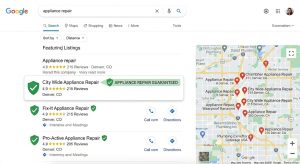
Most appliance repair owners think optimizing their Google Business Profile means filling out the description and uploading a logo. That’s 10% of the work.
Google ranks profiles using three main factors: relevance, proximity, and prominence. You can’t control proximity (you are where you are), but you can absolutely dominate relevance and prominence if you know what to focus on.
Category selection matters more than most people realize. Your primary category should be “Appliance Repair Service.” Period. Don’t pick something vague like “Contractor” or “Repair Service.” Google uses your primary category to decide what searches you’re eligible to rank for. Secondary categories should be used only if you genuinely offer other services, such as HVAC or small-appliance repair. Don’t stuff categories just to show up for more searches. It confuses Google and dilutes your relevance.
Service area definitions control where you show up. If you serve a 25-mile radius, you need to list every city, zip code, and neighborhood within that area. Most profiles just list the city where the business is located and wonder why they don’t show up in searches for nearby towns. Google needs explicit service area data. The more specific you are, the more search visibility you get.
Photos drive engagement and trust. Profiles with regular photo uploads rank higher and get more clicks. Upload real photos of your team, your trucks, completed jobs, and even behind-the-scenes shots of your shop. Avoid stock images. Homeowners want to see who’s coming to their house. If your profile has three blurry photos and your competitor has 50 high-quality images, guess who’s getting the call.
Reviews are the single biggest ranking factor you can control. Google heavily weights review velocity (how often you get new reviews) and overall rating. A company with 150 reviews and a 4.9 rating will almost always outrank a company with 30 reviews and a 5.0 rating, even if the second company is closer to the searcher. You need a system for requesting reviews after every job. Text the customer a direct link before you leave the driveway. Make it easy, make it fast, and do it every single time.
Posts and Q&A keep your profile active. Most owners don’t know these features exist. Google Business Profile posts let you share updates, promotions, or service highlights directly on your profile. The Q&A section is where potential customers ask questions and either you or random people on the internet answer them. If you’re not monitoring and responding to Q&A, you’re letting strangers control your messaging.
A properly optimized Google Business Profile generates 40-60% of the total lead volume for most appliance repair companies. It’s the highest ROI marketing channel available, and most owners are barely scratching the surface.
Why Most Google Ads Campaigns for Appliance Repair Companies Fail
Google Ads should be a predictable lead machine. For most appliance repair companies, it’s a money pit.
The problem is almost never the platform. It’s how the campaign is built and managed.
Broad Match keywords waste your budget on irrelevant searches. Broad Match tells Google to show your ads for any search it thinks is related to your keywords. In practice, this means you’re paying for searches like “refrigerator repair YouTube,” “appliance parts store,” and “GE appliance warranty phone number.” None of those people are hiring you. Use Exact Match and Phrase Match keywords only, and add negative keywords aggressively. I’ve seen ad accounts cut their Cost Per Lead by 40% just by switching match types and adding 50 negative keywords.
Campaigns send traffic to the homepage rather than to service-specific landing pages. If someone searches “washer repair near me” and clicks your ad, they should land on a page dedicated to washer repair, with a clear call to action and your phone number at the top. Instead, most campaigns send everyone to a generic homepage where visitors have to hunt for the service they need. That’s a conversion killer. Build dedicated landing pages for each appliance type, and ensure each page matches the search intent exactly.
Ad copy doesn’t address the actual pain point. Most appliance repair ads say something like “Fast, Reliable Appliance Repair | Call Today!” That’s not compelling. The homeowner already knows they need appliance repair or they wouldn’t be searching for it. Your ad needs to hit a specific pain point or provide a clear differentiator. Examples: “Same-Day Appliance Repair | No Trip Charges,” “Certified Technicians | 90-Day Warranty on All Repairs,” “Family-Owned Since 1998 | Serving [City] for 25+ Years.”
There’s no call tracking, so you can’t measure ROI. If you’re running Google Ads and you don’t have call tracking installed, you have no idea if it’s working. Call tracking assigns a unique phone number to your ads so you can see exactly how many calls came from Google Ads, what keywords triggered those calls, and whether those calls turned into booked jobs. Without this data, you’re just guessing. Most owners are shocked when they install call tracking and realize half their ad spend is generating calls that never book.
Budgets are too low to be competitive, or too high without proper management. I’ve seen appliance repair companies try to run Google Ads with a $500 monthly budget in a competitive market where the average Cost Per Click is $15. You’re getting 30 clicks a month. That’s not enough volume to generate consistent leads. On the flip side, I’ve also seen owners dump $5,000 a month into poorly managed campaigns and wonder why they’re losing money. The right budget depends on your market, your competition, and how well your campaign is optimized. Start with $1,500 to $2,000 a month, track everything, and scale up only when the numbers prove it’s working.
A well-run Google Ads campaign should deliver a 3:1 to 5:1 return on ad spend. Anything less means something in the setup, targeting, or tracking is broken.
The Hidden Cost of Bad Leads and How to Stop Paying for Them
Every appliance repair owner knows the frustration of bad leads. The phone rings, you get excited, and then it’s someone asking if you sell parts, or if you service commercial equipment, or if you can come out today for free to “just take a look.”
Bad leads don’t just waste time. They cost money, and they kill momentum.
Shared leads from aggregator platforms are the worst offenders. HomeAdvisor and Angi charge you for the lead the moment they send it, regardless of whether the homeowner answers the phone, whether you’re a good fit, or whether three other companies are calling the same person at the exact same time. You’re competing on price against contractors you’ve never heard of, and the homeowner is incentivized to pit everyone against each other for the lowest bid. It’s a race to the bottom. The companies that grow consistently stop buying shared leads entirely and invest that money into owned channels like Google Ads and SEO.
DIY searches are flooding Google Ads campaigns. Homeowners searching for “how to fix a leaking dishwasher” or “refrigerator not cooling troubleshooting” are not hiring you. They’re trying to fix it themselves. If your Google Ads campaign doesn’t have a strong negative keyword list, you’re paying for these clicks. Add negative keywords such as: DIY, YouTube, troubleshooting, how to, fix myself, parts, manual, warranty, and any appliance brand you don’t service.
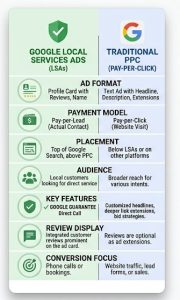
Out-of-area calls waste time and hurt your reputation. This happens most often with Google Local Service Ads (LSAs). A homeowner 40 miles outside your service area requests a quote, you either have to turn them down or drive an hour each way for a $150 repair. If you’re not setting clear service area boundaries in your LSA profile and Google Business Profile, you’ll keep getting calls you can’t take. Worse, if you turn them down, they might leave a bad review out of frustration.
Spam and robo-calls are increasing across all lead channels. Competitor spy calls, telemarketers pretending to be customers, and bots designed to waste your time are all real problems. Call tracking software with spam detection can flag these automatically and prevent them from being counted as legitimate leads. Some platforms even let you dispute and get refunds for confirmed spam calls.
The companies that win focus ruthlessly on lead quality, not lead volume. They’d rather get 20 high-intent calls a month that convert at 60% than 100 calls a month that convert at 10%. Quality always beats quantity in service businesses.
What a Predictable Lead System Actually Looks Like
Most appliance repair owners are stuck in a cycle of feast or famine. One month the phone won’t stop ringing. The next month it’s dead and they’re panicking.
That’s not seasonal variation. That’s a broken lead system.
A predictable lead system has three core components: visibility, conversion, and follow-up. If any one of these is weak, the whole system falls apart.
Visibility means showing up in the right places at the right time. For appliance repair, that means the top three spots in Google Maps (the Local Pack), the top of Google Search results (either through ads or organic rankings), and in the Google Local Services Ads carousel if you’re Google Verified. You should show up for every high-intent search in your service area, and you should do so consistently. If your visibility is inconsistent, your lead flow will be inconsistent.
Conversion means turning visibility into phone calls and form fills. Your Google Business Profile needs a clear call to action (your phone number should be a click-to-call link on mobile). Your website needs to load fast, work perfectly on phones, and make it stupid easy to call or request service. Your Google Ads landing pages need to align with search intent and eliminate all friction. If people see you but don’t call, your conversion assets are weak.
Follow-up means turning inquiries into booked jobs. This is where most companies lose money. A homeowner calls, you’re busy, they leave a voicemail. If you don’t call back within 10 minutes, they’ve already moved on to the next company. You give a quote over the phone, they say they’ll think about it. If you don’t follow up the next day, they’ll forget you exist. Automation fixes this. Missed call text-back, automated quote follow-ups, and review request sequences should all be running in the background without you having to think about it.
The companies with predictable lead systems track everything. They know how many calls they get each week, where those calls come from, how many of those calls turn into booked jobs, and their average revenue per job. They review these numbers every Monday, and they adjust their strategy based on data, not guesswork.
If you can’t answer the question “How many leads did you get last week and where did they come from?” then you don’t have a system. You have hope.
Why Most Appliance Repair Companies Will Fall Further Behind
The companies that adapted early are so far ahead now that it’s getting harder for everyone else to catch up.
They have 200+ Google reviews. You have 30. They show up in the Local Pack every time. You show up sometimes. They run efficient Google Ads campaigns with clean tracking and optimized landing pages. You’re either not running ads at all or you’re wasting money on a campaign that hasn’t been touched in six months.
The gap is widening, and it’s widening fast.
Here’s the hard truth. If you’re still waiting for things to go back to the way they were, you’re going to lose market share every single month. Homeowners are not going back to the Yellow Pages. Google is not going to make SEO easier. Ad costs are not going to go down.
The companies that win are the ones that accept the new reality and build systems around it. They treat marketing like a core business function, not an afterthought. They track their numbers. They optimize relentlessly. They invest in visibility, conversion, and follow-up because they understand that consistent lead flow is the foundation of predictable revenue.
If you’re an owner-operator with one to three technicians and your schedule is inconsistent, you need a system that generates 15 to 25 service calls per week without you having to think about it. If you’re a growth-stage owner with five to fifteen technicians, you need a system that fills your schedule two weeks out and gives you the data to make hiring decisions with confidence.
That system is not complicated, but it does require expertise and consistent execution. You can either build it yourself, which will take months of trial and error and thousands in wasted ad spend, or you can partner with someone who’s already done it hundreds of times.
What Appliance Marketing Pros Does Differently
We only work with appliance repair, HVAC, and vent cleaning companies in the United States. That’s it. We don’t take on dentists, lawyers, or e-commerce brands. We specialize because specialization is the only way to truly understand a market.
After 20+ years in digital marketing and hundreds of clients in the home services space, we’ve seen every version of the lead flow problem. We’ve audited Google Business Profiles that were completely misconfigured. We’ve taken over Google Ads campaigns that were burning $3,000 a month on DIY searches. We’ve helped companies go from 6 to 25 calls a week in 90 days by fixing their visibility, conversion, and follow-up systems.
Our core offering is AMPRank, which combines local SEO, Google Business Profile optimization, Google Ads management, and AI-powered visibility tools into one integrated system. It’s designed specifically for appliance repair companies that want predictable lead flow, clear ROI, and a marketing partner who actually understands how service businesses work.
We don’t sell you shared leads. We don’t lock you into a 12-month contract and disappear. We build systems that generate owned leads through Google Search, Google Maps, and Google Ads, and we track every dollar you spend so you know exactly what’s working.
If your lead flow is inconsistent, your Google Ads waste money, or you’re not sure where your calls are actually coming from, we should talk. Book a strategy call with our team. We’ll audit your current setup, show you what’s broken, and build a plan to fix it.
The appliance repair marketplace changed permanently. The companies that accept that reality and build systems around it will dominate their markets for the next decade. The ones who don’t will keep wondering why everyone else is busy while they struggle to fill their schedules.
You can either adapt now or fall further behind every month. The choice is yours.