
Blog
Why "Smart Campaigns" Are Wasting Your Ad Budget
If you’ve ever set up a Google Ads campaign and been nudged toward “Smart Campaigns,” you’re not alone. Google pushes them hard, especially to small business owners who don’t have time to learn the platform.
The pitch sounds great: Google’s AI handles everything. You just set a budget, write a few lines of copy, and let the machine do the work.
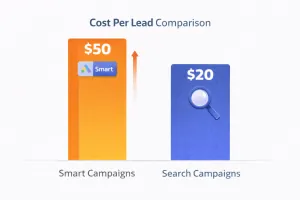
But here’s the truth most appliance repair business owners learn the hard way: Smart Campaigns burn through your budget with little to show for it. You get clicks, sure. But those clicks rarely turn into actual service calls. And when they do, the cost per lead is often double or triple what it should be.
This isn’t a theory. We’ve audited dozens of appliance repair Google Ads accounts, and the pattern is consistent. Smart Campaigns waste money because they prioritize Google’s goals, not yours.
Let’s break down why Smart Campaigns fail appliance repair businesses, what Google isn’t telling you, and what you should be running instead.
What Are Smart Campaigns?
Smart Campaigns are Google’s simplified advertising product. They’re designed for business owners who want to “set it and forget it.”
Here’s how they work:
You enter your business information and a few headlines.
Google automatically creates ads and chooses where to show them.
The system decides which keywords to target based on your business category.
Google optimizes for clicks and conversions using its own definition of success.
It sounds convenient. And for some businesses, it might work. But for appliance repair companies trying to generate qualified service calls, Smart Campaigns are a trap.
Why Smart Campaigns Fail for Appliance Repair Businesses
1. You Have Zero Control Over Keywords
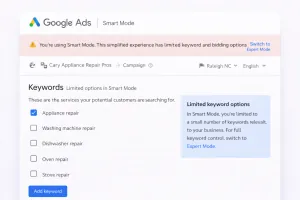
In a Smart Campaign, Google decides which search terms trigger your ads. You don’t get to see the search terms report. You don’t get to add negative keywords. You can’t prioritize high-intent searches like “refrigerator repair near me” over low-intent ones like “refrigerator troubleshooting tips.”
This is a massive problem.
Appliance repair has a wide range of search intent. Someone searching “how to fix a leaking dishwasher” is not ready to hire you. They want a YouTube video. But someone searching “dishwasher repair service in [city]” is ready to book.
Smart Campaigns don’t distinguish between these. They’ll spend your budget on both, and you’ll pay for clicks that were never going to convert.
We’ve seen accounts where 40% of the clicks came from informational searches. DIY queries. Parts lookups. Warranty questions. None of those people was going to call.
2. Google Optimizes for Clicks, Not Calls
Smart Campaigns are optimized to get you clicks. That’s how Google makes money. The more clicks you get, the more you pay.
But clicks don’t pay your bills. Service calls do.
If Google’s system can get you 100 cheap clicks from people who aren’t ready to hire, it will. Because to the algorithm, that looks like success. Your click-through rate goes up. Your cost per click goes down. Google’s revenue goes up.
Meanwhile, your phone isn’t ringing.
This is especially common with broad match keywords and vague business categories. Google will show your ad to anyone who’s remotely interested in appliances, even if they’re looking for parts, manuals, or DIY advice.
3. You Can’t Exclude Bad Traffic
One of the most important parts of running Google Ads for appliance repair is knowing what NOT to target.
You don’t want searches for:
“Appliance parts”
“Refrigerator diagram”
“Washer warranty claim”
“Free appliance removal”
“DIY dryer repair”
These searches eat budget and deliver zero value. In a traditional Search campaign, you add these as negative keywords and move on.
In Smart Campaigns, you can’t. Google controls the targeting, and you have no way to stop your ads from showing on irrelevant searches.
We’ve pulled reports from Smart Campaigns showing that more than half the spend went to terms the business owner would have blocked immediately if they’d known about them.
4. Limited Geographic Targeting
Most appliance repair businesses serve a specific area. Maybe a 15-mile radius. Maybe certain zip codes. Maybe you avoid neighborhoods that are too far out or have low service call values.
Smart Campaigns let you set a general location, but you don’t get the precision you need. Google will often show your ads outside your service area if it thinks the click might convert.
That means you’re paying for clicks from people you can’t even help. Or worse, you’re getting calls from areas where the drive time kills your profit margin.
5. No Conversion Tracking That Matters
Smart Campaigns rely on Google’s auto-conversion tracking. That might include:
Clicks to your website
Clicks to call from the ad
Form submissions
Sounds good, right?
The problem is, not all conversions are equal. A form submission from someone asking “do you work on commercial appliances?” is not the same as a phone call from someone whose refrigerator just died.
And if your conversion tracking isn’t set up correctly, or if Google is counting actions that don’t lead to actual jobs, you’re flying blind.
In traditional campaigns, you can set up call tracking, tag specific form submissions, and measure what actually drives revenue. Smart Campaigns don’t give you that level of detail.
6. You’re Competing with Better Campaigns
Here’s the part Google won’t tell you: when you run a Smart Campaign, you’re competing in the same auctions as businesses running full Search campaigns with experienced management.
Those campaigns have:
Tightly controlled keyword lists
Negative keyword lists hundreds of terms long
Custom ad copy for every service type
Landing pages optimized for conversions
Bid adjustments based on time, location, and device
Your Smart Campaign is going up against that with auto-generated ads and zero control. You’re outgunned, and you’re overpaying.
What You Should Be Running Instead
If Smart Campaigns are a waste, what’s the alternative?
The answer is Google Ads Search Campaigns built specifically for appliance repair lead generation.
Here’s what that looks like:
1. Search-Only Campaigns with Manual Keyword Control
You choose exactly which keywords to target. High-intent, service-ready searches like:
“Appliance repair near me”
“Refrigerator not cooling repair”
“Washing machine won’t drain fix”
“Dishwasher repair [city name]”
You also add negative keywords to block:
DIY terms
Parts searches
Warranty and recall queries
Informational content
This gives you full control over who sees your ads and when.
2. Service-Specific Ad Groups
Instead of one generic ad for “appliance repair,” you create separate ad groups for each service:
Refrigerator repair
Washer and dryer repair
Dishwasher repair
Oven and range repair
Each ad group has its own keywords, ad copy, and landing page. This improves relevance, increases your Quality Score, and lowers your cost per click.
It also makes your ads more compelling. Someone searching for dishwasher repair wants to see an ad about dishwasher repair, not a generic “we fix all appliances” message.
3. Call-Focused Ad Extensions
Most appliance repair leads come from phone calls, not form fills. Your ads should make it easy to call.
That means:
Call extensions with your business number
Location extensions showing your service area
Callout extensions highlighting same-day service, licensed techs, or warranties
Mobile-preferred ads with click-to-call functionality
These features exist in Search campaigns. They’re limited or automatic in Smart Campaigns.
4. Precise Geographic Targeting
You set your exact service area. Not a broad city radius, but the specific zip codes or neighborhoods you want to serve.
You can also set bid adjustments. If certain areas convert better, you bid higher there. If some areas have low job values or long drive times, you bid lower or exclude them entirely.
This level of control doesn’t exist in Smart Campaigns.
5. Real Conversion Tracking
You set up call tracking so every phone call from your ads is logged and recorded. You track form submissions separately. You measure which keywords and ads are driving actual booked jobs, not just clicks.
This is how you calculate real ROI. And it’s how you know where to spend more and where to cut back.
6. Ongoing Optimization
A properly managed Search campaign gets better over time. You review search terms weekly. You add negatives. You test the new ad copy. You adjust bids based on performance.
Smart Campaigns don’t allow this. They’re a black box. You set it up, and you hope it works.
What About Google Local Services Ads?
If you’re spending money on Google Ads, you should also be running Google Local Services Ads (LSAs).
LSAs are the ads that appear at the very top of Google, above even paid Search ads. They’re marked with a green Google Verified badge.
Here’s why they matter:
You only pay per lead, not per click.
They appear above all other ads.
Google screens your business and backs you with a guarantee.
Leads come in as phone calls, not website clicks.
For most appliance repair businesses, LSAs should get the first chunk of your ad budget. They’re lower risk and higher intent than any other paid channel.
But LSAs have limits. You can’t scale them infinitely. Once you max out your LSA budget or lead volume, that’s when a well-run Search campaign becomes critical.
The two work together. LSAs for top-of-funnel visibility and guaranteed leads. Search campaigns for scale and control.
How to Tell If You’re Running a Smart Campaign Right Now
Not sure what type of campaign you have? Here’s how to check:
Log in to your Google Ads account.
Go to the Campaigns tab.
Look at the “Type” column.
If it says “Smart,” you’re running a Smart Campaign.
If it says “Search,” you’re running a traditional Search campaign.
You can also check your campaign settings. If you don’t see options for keywords, ad groups, or negative keywords, you’re in a Smart Campaign.
Making the Switch
If you’re currently running Smart Campaigns and want to switch to Search, here’s what to do:
Don’t just pause the Smart Campaign and start fresh. You’ll lose any learning and data.
Instead:
Create a new Search campaign with proper structure.
Let it run alongside the Smart Campaign for a week or two.
Compare performance: calls, cost per lead, lead quality.
Once the Search campaign is outperforming, pause the Smart Campaign.
If you’re not comfortable setting this up yourself, this is exactly the type of work a specialist agency handles. It’s not complicated, but it does require experience with appliance repair lead gen and knowing which keywords actually convert.
The Bottom Line
Smart Campaigns are designed for convenience, not performance. They’re built to get Google paid, not to get your phone ringing with qualified service calls.
Appliance repair businesses waste budget on irrelevant clicks, unqualified traffic, and searches that will never convert. You have no control, no visibility, and no way to improve.
The alternative is a properly structured Google Ads Search campaign with manual keyword control, service-specific ad groups, call tracking, and ongoing optimization. Pair that with Google Local Services Ads, and you have a system that actually drives predictable lead flow.
If your ad budget isn’t delivering consistent calls, the campaign type is probably the problem. And if you’re running Smart Campaigns, that’s the first thing to fix.
Ready to Stop Wasting Your Ad Budget?
If you’re tired of paying for clicks that don’t turn into calls, it’s time to take a closer look at how your Google Ads are set up.
At Appliance Marketing Pros, we specialize in building Google Ads systems that actually work for appliance repair companies. We focus on high-intent search traffic, real call tracking, and campaigns that deliver qualified leads, not vanity metrics.
Want to see what’s really happening with your ad spend? Book a free strategy call, and we’ll walk you through your account. No pressure, no sales pitch. Just a clear breakdown of what’s working, what’s not, and what it would take to fix it.
Schedule your strategy call here and let’s get your ad budget working the way it should.