
Blog
The Smart Way to Scale from Solo to a Service Empire
You’re stuck in the truck.
You’re running service calls, answering the phone while you’re wrist-deep in a compressor swap, and quoting jobs at red lights. You’re making decent money, maybe $150k to $250k a year, but you’re capped out. You can’t take another call because there aren’t enough hours in the day.
You know you need to hire. You know you need systems. But every time you think about scaling, you hit the same wall: What if the phone stops ringing? What if the new tech quits? What if I can’t afford the overhead?
Here’s the truth: scaling an appliance repair business isn’t about working harder or being luckier. It’s about building a system that generates predictable calls, hires the right people, and protects your profit margins while you grow.
This guide walks you through the exact roadmap we’ve seen work for appliance repair companies that went from solo operators to multi-truck service empires. No fluff. No generic business advice. Just the real steps that separate the owners who scale from the ones who stay stuck.
Why Most Appliance Repair Owners Never Scale Past One Truck
The appliance repair industry rewards technical skill. If you can diagnose a failed inverter board or swap a transmission in 45 minutes, you can make great money as a one-person operation.
But that same skillset doesn’t translate to running a business. The best technician in town is often the worst business owner because the habits that made them successful in the truck actively hurt them in the office.
Here’s what keeps most owners stuck:
You’re the bottleneck. Every estimate, every callback, every parts run depends on you. Your revenue is capped at the number of calls you can personally handle.
You bill by the hour. Time and materials pricing works fine when you’re solo, but it makes hiring impossible. You can’t predict what a tech will earn per call, so you can’t afford to pay them a stable wage or commission.
You rely on word of mouth. Referrals are great until they dry up. One slow week and you’re panicking, running Craigslist ads or begging the parts counter guy for leads.
You don’t track numbers. You know you’re busy, but you don’t know your average ticket, your callback rate, or how much it costs to acquire a customer. You’re flying blind.
The shift from technician to business owner requires you to stop being the person who does all the work and start being the person who builds the system that does the work.
Stage 1: Lock In Your Pricing (The Financial Foundation)
You cannot scale an appliance repair business on hourly billing. Full stop.
Here’s why: if you charge $95 an hour plus parts, every job is different. One tech might finish a dryer repair in 30 minutes and make you $50. Another might take 90 minutes on the same job and cost you money. You have no idea what a service call is worth until it’s over.
That uncertainty kills your ability to hire, advertise, or plan.
Flat rate pricing fixes this.
When you use a flat rate price book (like the Blue Book or your own custom rates), every job has a set price before the wrench turns. A dryer heating element is $220. A refrigerator compressor is $650. The price doesn’t change based on how long it takes.
This gives you three things you need to scale:
- Predictable revenue per call. You know the average ticket before you dispatch the truck.
- Incentive for efficiency. Faster techs make you more money per hour, so you can pay them better.
- Clear math on hiring. If your average ticket is $280 and you close 70% of quotes, you know exactly how many calls a new tech needs to cover their cost.
Here’s the formula every multi-truck owner lives by:
Breakeven per truck = (tech pay + truck cost + insurance + marketing + overhead) / average ticket
If it costs you $8,000 a month to run a truck and your average ticket is $250, you need 32 paid jobs per month to break even. Anything above that is profit.
You can’t do that math on hourly billing.
Action step: If you’re still billing hourly, switch to flat rate pricing this month. Buy a price book, adjust it for your market, and start quoting every job with a fixed price. It will feel weird at first. Do it anyway.
Stage 2: Build a Predictable Lead Engine (Marketing That Actually Scales)
Word of mouth is not a marketing strategy. It’s luck.
You can’t scale a business on luck. You need a system that puts your phone number in front of people who need appliance repair right now, in your service area, every single day.
Here’s what actually works:
Google Local Services Ads (LSA): Your First Lever
If you’re not running Google Local Services Ads, you’re leaving money on the table.
LSA is the Google Verified green checkmark that shows up at the very top of search results when someone types “appliance repair near me.” You only pay when someone calls you directly from the ad. No clicks. No impressions. Just calls.
For appliance repair, LSA is the highest-converting channel we see. The leads are local, they’re ready to book, and the cost per call is predictable (usually $15 to $40 depending on your market).
The setup is simple: pass a background check, verify your license and insurance, and set your weekly budget. Google does the rest.
Why it works for scaling: LSA is pay-per-call, so your cost per lead stays stable even as you grow. If you’re booking 60% of LSA calls and your average ticket is $280, you know exactly what each lead is worth.
Google Ads (Search Only): The Volume Lever
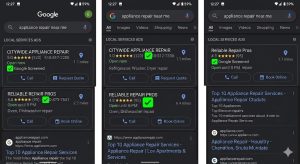
Once LSA is maxed out, Google Ads lets you buy more visibility. But here’s the key: search-only campaigns.
We’re not talking about display ads, YouTube ads, or “awareness” campaigns. Those waste money in the appliance repair space. You want search ads that show up when someone types “Samsung refrigerator repair” or “washer won’t drain.”
Search intent is everything. If someone is Googling your service, they need it now. That’s the lead you want.
A well-run Google Ads campaign for appliance repair should deliver leads at $30 to $60 per call, depending on your market. If you’re paying more than that, your targeting is too broad or your ad copy is weak.
SEO and Google Business Profile: The Long-Term Asset
Paid ads get you calls today. SEO gets you calls for free in six months.
Your Google Business Profile is the single most important SEO asset for a local service business. When it’s optimized (correct categories, consistent NAP info, fresh photos, 50+ reviews), it shows up in the map pack for searches like “appliance repair in [city].”
That map pack drives 30% to 50% of all service calls in most markets, and it costs you nothing.
Here’s what moves the needle:
- Get reviews every single week (ask every happy customer, send a follow-up text with a link)
- Post updates or offers monthly
- Add photos of your trucks, your team, and completed jobs
- Respond to every review, good or bad
SEO takes time, but once you rank, you own that visibility. It’s an asset that reduces your reliance on paid ads and improves your profit per call.
What to avoid: Lead gen sites like Angi, HomeAdvisor, or Thumbtack. You’re paying $40 to $80 per lead, and you’re competing with three other companies for the same homeowner. Shared leads kill margins. Focus on owned channels where you control the cost and the customer experience.
Stage 3: Hire and Train the Right Technicians
Hiring is where most owners fail. They look for the “unicorn” tech: someone with 10 years of experience, every certification, a clean driving record, and a great attitude. That person doesn’t exist, and if they do, they already own their own business.
Here’s the mindset shift: hire for character, train for skill.
You want someone who shows up on time, communicates well, and doesn’t argue with customers. You can teach them how to replace a water inlet valve. You can’t teach them how to not be a jerk.
Pay Structures: Commission vs. Hourly
Most successful multi-truck appliance repair companies pay on commission. Here’s why:
Commission aligns incentives. The tech makes more money when they close more jobs and upsell maintenance agreements. You make more money when they do the same. Everyone wins.
It’s scalable. You don’t need to worry about slow weeks eating into payroll. If the calls drop, the tech’s pay adjusts automatically.
A typical structure is 20% to 25% of collected revenue. If a tech averages $2,000 a day in invoiced work, they take home $400 to $500. That’s $8,000 to $10,000 every two weeks, which beats the $18-an-hour rate they’d get working for a big box store.
Hourly pay works too, especially for newer techs who are still learning. Just make sure you structure it so there’s a path to commission once they hit their numbers.
Preventing Poaching and Turnover
Good techs get poached. It’s part of the business. Here’s how to reduce it:
- Pay competitively (top 25% in your market)
- Offer benefits (health insurance, PTO, retirement match)
- Build a culture (weekly team meetings, recognition, clear growth path)
- Give them the tools (stocked trucks, good software, fast parts access)
The #1 reason techs leave is they feel undervalued. If they’re making you $15,000 a week and you’re nickel-and-diming them on pay or tools, they’ll walk.
Stage 4: Build Systems That Run Without You
At some point, you need to stop being the person who answers every call, orders every part, and handles every customer complaint. That requires systems.
The Dispatcher: Your Most Important Hire
The first non-tech hire you make should be a dispatcher. Not a marketer. Not an accountant. A dispatcher.
This person answers the phone, books the calls, coordinates the schedule, and follows up with customers. They are the air traffic controller of your business.
A great dispatcher increases your booking rate from 50% to 75%, which is the equivalent of a 50% increase in marketing ROI. They also free you up to focus on hiring, training, and managing the business.
Budget $3,000 to $4,500 a month for a full-time dispatcher. It’s the best money you’ll spend.
Inventory Management: Stop the Parts Run Bleed
Every time a tech drives to the parts distributor mid-job, you lose money. You lose time, you lose efficiency, and you lose customer trust.
The fix: stock your trucks with the 20 most common parts for your area. Heating elements, thermostats, water valves, belts, and door switches cover 60% of repairs. Keep them in the truck and restock weekly.
For less common parts, build relationships with local distributors who deliver same-day or use a central warehouse if you’re running five or more trucks.
Parts inventory ties up cash, but it’s worth it. The time saved and the jobs closed on the first visit pay for themselves in weeks.
Warranty vs. COD: Finding the Profitable Mix
Warranty work (home warranty companies, manufacturer contracts) keeps you busy, but it doesn’t make you rich. Warranty jobs pay $90 to $150 per call, and they take just as long as a $300 cash call.
COD (cash on delivery, direct homeowner work) is where the profit is. Your goal is to get 60% to 70% of your revenue from COD calls and use warranty work to fill gaps in the schedule.
Track this monthly. If warranty work creeps over 50%, your margins will suffer, and you won’t have the cash flow to grow.
Common Pitfalls When Scaling from Solo to a Service Empire (And How to Avoid Them)
Taking on Too Much Warranty Work
We just covered this, but it’s worth repeating: warranty work is a margin killer. It feels good to stay busy, but busy doesn’t equal profitable.
If you’re running three trucks and 70% of your revenue is warranty, you’re working twice as hard for half the profit. That’s not scaling. That’s treading water.
Ignoring Google Reviews
Your Google Business Profile reviews directly impact how many calls you get from SEO and LSA. If you’re sitting at 12 reviews with a 3.8-star average, you’re losing to the guy with 120 reviews at 4.9 stars.
Make review collection a daily habit. Send a text after every completed job with a link to your Google profile. Offer a small thank-you (entry into a monthly drawing, a discount on future service) if you need to, but never pay for reviews.
Even one or two new reviews per week compounds over time.
Not Tracking Your Numbers
You can’t manage what you don’t measure. At minimum, you need to track:
- Average ticket (total revenue / number of completed jobs)
- Booking rate (jobs booked / total inbound calls)
- Cost per lead (marketing spend / number of leads)
- Callback rate (repeat service calls / total jobs)
If you don’t know these numbers, you’re guessing. Guessing doesn’t scale.
Use your field service software (ServiceTitan, Housecall Pro, Jobber, whatever you’re running) to pull these reports weekly. Make decisions based on data, not gut feel.
Your First Next Step: Stop Guessing and Start Measuring
Scaling an appliance repair business comes down to one thing: building a system that works without you in the truck.
That system has four parts:
- Flat rate pricing so you know what every job is worth
- Predictable lead flow from Google LSA, Ads, and SEO
- The right people hired, trained, and paid to perform
- Operations that run smoothly whether you’re there or not
The owners who scale are the ones who stop reacting and start planning. They know their numbers. They invest in marketing that works. They build teams they can trust.
If you’re ready to move from owner-operator to business owner, the first step is understanding where you actually stand. What’s your cost per lead? What’s your average ticket? How many calls do you need to add another truck?
At Appliance Marketing Pros, we help appliance repair companies answer those questions and build the marketing system that fills the schedule. We specialize in Google Local Services, search-only Google Ads, and local SEO for appliance repair businesses across the U.S.
If you want to see what predictable call flow looks like for your market, let’s talk. Book a free strategy session and we’ll walk through your numbers, your market, and the fastest path to your next truck.
Schedule Your Free Strategy Call Here
You didn’t get into this business to stay stuck in the truck forever. Let’s build the system that gets you out.