Blog
The Owner's Playbook for High-Intent Keywords That Convert
How High-Intent Keywords that Convert Drive More Booked Appliance Repair Jobs
You already know that most appliance repair calls come from Google. Someone’s fridge stops cooling at 9 PM, they grab their phone, and they search. If your business shows up at the right moment with the right message, you get the call. If not, your competitor does.
The difference between a profitable Google Ads campaign and one that burns cash comes down to keyword selection. Not just any keywords. High-intent keywords that attract people ready to book, not tire-kickers looking for DIY videos or price shoppers hunting for the cheapest option three towns over.
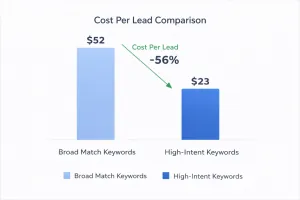
Most appliance repair owners waste 30 to 40 percent of their Google Ads budget on the wrong clicks. They target broad terms that sound good but attract the wrong audience. They skip negative keywords. They don’t separate emergency calls from routine maintenance. And they wonder why their cost per lead keeps climbing while call quality drops.
This guide walks you through exactly how to build a high-intent keyword strategy for your appliance repair business. You’ll learn which keywords actually convert, how to structure your campaigns to avoid wasted spend, and how to align your ads and landing pages so Google rewards you with lower costs and better placement.
Why Most Appliance Repair Google Ads Campaigns Fail
Before we get into what works, let’s talk about what doesn’t. Because if you’ve tried Google Ads before and didn’t see results, it probably wasn’t the platform. It was the setup.
You targeted keywords that attract researchers, not buyers. Keywords like “how to fix a refrigerator” or “dishwasher troubleshooting” get plenty of searches. But those people aren’t looking for a repair company. They’re looking for YouTube videos. Every click costs you money, and none of them turn into booked jobs.
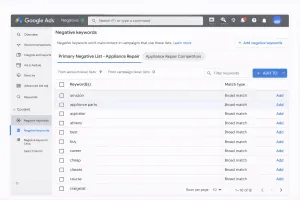
You didn’t use negative keywords. Without negative keywords, your ads show up for searches like “appliance repair jobs,” “appliance parts wholesale,” or “DIY refrigerator repair.” You pay for clicks from job seekers, parts suppliers, and homeowners who have no intention of hiring you.
You used one ad group for everything. Lumping all your services into a single campaign with generic ad copy means your message doesn’t match what people are searching for. Someone looking for emergency dryer repair sees the same ad as someone researching dishwasher maintenance. Your click-through rate suffers, your Quality Score drops, and your cost per click goes up.
Your landing page didn’t match the search. If someone searches “refrigerator repair near me” and lands on your homepage with a generic “We fix all appliances” message, they bounce. Google notices. Your Quality Score tanks, and you pay more for worse placement.
These mistakes are fixable. And when you fix them, your cost per lead drops, your call quality improves, and your marketing budget starts working the way it should.
What Makes a Keyword High-Intent for Appliance Repair
High-intent keywords signal that someone is ready to take action. They’re not browsing. They’re not learning. They need a repair, and they need it soon.
For appliance repair, high-intent keywords usually include one or more of these elements:
Service type plus appliance type. “Refrigerator repair,” “dishwasher repair,” “dryer repair.” These searches come from people who know what’s broken and need professional help.
Location modifiers. “Appliance repair near me,” “refrigerator repair in [city],” “emergency appliance repair [zip code].” Adding location signals immediate local intent. These people are looking for someone in their area who can come out today or tomorrow.
Urgency indicators. “Emergency refrigerator repair,” “same-day dryer repair,” “24-hour appliance repair.” Urgency keywords attract customers willing to pay premium pricing for fast service. They convert at higher rates and typically have higher average ticket values.
Problem-specific searches. “Refrigerator not cooling,” “dishwasher won’t drain,” “dryer not heating.” These searches show someone who has already diagnosed the problem and is ready to hire a pro.
Low-intent keywords, by contrast, include terms like “how to,” “DIY,” “troubleshooting,” “parts,” or “cost to.” These attract researchers, not buyers.
Your goal is to build campaigns around keywords that consistently bring in qualified leads while systematically blocking the ones that waste your budget.
The Core Keyword Categories Every Appliance Repair Campaign Needs
A well-structured Google Ads account for appliance repair organizes keywords into clear categories. This structure lets you write targeted ad copy, send people to relevant landing pages, and track which services generate the best ROI.
General Appliance Repair Keywords
These are your broadest terms. They capture the largest search volume but require careful management to avoid low-quality clicks.
High-volume general keywords:
- Appliance repair (165,000 monthly searches, $3 to $12 CPC)
- Appliance repair near me (301,000 monthly searches, $2.35 to $10 CPC)
- Emergency appliance repair
- Same-day appliance repair
- Affordable appliance repair
These keywords work best when you use phrase match or exact match to maintain control. Broad match on “appliance repair” will trigger your ads for appliance sales, parts, and DIY guides. Stick with tighter match types and aggressive negative keyword lists.
Appliance-Specific Keywords
Appliance-specific keywords attract more qualified traffic because the searcher already knows what’s broken. These should form the backbone of your campaign structure.
Refrigerator repair keywords:
- Refrigerator repair (74,000 monthly searches, $2.98 to $12.46 CPC)
- Refrigerator repair near me
- Emergency refrigerator repair
- Refrigerator not cooling
- Refrigerator leaking
Washing machine and dryer repair keywords:
- Washing machine repair (110,000 monthly searches, $2.38 to $10.14 CPC)
- Washer repair near me
- Dryer repair
- Dryer not heating
- Washer won’t drain
Dishwasher repair keywords:
- Dishwasher repair
- Dishwasher not draining
- Dishwasher won’t start
- Emergency dishwasher repair
Oven and stove repair keywords:
- Oven repair
- Stove repair
- Oven not heating
- Gas stove repair
Each appliance type should get its own campaign or at minimum its own ad group. This lets you write specific ad copy (“Expert Refrigerator Repair” performs better than “We Fix Appliances”) and send traffic to dedicated landing pages that speak directly to the problem.
Emergency and Urgency Keywords
Emergency keywords attract customers who need help right now. They’re often willing to pay more for fast service, and they convert quickly because delay isn’t an option.
Emergency-focused keywords:
- Emergency appliance repair
- 24-hour appliance repair
- Same-day refrigerator repair
- Emergency dryer repair
- Weekend appliance repair
These keywords typically have lower search volume than general terms, but they convert at much higher rates. If your business offers same-day or emergency service, dedicate budget to these terms. If you don’t offer emergency service, add these as negative keywords so you don’t pay for clicks you can’t convert.
Location-Based Keywords
Local intent is everything in appliance repair. Someone three towns over isn’t going to call you, and you don’t want to pay for their click.
Location-modified keywords:
- Appliance repair in [city]
- [City] refrigerator repair
- Appliance repair [zip code]
- Dishwasher repair near [neighborhood]
Google Ads lets you set geographic targeting at the campaign level, but including location in your keywords reinforces local intent and often improves Quality Score because your ad copy and landing page can emphasize your service area.
Brand-Specific Keywords
Some customers search by appliance brand, especially for high-end or specialized equipment.
Brand-specific examples:
- Samsung refrigerator repair
- LG washer repair
- Bosch dishwasher repair
- GE appliance repair
- Sub-Zero refrigerator repair
Brand keywords typically have lower search volume but higher intent. Someone searching “Sub-Zero refrigerator repair” owns a premium appliance and expects professional service. These customers often convert quickly and have higher lifetime value.
How to Structure Your Google Ads Campaigns for Maximum ROI
Keyword selection matters, but campaign structure determines whether those keywords actually perform. Poor structure leads to mismatched ads, irrelevant landing pages, low Quality Scores, and wasted budget.
Here’s the campaign structure that works for most appliance repair businesses:
Campaign Level: Organize by Service Urgency or Appliance Type
You have two main options for organizing campaigns.
Option 1: Organize by urgency.
- Campaign 1: Emergency and Same-Day Repair
- Campaign 2: Routine Appliance Repair
- Campaign 3: Maintenance and Tune-Ups
This structure works well if you offer premium pricing for emergency service and want to allocate more budget to high-value urgent calls.
Option 2: Organize by appliance type.
- Campaign 1: Refrigerator Repair
- Campaign 2: Washer and Dryer Repair
- Campaign 3: Dishwasher Repair
- Campaign 4: Oven and Stove Repair
This structure works better if you want granular control over budget allocation by service line, or if certain appliance types generate better margins.
Most appliance repair businesses find that organizing by appliance type gives them better control and clearer performance data.
Ad Group Level: Organize by Specific Problem or Search Intent
Within each campaign, create tightly themed ad groups. Each ad group should contain 5 to 15 closely related keywords and 3 to 5 ads that speak directly to those keywords.
Example: Refrigerator Repair Campaign
Ad Group 1: General Refrigerator Repair
- refrigerator repair
- refrigerator repair near me
- fridge repair
- refrigerator service
Ad Group 2: Refrigerator Not Cooling
- refrigerator not cooling
- fridge not cold enough
- refrigerator warm
- refrigerator compressor not working
Ad Group 3: Emergency Refrigerator Repair
- emergency refrigerator repair
- same-day fridge repair
- 24-hour refrigerator repair
This structure lets you write ad copy that directly addresses what the person searched for. Someone searching “refrigerator not cooling” sees an ad headline like “Refrigerator Not Cooling? Same-Day Repair Available” instead of generic “Appliance Repair Services.”
Tighter ad group themes improve click-through rate, which improves Quality Score, which lowers your cost per click. It’s a compounding advantage.
Match Types: Balance Volume and Control
Google Ads offers several match types. Each gives you different levels of control over when your ads appear.
Exact match gives you the most control. Your ad only shows when someone searches your exact keyword or a very close variant. Use exact match for your highest-intent, highest-converting keywords.
Phrase match gives you moderate control. Your ad shows when someone’s search includes your keyword phrase in the right order, but it can have additional words before or after. Phrase match works well for most appliance repair keywords.
Broad match gives you the least control. Google shows your ads for searches it thinks are related to your keyword, even if the actual search is quite different. Broad match can work if you have a comprehensive negative keyword list and monitor search terms closely. Otherwise, it wastes budget.
Start with exact match and phrase match for your core keywords. Add broad match only after you’ve built a strong negative keyword list and have data showing which search terms actually convert.
The Negative Keyword Strategy That Stops Budget Waste
Negative keywords might be more important than your target keywords. They tell Google when not to show your ads, preventing wasted clicks from people who will never become customers.
Essential Negative Keywords for Every Appliance Repair Campaign
Add these negative keywords to every campaign from day one:
DIY and how-to terms:
- how to
- DIY
- fix myself
- repair myself
- tutorial
- instructions
- video
Parts and sales terms:
- parts
- wholesale
- buy
- purchase
- for sale
- store
- shop
Job and career terms:
- jobs
- careers
- hiring
- employment
- technician jobs
- appliance repair jobs
Competitor and brand terms (if not relevant):
- Sears
- Home Depot
- Lowe’s
- Best Buy
- warranty
- manufacturer
Informational terms:
- cost
- how much
- price
- average cost
- estimate (unless you want estimate requests)
Your negative keyword list should grow over time. Check your search terms report weekly during the first month and monthly after that. Any time you see a search that triggered your ad but has zero chance of converting, add it as a negative keyword.
Aligning Ad Copy and Landing Pages to Your Keywords
High-intent keywords only convert if your ad copy and landing page match what the person searched for. Misalignment kills campaigns.
Writing Ad Copy That Matches Search Intent
Your ad headline should echo the keyword. If someone searches “refrigerator not cooling,” your headline should say “Refrigerator Not Cooling?” or “Fix Your Refrigerator Fast.”
Your description should address the immediate need and include a clear call to action. “Same-Day Refrigerator Repair. Certified Technicians. Call Now for Fast Service.”
Include your location if it’s relevant. “Serving [City] Since 2010” or “[City]’s Trusted Appliance Repair” reinforces local intent and improves click-through rate.
Use ad extensions. Sitelink extensions, callout extensions, and call extensions give you more space on the search results page and provide additional ways for people to contact you.
Landing Pages That Convert Clicks Into Calls
Your landing page must match the ad and the keyword. If your ad promises refrigerator repair, the landing page should be about refrigerator repair, not a generic homepage.
Key elements every appliance repair landing page needs:
A headline that matches the ad and keyword. If the ad says “Refrigerator Not Cooling?” the landing page headline should say the same thing.
A clear explanation of your service. What you fix, how fast you respond, what areas you cover.
Trust signals. Years in business, certifications, customer reviews, photos of your team or trucks.
A prominent phone number. Make it easy to call. Many appliance repair customers prefer calling over filling out forms.
A simple contact form as a backup option for people who can’t call right away.
Avoid sending all traffic to your homepage. Homepages are designed for browsing, not converting. Dedicated landing pages convert 3 to 5 times better because they focus on one message and one action.
Tracking Performance and Optimizing for Better Results
Running Google Ads without tracking performance is like driving with your eyes closed. You need to know which keywords generate calls, which calls turn into booked jobs, and which jobs are profitable.
Set Up Call Tracking
Most appliance repair leads come through phone calls, not form fills. Use call tracking software that assigns unique phone numbers to your Google Ads campaigns so you can see exactly which keywords drove each call.
Call tracking also lets you record calls (with proper disclosures) so you can review how your team handles leads and identify training opportunities.
Monitor These Metrics Weekly
Search terms report. This shows you the actual searches that triggered your ads. Look for irrelevant terms to add as negatives and high-performing terms to add as exact match keywords.
Cost per click. Track CPC by keyword and ad group. If certain keywords have unusually high CPCs, check your Quality Score and ad relevance.
Click-through rate. Low CTR usually means your ad copy doesn’t match search intent or your ad position is too low. Test new ad copy and consider increasing bids for high-value keywords.
Conversion rate. Track how many clicks turn into calls and how many calls turn into booked jobs. If clicks aren’t converting to calls, your landing page needs work. If calls aren’t converting to jobs, your pricing or availability might be the issue.
Cost per lead and cost per acquisition. These are your bottom-line metrics. You need to know how much you’re paying to acquire each customer and whether that cost is sustainable given your average job value.
Continuous Optimization
Google Ads isn’t set-it-and-forget-it. Plan to spend 2 to 4 hours per month reviewing performance and making adjustments.
Pause underperforming keywords. If a keyword has spent $200 without generating a single call, pause it and reallocate that budget to better performers.
Increase bids on high-converting keywords. If a keyword consistently generates quality leads at a profitable cost per acquisition, increase your bid to capture more traffic.
Test new ad copy. Run 3 to 5 ads per ad group and let them compete. Google will favor the best performers. Regularly test new headlines and descriptions to improve click-through rate.
Expand your negative keyword list. Every month you’ll discover new irrelevant searches. Add them as negatives to prevent future waste.
Adjust bids by location and time of day. If you notice that calls from certain zip codes convert better or that evening searches have higher intent, adjust your bids accordingly.
Common Mistakes That Kill Appliance Repair Google Ads ROI
Even with the right keywords, certain mistakes can undermine your entire campaign.
Ignoring Quality Score. Google rewards relevance with lower costs and better ad positions. If your Quality Score is below 7, you’re paying more than you should. Improve relevance by tightening keyword themes, rewriting ad copy, and creating dedicated landing pages.
Not separating mobile and desktop traffic. Mobile searchers often have higher intent because they’re searching in the moment of need. Consider bidding more aggressively on mobile if your call tracking shows mobile leads convert better.
Sending all traffic to your homepage. We covered this already, but it’s worth repeating. Dedicated landing pages convert better. Period.
Running ads without call tracking. If you don’t know which keywords generate calls, you’re optimizing blind. Call tracking is non-negotiable.
Setting budgets too low to gather data. Google Ads needs volume to optimize. If your daily budget is $10 and you’re only getting 2 or 3 clicks per day, you won’t gather enough data to make informed decisions. Plan to spend at least $30 to $50 per day to start.
Not adjusting for seasonality. Appliance repair demand fluctuates. Refrigerator calls spike in summer. Heating appliance calls increase in winter. Adjust your budget and keyword focus based on seasonal patterns in your market.
When to Handle Google Ads Yourself vs. Hiring an Agency
Some appliance repair owners successfully manage their own Google Ads. Others waste thousands before realizing they need help.
You can probably handle it yourself if:
- You have 5 to 10 hours per month to dedicate to setup and optimization
- You’re comfortable learning new software and tracking systems
- You have a clear understanding of your numbers (average job value, acceptable cost per lead)
- Your market isn’t extremely competitive
You should consider hiring an agency if:
- You don’t have time to manage campaigns consistently
- You’ve tried Google Ads before and didn’t see positive ROI
- Your market is highly competitive with expensive clicks
- You want to scale quickly without the learning curve
- You need integrated strategy across Google Ads, SEO, and Google Business Profile
The right agency doesn’t just run ads. They build systems that generate predictable lead flow, track every dollar spent, and optimize continuously based on real performance data.
Your Next Steps
If you’ve been frustrated with inconsistent call volume or unclear ROI from your marketing, high-intent keyword strategy is where you start. The difference between profitable Google Ads and money down the drain comes down to targeting the right searches, blocking the wrong ones, and aligning your message at every step.
Start by auditing your current keyword list. Identify which keywords are actually generating calls and which are burning budget. Build out your negative keyword list. Tighten your ad groups so your messaging matches search intent. And make sure every click lands on a page designed to convert.
If you want help building a Google Ads system that generates predictable, qualified leads for your appliance repair business, that’s exactly what we do. Appliance Marketing Pros specializes in high-intent keyword strategies, campaign structure, and conversion tracking for appliance repair companies across the United States.
We work with owner-operators looking for consistency and growth-stage businesses that need scalable lead generation systems. Our approach focuses on real metrics that matter: cost per lead, call quality, and booked jobs.
Ready to stop wasting ad spend and start generating qualified repair calls? Schedule a free strategy call with our team. We’ll review your current setup, identify what’s working and what’s not, and show you exactly how to build a Google Ads system that drives predictable growth.