
Blog
Google Local Services Ads for Appliance Repair: Full Guide

You run a solid appliance repair business. Your technicians know their stuff. Your customers leave happy reviews. But your phone goes quiet for three days, then rings off the hook for two, then goes quiet again.
The feast-or-famine cycle is exhausting. You need consistent call volume so you can plan your schedule, keep your technicians busy, and grow without guessing.
That’s exactly what Google Local Services Ads are designed to solve.
We’ve managed Local Services Ads for appliance repair companies across the country. Some were owner-operators with two trucks trying to fill their schedule. Others were 10-technician operations looking for predictable lead flow. The specifics vary, but the goal is always the same: consistent, qualified calls that turn into booked jobs.
This guide walks through everything you need to know to master Google LSA for appliance repair. You’ll learn how they work, what they cost, how to set them up correctly, and how to avoid the mistakes that waste money and kill results.
Let’s start with the basics.
What Are Google Local Services Ads (And Why Appliance Repair Companies Use Them)
Google Local Services Ads (LSA) are ads that appear at the very top of search results when someone searches for appliance repair in your area. They appear above the regular Google Ads, above the map pack, and above the organic results.
When someone searches “refrigerator repair near me” or “emergency appliance repair,” your business can show up first with a green Google Verified badge next to it.
Here’s why that matters.
How LSA Shows Up in Search Results
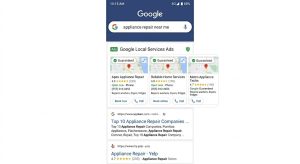
Local Services Ads take the top position on both mobile and desktop. That’s prime real estate. Most people searching for appliance repair are scrolling on their phone with a broken fridge or a washer that won’t drain. They’re not doing research. They’re looking for someone to fix it today.
The LSA section shows your business name, star rating, phone number, and that Google Verified badge. The person can call you directly from the ad or send you a message through Google.
You don’t show up for every search. Google’s algorithm decides which businesses to display based on your proximity to the searcher, your reviews, your response time, and your budget. We’ll cover those ranking factors in detail later.
The Google Verified Badge (And Why It Matters for Trust)
The Google Verified badge is a trust signal. It tells the customer that Google has verified your business, checked your licenses and insurance, and run background checks on your technicians.
If the customer isn’t satisfied with your work, Google offers a money-back guarantee up to the amount they paid (with some limits and conditions). That’s a big deal when someone is choosing between five repair companies they’ve never heard of.
In practice, the badge does a lot of the trust-building work for you. People feel more confident calling a Google Verified business than one without verification. It levels the playing field for smaller shops competing against bigger names.
Pay Per Lead vs Pay Per Click
Here’s the biggest difference between Local Services Ads and traditional Google Ads: you pay per lead, not per click.
With regular Google Ads, you pay every time someone clicks your ad, whether they call you or not. With LSA, you only pay when someone actually contacts you through the ad (either a phone call or a message request).
Google defines a lead as any contact that meets a minimum time threshold (usually around 30 seconds for a call). You’ll pay even if the lead isn’t perfect, but you can dispute leads that are clearly outside your service area or are spam. We’ll cover the dispute process later.
The pay-per-lead model is attractive because you’re paying for actual contact, not just traffic. But it also means you need to respond fast and book those leads. A missed call is money you spent with nothing to show for it.
How Google Local Services Ads Are Different From Google Ads
Most appliance repair owners ask us whether they should use Local Services Ads, traditional Google Search Ads, or both.
The short answer: both, if you have the budget. They serve different purposes and work better together than alone.
Let’s break down the differences.
Comparison Table: LSA vs Google Search Ads
| Feature | Local Services Ads | Google Search Ads |
| Ad Placement | Top of search results, above everything | Below LSA, above organic results |
| Cost Model | Pay per lead (phone call or message) | Pay per click |
| Targeting | Service area and categories only | Keywords, location, device, time of day |
| Qualification Required | Yes (background checks, license, insurance) | No |
| Ad Customization | Limited (profile-based) | Full control (headlines, descriptions, extensions) |
| Best Use Case | Local, high-intent service calls | Broader reach, seasonal promotions, specific services |
Both platforms work. The question is how you use them.
When to Use LSA vs Search Ads (Or Both)
Local Services Ads are best for capturing high-intent local searches. Someone searching “washer repair near me” wants help now. LSA puts you at the top with the Google Verified badge, and you only pay when they contact you.
Google Search Ads give you more control. You can target specific keywords like “LG refrigerator repair” or “emergency dishwasher repair.” You can write custom ad copy. You can adjust bids based on time of day or device. And you can appear for searches that might not trigger LSA.
In practice, most appliance repair shops see the best results when they use both. Local Services Ads capture the high-intent local searches. Search Ads fill in the gaps and let you target specific appliance types, brands, or service categories.
When we set up clients with both, we typically see 30-40% more total call volume than using either one alone. The strategies complement each other.
If you’re starting from scratch and budget is tight, start with LSA. It’s simpler to set up, and the pay-per-lead model gives you more predictable costs.
The LSA Verification Process for Appliance Repair Companies
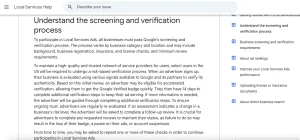
Before you can run Local Services Ads, you need to get verified. This isn’t a quick process. Plan on 3-4 weeks from the time you start to the time your ads go live.
Google’s verification requirements are strict, but they’re also what makes the Google Verified badge valuable. Here’s what you need to do.
Background Checks and What They Include
Google requires background checks for all business owners and any technicians who will be responding to LSA leads. The background check is run by a third-party provider like Pinkerton or Evident.
The check looks at criminal history, identity verification, and sometimes motor vehicle records depending on your state and service category. Most standard background issues won’t disqualify you, but serious offenses or recent violations can.
If you have multiple technicians, you’ll need to submit background check authorization for each one. This is where delays often happen. One technician doesn’t submit their paperwork, and your whole account sits in pending status.
Get everyone’s information submitted at the same time. It saves you weeks.
License and Insurance Requirements
Google requires proof of business licenses and insurance. For appliance repair, that usually means:
- General liability insurance (typically $1 million minimum coverage)
- Business license (city, county, or state depending on your location)
- Any trade-specific licenses required in your state
Some states don’t require a specific appliance repair license, but Google still wants to see that you’re a legitimate, insured business. If you’re not sure what licenses you need, check with your state’s contractor licensing board or your insurance agent.
You’ll upload copies of your insurance certificate and license documentation through the LSA dashboard. Make sure the business name on your insurance and licenses matches the name on your Google Business Profile. Mismatches cause delays.
Google Business Profile Requirements
Your Google Business Profile needs to be complete, verified, and in good standing before you can run Local Services Ads. Google also requires a minimum of three reviews on your profile before you’re eligible.
If your GBP isn’t verified yet, do that first. If you only have one or two reviews, ask a few recent customers to leave feedback before you apply for LSA.
Your GBP and LSA accounts are connected. A strong, optimized Google Business Profile actually improves your LSA performance. We’ll talk more about that connection later.
How Long Verification Actually Takes
The official timeline is 2-4 weeks, but we’ve seen accounts approved in 10 days and others take 6 weeks.
What speeds it up:
- Submitting all documents at once
- Making sure business names match across all platforms
- Responding quickly to any requests for additional information
- Already having a verified Google Business Profile with reviews
What slows it down:
- Missing or incomplete documents
- Name mismatches between your GBP, license, and insurance
- Background check delays (technicians not submitting authorization)
- Verification issues with your Google Business Profile
Once you’re approved, you’re good to go. Verification doesn’t expire, but Google may ask you to re-verify if they see issues with customer complaints or policy violations.
Setting Up Your LSA Profile Step by Step
After you’re verified, it’s time to set up your profile. This is where most businesses either set themselves up for success or waste money on the wrong settings.
Here’s how to do it right.
Choosing the Right Service Categories

Google will show you a list of service categories you can enable for your appliance repair business. These typically include options like:
- Appliance repair (general)
- Refrigerator repair
- Washer and dryer repair
- Dishwasher repair
- Oven and stove repair
Most shops should start with 4-6 core categories. Don’t enable everything just because you can. Every category you add increases your lead volume, but it also increases your spend.
Start with the services you want more of. If refrigerator repair is your bread and butter, enable that. If you hate working on built-in ovens, don’t enable oven repair just to get more leads.
You can adjust categories over time. We often see shops add categories during busy seasons and pause them during slow months. Refrigerator repair tends to spike in summer. Oven repair picks up around Thanksgiving.
Defining Your Service Area
You’ll set your service area by zip code or radius from your business location. Be realistic about how far you’re willing to drive.
If you say you serve a 30-mile radius but you really only want jobs within 15 miles, you’re going to pay for leads you don’t want. Google will send you calls from the edge of that 30-mile zone, and you’ll either have to drive an hour round trip or turn down the job (and pay for the lead anyway).
Set your radius based on where you actually want to work, not where you could theoretically work in an emergency.
For multi-location businesses, set up each location separately with its own service area. Don’t try to cover a whole metro area from one location.
Setting Your Budget and Weekly Lead Limits
Google lets you set a weekly budget and a maximum number of leads per week. Both are important.
Your weekly budget controls your maximum spend. If you set a $500 weekly budget and leads cost $40 each, you’ll get about 12 leads before Google pauses your ads for the week.
The lead limit controls volume separately. You can set a weekly lead cap even if you haven’t hit your budget. This is useful if you only have capacity for 15 jobs a week and you don’t want 25 leads showing up.
Start with a budget that gets you at least 10-15 leads in your first month. That’s the minimum you need to understand your booking rate and cost per job. If leads in your market cost $50 each, budget at least $150-200 per week to start.
You can increase your budget once you know your numbers.
Optimizing Your Profile Photos and Business Description
Your LSA profile includes your business name, star rating, phone number, and a few photos. You can’t control much about the ad itself, but you can make sure your profile looks trustworthy.
Upload clear photos of:
- Your service trucks with your company name visible
- Your technicians in uniform (this builds trust)
- Any certifications or training credentials
- Before-and-after shots of completed work
Avoid generic stock photos. People want to see your actual business and your actual team.
Your business description is short (just a few sentences), but use it to mention what makes you different. Years in business, same-day service, family-owned, specialties (like high-end appliances), and any manufacturer certifications all work well.
What LSA Leads Actually Cost (And How to Budget for Seasonal Changes)
Let’s talk money. What do Local Services Ads actually cost for appliance repair, and how do you budget for them?
The answer depends on your market, your competition, and the time of year.
Typical Cost Per Lead for Appliance Repair
Based on the accounts we manage across 15+ markets, most appliance repair leads through LSA cost between $25 and $75 per lead.
In smaller markets with less competition, you might pay $25-40 per lead. In competitive metro areas like Phoenix, Dallas, or Atlanta, expect $50-75 per lead. Some high-cost markets push even higher.
What drives the cost:
- How many other appliance repair businesses are competing in your area
- How many searches happen in your service area (more demand = higher prices)
- How specific the search is (general “appliance repair” vs “refrigerator repair”)
- What time of year it is (summer and holiday seasons cost more)
You can’t control what Google charges per lead, but you can control how many of those leads you book. A $60 lead that books a $350 job is a better investment than a $30 lead that never converts.
Seasonal Cost Fluctuations You Should Expect
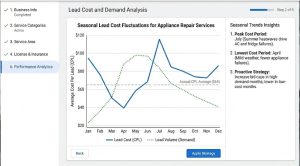
Appliance repair demand isn’t consistent year-round, and LSA costs reflect that.
June through August typically sees 30-40% higher lead volume for refrigerators and freezers. Everyone’s ice maker stops working the week before they’re hosting a barbecue. Lead costs go up during this window because more businesses are competing for the same searches.
November and December see a spike in oven and range repair. Thanksgiving hits, someone’s oven dies, and they need it fixed before the family shows up. Lead costs for oven repair climb during this period.
Spring and fall are usually steadier. Washer and dryer repair stays pretty consistent year-round because people do laundry no matter what month it is.
Plan your budget with seasonality in mind. If you know summer is your busy season, increase your LSA budget in May so you’re capturing those high-intent calls. Scale it back in slower months to control costs.
How to Calculate Your Target Booking Rate and ROI
Here’s the formula that matters: booking rate x average ticket = ROI.
Let’s say you pay $50 per lead and you book 50% of your leads. That means each booked job costs you $100 in advertising. If your average appliance repair ticket is $300, you’re spending $100 to make $300. That’s a solid return.
If you’re only booking 30% of your leads, each booked job costs you $167. Still profitable, but you’re leaving money on the table.
Most appliance repair shops with good response times and solid customer service see booking rates between 40% and 60%. If you’re below 40%, something’s wrong (usually slow response time, poor phone skills, or leads outside your actual service area).
Track your numbers every week. How many LSA leads came in, how many you contacted, how many booked, and how much revenue those jobs generated. That’s how you know if LSA is working.
How to Improve Your LSA Rankings and Get More Calls
You can’t just turn on Local Services Ads and expect to be the first result every time. Google’s algorithm decides who shows up based on several ranking factors.
Understanding those factors is how you get more visibility and more leads without just spending more money.
The Ranking Factors That Actually Matter
The LSA algorithm prioritizes three main factors:
- Proximity to the searcher – The closer you are to the person searching, the more likely you are to show up. You can’t change your location, but you can make sure your service area is set correctly.
- Review count and rating – Businesses with more reviews and higher ratings get priority. Google wants to show businesses that customers trust.
- Response time – How fast you respond to LSA leads affects your ranking. Faster response = better placement.
Secondary factors include your budget (running out of budget tanks your visibility), how long you’ve been active on LSA, and whether you have the Google Verified badge (you should).
You control your reviews and your response time. Focus on those.
Response Time and Why It’s Critical
Google tracks how fast you respond to LSA leads. If you consistently take 30 minutes or an hour to return calls, your ranking drops. If you respond within 5 minutes, your ranking improves.
We see a direct correlation in the accounts we manage: shops responding within 5 minutes book 2x more jobs than shops that take 30 minutes or longer.
Why? Because the customer isn’t just contacting you. They’re contacting three or four other businesses at the same time. The first one to call back and sound competent usually gets the job.
Set up systems to respond fast. That might mean:
- Call forwarding to your cell phone
- An answering service that picks up after hours
- Automated text replies that say “We got your message and we’ll call you in 5 minutes”
- A dedicated person monitoring the LSA dashboard during business hours
Missed calls are wasted money. Fast responses are free ranking improvements.
Review Quantity and Quality Standards
Google requires at least 3 reviews to qualify for LSA, but that’s the bare minimum. To compete, you need 15-25+ reviews with a rating of 4.5 stars or higher.
More reviews improve your LSA ranking, but they also improve your Google Business Profile ranking and your organic visibility. Reviews are the most underutilized marketing tool for appliance repair companies.
Build a system for asking every happy customer to leave a review. Most won’t do it unless you ask. Send a text or email after the job with a direct link to your Google review page. Make it easy.
Respond to every review, good or bad. It shows you care and it builds trust with people who are reading reviews before they call.
How Your Google Business Profile Affects LSA Performance
Here’s something most businesses don’t realize: your Google Business Profile and your LSA account are connected.
When we optimize a client’s GBP (complete business information, accurate service hours, high-quality photos, consistent posts, keyword-rich description), we typically see their LSA lead volume increase 15-25% within 4-6 weeks. Google treats GBP optimization as a signal of business quality.
A neglected, incomplete GBP tells Google you’re not serious. A well-maintained profile tells them you’re a legitimate, active business worth promoting.
Spend time on your GBP. It’s not just for map rankings. It’s part of your LSA performance.
Managing Lead Quality and Disputing Bad Leads
Not every LSA lead will be perfect. Some leads will be outside your service area. Some will be for services you don’t offer. Some will be spam or pocket dials.
Here’s how to manage lead quality and get refunds when appropriate.
What Qualifies as a Disputeable Lead
Google allows you to dispute leads that meet certain criteria. You can dispute a lead if:
- The call was less than 30 seconds (pocket dial or immediate hang-up)
- The caller is outside your service area
- The caller is asking for a service you don’t offer (and isn’t listed in your categories)
- The call is spam, a robocall, or a solicitation
- It’s a duplicate lead (same customer called twice in a short window)
You can’t dispute a lead just because the customer didn’t book. If someone calls and asks about pricing, then decides not to hire you, that’s a valid lead. If someone calls and you miss the call and they don’t answer when you call back, that’s still a valid lead.
Google is strict about what qualifies. But if a lead genuinely meets their dispute criteria, you should dispute it.
How to Document and Submit a Dispute
To dispute a lead, go into your LSA dashboard, find the lead in question, and click “Dispute.”
Google will ask why you’re disputing it. Choose the reason that matches (out of service area, wrong service type, spam, etc.). You may need to provide additional information:
- For out-of-service-area disputes, note where the caller was located
- For wrong service disputes, explain what they asked for vs what you offer
- For spam disputes, describe the nature of the call
If you have call recording enabled (which you should), Google can review the call. That makes disputes much more likely to get approved.
In our experience, 60-70% of properly documented disputes get approved. The ones that get denied are usually cases where the lead technically met Google’s definition even if it wasn’t a great fit for the business.
Submit disputes within 30 days. After that, the window closes and you can’t get a refund.
Realistic Expectations for Lead Quality
Even with perfect optimization, you’ll see 10-15% of leads that aren’t a good fit. That’s normal. Some people will call multiple businesses, get pricing, and disappear. Some will be shopping and not ready to book. Some will be outside your service area by a mile or two (close enough that Google considers it valid).
Your goal is a 40-60% booking rate on LSA leads. If you’re hitting that range, the system is working. If you’re below 40%, look at your response time, your phone skills, and whether your service area is set too wide.
LSA isn’t perfect, but it’s one of the most reliable lead sources for appliance repair when managed correctly.
What to Do If Your LSA Profile Gets Suspended
Profile suspensions happen. Sometimes it’s policy violations. Sometimes it’s customer complaints. Sometimes Google makes a mistake.
Here’s how to handle it.
Common Reasons for LSA Suspension
The top five reasons we see LSA profiles get suspended:
- Policy violations – Running ads for services you’re not licensed for, operating outside your verified service area, or violating Google’s advertising policies.
- Customer complaints – Multiple customers reporting poor service, no-shows, or deceptive practices.
- Inaccurate business information – Your address, phone number, or business name doesn’t match your verification documents.
- Verification issues – Your background check expired, your insurance lapsed, or your business license wasn’t renewed.
- Suspected spam or fraud – Unusual activity on your account that Google flags as suspicious (this is rare but happens).
Most suspensions are policy-related or tied to verification lapses. Those are fixable.
The Appeal and Reinstatement Process
If your profile gets suspended, Google will send you an email notification explaining why. Read it carefully.
To appeal:
- Log into your LSA dashboard and look for the suspension notice.
- Fix whatever caused the suspension (update your insurance, correct your business info, address the customer complaints).
- Submit an appeal through the LSA dashboard with a clear explanation of what you’ve corrected.
- Provide any supporting documentation (updated insurance certificate, proof of address correction, etc.).
Google typically reviews appeals within 5-7 business days. Most appeals with proper documentation get resolved within 3 weeks.
If Google denies your appeal, you can submit a second appeal with additional information. Don’t just resubmit the same thing. Add new documentation or clarify what you’ve fixed.
In rare cases where Google won’t reinstate your profile, you may need to set up a new account with corrected information. We’ve only seen this necessary a handful of times in situations where the business had serious policy violations or repeated customer complaints.
How to Prevent Suspension in the First Place
The best way to handle suspensions is to avoid them. Here’s your prevention checklist:
- Keep your business information accurate and consistent across your LSA profile, Google Business Profile, and verification documents
- Respond to every LSA lead quickly and professionally
- Maintain your licenses and insurance, and update Google when they renew
- Address customer complaints immediately before they escalate
- Don’t advertise services you’re not licensed for or don’t actually offer
- Monitor your account weekly for any warnings or notices from Google
Most suspensions are preventable. Stay compliant and stay active.
How LSA Fits Into Your Overall Marketing Strategy
Local Services Ads work best as part of an integrated visibility system, not as a standalone tactic.
Here’s how LSA fits with your other marketing channels.
LSA + Google Business Profile + Local SEO
These three strategies work together to dominate local search results.
When someone searches “appliance repair near me,” Google shows:
- Local Services Ads at the top
- The map pack (Google Business Profile results) below that
- Organic search results below that
If you’re optimized for all three, you can own the entire first page. Your LSA ad shows up first with the Google Verified badge. Your GBP shows up in the map pack with your reviews and photos. And your website shows up in the organic results.
That’s compound visibility. The customer sees your business three times in one search. That builds trust and increases the chances they call you instead of a competitor.
This is the foundation of how we built the AMPRank system. LSA gets you immediate visibility. GBP optimization gets you map rankings. Local SEO gets you organic traffic. All three together create consistent, predictable lead flow.
Adding Google Search Ads for Maximum Coverage
Once you have LSA and local SEO working, Google Search Ads fill in the gaps.
Search Ads let you target specific appliance brands, specific problems, or emergency searches that might not trigger LSA. You can run ads for “LG refrigerator repair,” “ice maker not working,” or “emergency appliance repair near me” and show up even when LSA doesn’t display your business.
Budget split recommendation: if you have $2,000/month to spend on Google advertising, we typically recommend $1,200-1,400 on LSA and $600-800 on Search Ads. LSA should be the priority because of the pay-per-lead model and the Google Verified badge, but Search Ads provide additional reach.
When both are running, you can appear twice in the same search (once in LSA, once in Search Ads). That’s powerful.
The Role of Reviews Across All Channels
Reviews impact everything. Your LSA ranking depends on reviews. Your Google Business Profile ranking depends on reviews. Your organic SEO benefits from reviews. And your conversion rate improves when people read positive reviews.
Build one system that generates reviews consistently, and it benefits every channel. That’s leverage.
Common Mistakes Appliance Repair Companies Make With LSA
Here are the mistakes we see most often when businesses try to manage LSA themselves.
Setting Budget Too Low to Gather Data
Some shops set a $100/week budget, get 2-3 leads, and decide LSA doesn’t work.
You need at least 10-15 leads to understand your real booking rate and cost per job. If you’re getting 2 leads a week, it’ll take two months to gather enough data, and by that time, the seasonality has probably changed.
Start with enough budget to generate 15-20 leads in your first month. That gives you real data to make decisions.
Slow Response Times Killing Booking Rates
We’ve seen accounts with great rankings, strong reviews, and reasonable lead costs completely fail because the business took 45 minutes to return calls.
In appliance repair, speed matters. The customer has a problem right now. The first business that calls back and sounds professional usually wins.
If you can’t answer the phone during business hours, get an answering service. If you’re running service calls all day, set up an auto-response text that says you’ll call back in 10 minutes, then actually call back in 10 minutes.
Slow response time is the most common reason businesses waste money on LSA.
Not Tracking Which Leads Actually Book
You’d be surprised how many businesses pay for LSA leads but never track which ones turn into jobs.
If you’re getting 20 leads a week but you have no idea how many of those booked or how much revenue they generated, you’re flying blind. You don’t know if LSA is profitable or if you’re just spending money for the sake of spending money.
Use a simple spreadsheet or a CRM to track every LSA lead. Date, name, service needed, booked or not, job value. Review it every week.
That’s how you optimize.
Treating LSA as a Standalone Solution
LSA is a great tool, but it’s not a complete marketing strategy.
If all you’re doing is running LSA and hoping for the best, you’re missing opportunities. Your competitors who are also running GBP optimization, local SEO, and Search Ads are getting more total visibility and more total calls.
Think of LSA as one part of a visibility system, not the whole system.
Your First 90 Days on Local Services Ads
If you’ve read this far, you understand how Local Services Ads work, what they cost, and what it takes to make them successful.
Here’s how to actually get started.
The First 90 Days: What to Expect
Month 1: Setup and Verification
You’ll spend most of the first month getting verified. Submit your documents, get your background checks completed, make sure your Google Business Profile is solid, and set up your profile correctly.
If everything goes smoothly, you’ll be live by week 3 or 4. If there are delays, it might take the full month.
Month 2: Data Gathering
This is where you learn your numbers. How many leads are you getting per week? What’s your cost per lead? How many are booking? What’s your average ticket?
Don’t make big changes in month two. Just run the system and gather data. Track everything.
Month 3: Optimization
Now you have enough data to optimize. Adjust your service categories based on what’s converting. Tweak your budget based on lead volume. Tighten your service area if you’re getting too many leads from the edges. Improve your response time if your booking rate is low.
By the end of 90 days, you should have a clear picture of whether LSA is working and what adjustments will improve your results.
When to Handle LSA Yourself vs Getting Help
LSA isn’t complicated, but it does take time and attention.
If you’re an owner-operator with 1-3 technicians and you’re comfortable with technology, you can probably manage LSA yourself. You’ll need to spend 2-3 hours a week monitoring performance, disputing bad leads, adjusting settings, and making sure your response times are solid.
If you’re running 5+ technicians and your time is better spent running service calls or managing operations, LSA management usually makes sense to outsource. The cost of hiring someone (or an agency) to manage it is typically offset by better performance and fewer wasted leads.
Be honest with yourself about whether you’ll actually do the weekly management work. If the answer is no, get help.
How Appliance Marketing Pros Can Help
This is what we do all day, every day. We manage Local Services Ads for appliance repair companies across the country as part of our AMPRank system.
What makes us different:
We only work with appliance repair, HVAC, and vent cleaning companies. We’re not generalists. We know your industry, your seasonality, your lead costs, and what works.
We integrate LSA with GBP optimization, local SEO, and Search Ads. LSA is one piece. We build complete visibility systems that generate consistent calls from multiple channels.
We’re transparent. You’ll see exactly where your money goes, how many leads you got, and what your ROI is. No vanity metrics, no fluff, no smoke and mirrors.
If you’d rather focus on fixing appliances and let someone else handle the marketing, we can help. We’ll handle the setup, manage your campaigns, dispute bad leads, optimize your performance, and make sure you’re getting the most out of every dollar you spend.
Final Thoughts on LSA for Appliance Repair
Google Local Services Ads are one of the most reliable ways to generate consistent, qualified leads for appliance repair companies. The Google Verified badge builds trust. The pay-per-lead model keeps costs predictable. And the top placement in search results means you’re the first business potential customers see.
But LSA isn’t a magic button. It requires proper setup, fast response times, good customer service, and integration with your other marketing channels. Done right, it fills your schedule with booked jobs. Done poorly, it wastes money on leads you’ll never convert.
Most appliance repair shops with 3+ technicians, strong service quality, and growth goals will benefit from LSA. If you’re already getting inconsistent call volume from referrals or other lead sources, LSA gives you a way to control and predict your lead flow.
It’s not perfect. You’ll deal with some bad leads. You’ll need to stay on top of your reviews and response times. And you’ll need to integrate it with GBP optimization and local SEO to get the full benefit.
But if you want consistent calls, LSA is one of the best tools available.
Ready to master Google LSA for consistent calls?
Let’s talk about how AMPRank combines Local Services Ads with local SEO and Google Search Ads to keep your technicians busy. Book a free Strategy Call and we’ll walk through exactly what LSA can do for your business.
No pressure. No sales pitch. Just an honest conversation about whether LSA is the right fit for where you are right now.
Let’s get your phone ringing consistently.